 FDA Thailand
 Exporters
Exporting Thai herbs: raw material vs extract vs finished product

Export Thai herbal products: first decide what you are shipping
To export Thai herbal products, there is no single route. The word herb on a purchase order can mean dried and sliced leaves or rhizomes, a powder or extract the buyer will process further, or finished capsules and teas ready for sale. These three fall under different legal conditions, need different licences, and buyers ask for different documents. Start from the wrong assumption and an entire document set can turn out to be unusable.
On the Thai FDA side, the main law is the Herbal Products Act B.E. 2562 (2019). It separates herbs from herbal products, and lets the Minister specify which products need a licence, which need product registration, and which need a detailed notification or a simple notification. Products that contain herbs but are classed as food or cosmetics are not herbal products under this Act at all.
This guide walks through raw materials, extracts and finished products one by one: what each needs, how the export-only route works, and which certificates the Thai FDA can issue. If you are unsure how your product is classified, try our product classification tool.
Herbs vs herbal products under the Act
Section 4 of the Herbal Products Act defines two terms:
- Herb: a natural product from plants, animals, microorganisms or minerals that is used, mixed, compounded or processed into a herbal product.
- Herbal product, in four groups: (1) herbal medicines, including Thai traditional medicines, medicines developed from herbs, traditional medicines for humans and alternative-medicine remedies; (2) products whose key components are or are processed from herbs, ready for human use to improve health or bodily function; (3) materials intended as ingredients for making herbal products; and (4) other materials the Minister designates.
The definition of herbal product excludes materials intended for agriculture or industry, and materials classed as modern medicines, human or animal food, cosmetics, medical devices, psychotropic substances, narcotics or hazardous substances. The same plant can therefore fall under different laws depending on the product's form and intended use.
Herbal products handled under this Act are exempt from also complying with the drug and food laws. Authorisation works at three levels: a licence to manufacture, import or sell (Section 17), product registration (Section 34), and a detailed notification or notification receipt (Section 45), each valid for five years. The table below shows how the three export forms fit this framework.
Source: Herbal Products Act B.E. 2562 (2019) · MOPH notification on herbal products requiring a licence (2020) · Thai FDA Q&A (2026)
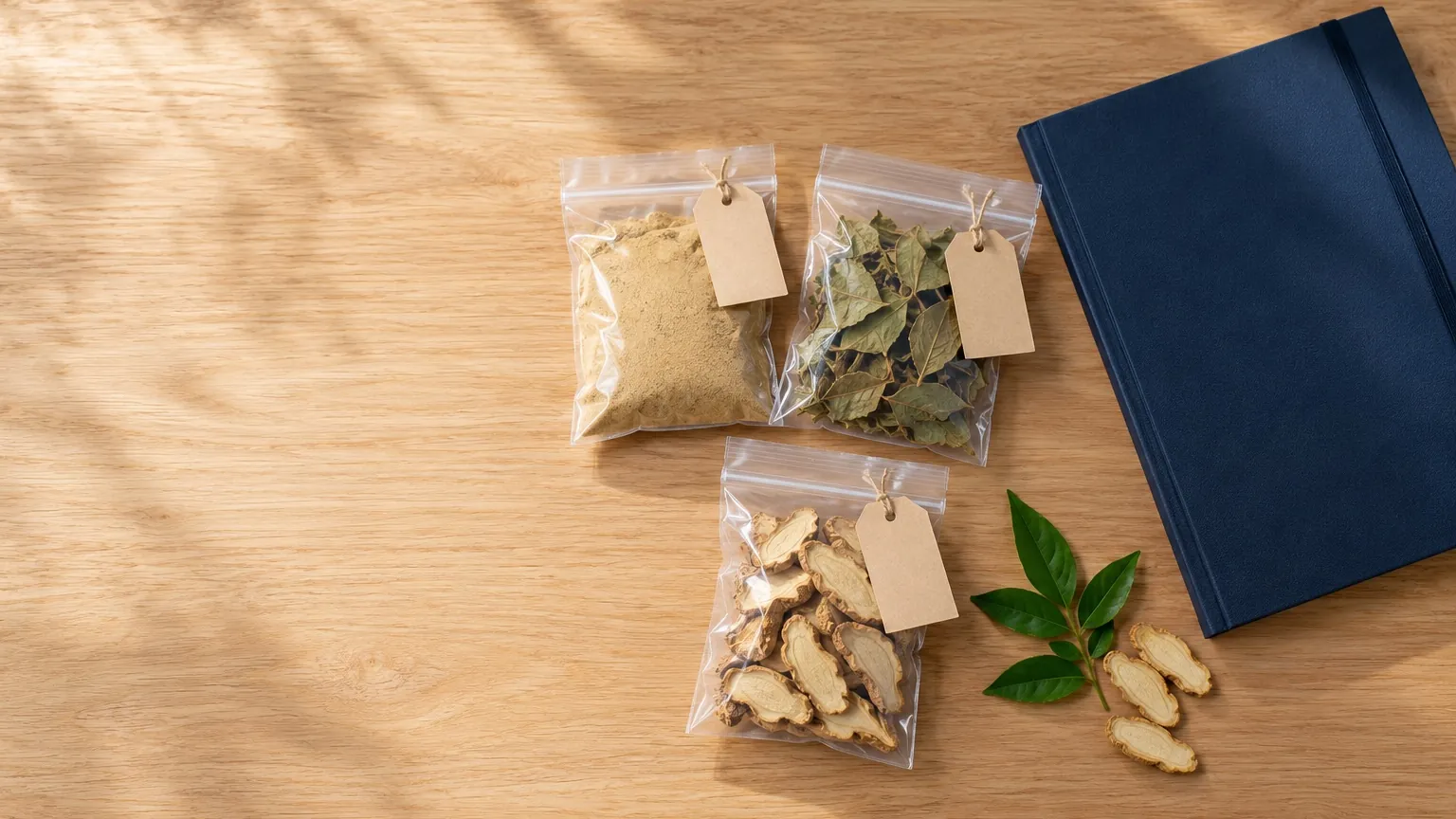
Thai herbal raw material export: fresh, dried or sliced
Raw herbs such as dried rhizome slices, dried leaves or cut bark are closest to the Act's idea of a herb as a natural product. The points to check are below.
Simple processing of herbs
The Ministry of Public Health notification on herbal products whose manufacture, import or sale requires a licence (2020) requires manufacturers of herbal products to hold a manufacturing licence. However, manufacturing excludes simple processing of herbs by community enterprises or small farmers under criteria set by the Thai FDA Secretary-General. Simple processing means drying, cutting or otherwise reducing size while it is still visible to the naked eye which part of the plant the material came from, plus packing for storage or transport. It does not include processing several herbs together.
A 2023 Thai FDA notification names who benefits: community enterprises and their networks registered under the community enterprise law, and non-incorporated farmers who meet conditions such as registration with the Department of Agricultural Extension or organic certification. A regular company doing the processing is not covered by this exemption and should check whether its product counts as a herbal product needing a manufacturing licence.
Conserved plants
A Thai FDA circular cites the Ministry of Agriculture and Cooperatives notification on conserved plants B.E. 2557 (2014): conserved plants may not be imported, exported or transited without a permit from the Director-General of the Department of Agriculture or a delegate, including CITES permits. Check the plant's scientific name against the conserved plant list before accepting any order.
Quality documents for raw herbs
For imports of raw herbal materials, Thai FDA guidance requires the quality certificate to show at least four items: scientific name, part used, appearance, and a check for foreign matter, signed by the producer. Exporters can use these four items as the minimum structure for the document that travels with raw herbs, then add whatever the buyer specifies. For documents from agencies other than the Thai FDA that the destination requires, check directly with the buyer and the agency concerned.
Herbal extract export Thailand: ingredients for further processing
Herbal powders and extracts that the buyer will process further usually fit herbal product group 3, materials intended as ingredients for making herbal products. This group differs from finished products in clear ways:
- No product registration, detailed notification or notification. Section 35 (3) exempts materials used as ingredients in herbal products from registration, and Section 46 applies Section 35 to detailed notifications and notifications as well.
- Manufacturing still sits within the premises system. The Thai FDA form certifying herbal manufacturing categories lists raw material production separately: fresh or dried herb pieces, herb powders and herbal extracts. The request form for an inspection leading to a manufacturing standard certificate also has a category for materials intended as ingredients, covering raw herbs and extracts.
- The standard that applies to extracts. The Thai FDA question-and-answer document on the herbal manufacturing criteria (No. 3) of 2026 says ASEAN GMP applies only to finished products, while low-risk extracts must follow the GHPP standard.
- Risk depends on the process. The Herbal Products Division inspection guidance says raw material producers with high-risk processes must be inspected by a division team qualified under PIC/S guidance, while low-risk raw material producers are inspected against the criteria annexed to the ministerial notification.
Extracts the buyer will use in food or cosmetics
If an extract is meant as an ingredient for another kind of product, its classification changes. The clearest example is the Cosmetic Act B.E. 2558 (2015), which defines cosmetics to include materials intended specifically as ingredients for making cosmetics. An extract sold for cosmetic manufacturing therefore falls within the cosmetic definition, and the herbal product definition excludes materials classed as cosmetics. For extracts meant for food, check the classification under food law. Before agreeing an order, ask the buyer exactly what the extract will be used for, because the answer decides which document set you need.
Finished herbal products: licence and product authorisation
Finished products, such as Thai traditional medicines in capsule form, medicines developed from herbs, or health products like herbal teas and drinks, must clear two hurdles before being manufactured for sale:
- A manufacturing licence under Section 17, with the applicant meeting the Section 19 qualifications, such as having premises and the necessary equipment as specified by the Minister and a designated operator. The licence is valid for five years.
- Product registration, a detailed notification receipt or a notification receipt, depending on the group the Minister has placed the product in. Section 47 requires detailed notification and notification requests to include the product name, formula, container and pack size, a certificate of analysis, the label and the product leaflet.
As an example of how products are grouped, the Ministry notification on herbal products requiring notification receipts (No. 4) of 2026 (published in the Royal Gazette on 9 February 2026) repealed the earlier Lists 1 to 3, as amended several times, and replaced them with new lists: 208 Thai traditional formulas in List 1, 15 developed herbal medicines in List 2 and 88 herbal health products in List 3, such as garlic. Each entry already sets the formula, parts used, method, pack size and required text, so products matching an entry can use the notification route, while different formulas need to be checked against the detailed notification or registration routes.
Quality and certificates of analysis
The Herbal Products Committee notification on quality control and specifications of herbal products (No. 3) of 2024 sets test items by dosage form, such as microbial limits, heavy metals and active content where claimed, and requires certificates of analysis to come from accepted laboratories: the Department of Medical Sciences or its regional centres, the Department of Science Service, ISO/IEC 17025-accredited laboratories, the laboratory of a licensed herbal product manufacturer, the laboratory of a licensed modern-medicine manufacturer, or another laboratory that demonstrates method validation as the Thai FDA requires.
Export-only herbal product Thailand: made to the buyer's requirements
If the buyer wants a formula, specification or label based on its own country's law, and the product will never be sold in Thailand, the Herbal Products Division has an export-only application route. It covers traditional-knowledge medicines, medicines developed from herbs and herbal health products. The division's infographic summarises the main steps: file at the Thai FDA One Stop Service Center (OSSC), officials check the documents, the application is assessed, and the result is notified.
Specifications follow the importing country
The Herbal Products Committee notification (No. 3) of 2024 added clause 8/1: herbal products made for export only may have specifications that differ from the lists used for domestic products, but must meet the importing country's standards.
Documents: example from checklist F-HB2-51 (developed herbal medicines and herbal health products)
- The application on form TorBor.1, JorJor.1 or JorRor.1 as applicable, with label and leaflet, colour photos and samples.
- The export-only set of declarations: safety follow-up, consent on personal data, a statement of intent to manufacture for export only with the conditions, and a declaration on safety and efficacy.
- A copy of the manufacturing licence, the manufacturing standard certificate, and applicant evidence.
- Quality data: a declaration on quality control with analytical method details, and specifications and certificates of analysis to the importing country's standard, followed by safety and efficacy sections.
Conditions the applicant must accept
The conditions declaration confirms the product is authorised solely for export and will never be sold in the Kingdom, that an annual production report will be sent to the Thai FDA, and that export evidence such as purchase orders or export reports will be kept for officials on request. If the conditions are breached, the applicant agrees the Thai FDA may revoke the registration or receipt, and if the product is found on the Thai market, it must be recalled at the applicant's own cost. A separate quality-control declaration states whether the specifications and methods come from a pharmacopoeia designated by the Minister, another pharmacopoeia, or the manufacturer's in-house method.
Thai herbal export certificate: what foreign buyers usually ask for
Once the product is ready, buyers often want confirmation from a Thai government agency. On the herbal product side, our archive holds request forms for the following:
- English-language certificate of premises licence: a licensed manufacturer, importer or seller of herbal products files form F-HB3-28 for an English certificate confirming its premises licence. In Bangkok it is filed at the Herbal Products Division, and in other provinces at the provincial public health office. Attachments are a certified copy of the latest renewed licence, copies of the GMP certificate and any earlier English certificate, and a power of attorney if someone else files.
- Manufacturing standard certificates: form F-HB3-2 covers four types, namely PIC/S GMP Certificate, ASEAN GMP Certificate, GHPP Certificate and a checklist-based site standard document, in Thai or English. Sites without a certificate first request an inspection, submitting the Site Master File, quality manual and list of standard operating procedures.
- Certificates of analysis from laboratories accepted under the Committee notification.
A note at the foot of the premises certificate form says the Thai FDA reserves the right not to certify products outside its regulatory control. Purely agricultural raw materials may therefore need documents from other agencies instead. If a buyer asks for a Certificate of Free Sale, ask the Herbal Products Division which certificate format it can issue for that product, and see what a Certificate of Free Sale is for the broader picture.
Check the plant's GMP certificate status after 2026
The Ministry notification on herbal manufacturing criteria (No. 3) of 2026 took effect on 25 May 2026. A follow-up Thai FDA notification required low-risk manufacturers holding existing PIC/S GMP or ASEAN GMP certificates to submit a statement of intent by 15 June 2026; those who did not are inspected against a different standard level instead. If you use a contract manufacturer, ask whether it submitted, and whether the certificate it gives you for buyers is still current.
Herbal export company Thailand: checklist before accepting an order
Herbal exporters whose paperwork is ready from day one usually ask the same questions before confirming an order:
- Is the shipment raw material, powder or extract, or a finished product, and what will the buyer use it for?
- Under Thai law, is it a herbal product, food or a cosmetic?
- Does the plant's scientific name match on every document, and has it been checked against the conserved plant list? If it is listed, a Department of Agriculture permit is required.
- Does the producer's manufacturing licence cover that manufacturing category, or does the simple-processing exemption apply?
- Does the finished product have a registration, detailed notification or notification receipt, or is it using the export-only route?
- Is there a manufacturing standard certificate matching the product type, such as GHPP for low-risk extracts?
- Do the certificates of analysis come from an accepted laboratory, with the test items the buyer requires?
- Has the buyer given a written list of documents the destination requires?
Products that contain herbs but are classed as food or cosmetics use a different document set; see exporting processed food from Thailand and Thai FDA export certificates for cosmetics. Ask regulatory questions in our RA Advisor, get help with the full document set through our regulatory documents service, and arrange the analyses buyers ask for through our lab testing service.
- ✓Know whether it is raw material, extract or finished product, and its end use
- ✓Classified under Thai law: herbal product, food or cosmetic
- ✓Scientific name consistent, conserved plant list checked
- ✓Manufacturing licence covers the category, or simple-processing exemption applies
- ✓Registration or receipt in place, or export-only route used
- ✓Manufacturing standard certificate matches the product type
- ✓Analysis from an accepted laboratory, with the buyer's test items
- ✓Written list of destination documents received
Source: Herbal Products Act B.E. 2562 (2019) and Herbal Products Division notifications, guidance and forms
Frequently asked questions
Do I need a Thai FDA licence to export dried herbs?
It depends on who processes them and how the product is classified. Simple processing such as drying or slicing by community enterprises or small farmers under the criteria is not manufacturing that needs a licence. A regular company should check whether its product is a herbal product requiring a manufacturing licence.
Must a herbal extract be registered before export?
Materials used as ingredients for herbal products are exempt from registration, detailed notification and notification under Sections 35 (3) and 46 of the Herbal Products Act, but they must still be made at licensed premises, and low-risk extracts follow the GHPP manufacturing standard.
Can I make herbal products to a foreign buyer's formula?
Yes, through the export-only application. Specifications follow the importing country's standards, and the applicant declares the product will not be sold in Thailand, sends an annual production report and keeps export evidence.
Which certificates can the Thai FDA issue to herbal product exporters?
Examples include an English-language certificate of premises licence and manufacturing standard certificates of four types: PIC/S GMP, ASEAN GMP, GHPP and a checklist-based document. Products outside Thai FDA control may not be certified.
What if the herb is a conserved plant?
Under the Ministry of Agriculture and Cooperatives notification on conserved plants (2014), export needs a permit from the Director-General of the Department of Agriculture or a delegate, including CITES permits, before shipment.
Sources
- Herbal Products Act B.E. 2562 (2019) · Open source · Search our archive
- MOPH notification on herbal products whose manufacture, import or sale requires a licence, B.E. 2563 (2020) · Open source · Search our archive
- Thai FDA notification on community enterprises and small farmers exempt from a herbal manufacturing licence, B.E. 2566 (2023) · Open source · Search our archive
- Thai FDA circular on cosmetics containing conserved plants under the Ministry of Agriculture and Cooperatives notification (2014) · Open source · Search our archive
- Thai FDA guidance on certificates of analysis for imported herbal raw materials · Open source · Search our archive
- Thai FDA form certifying herbal product manufacturing categories · Open source · Search our archive
- Thai FDA request form for inspection of herbal manufacturing premises (F-HB3-47) · Open source · Search our archive
- Thai FDA Q&A on the herbal manufacturing criteria (No. 3) B.E. 2569 (2026) · Open source · Search our archive
- Herbal Products Division guidance on inspecting herbal manufacturing premises · Open source · Search our archive
- Cosmetic Act B.E. 2558 (2015) · Open source · Search our archive
- MOPH notification on herbal products requiring notification receipts (No. 4) B.E. 2569 (2026) · Open source · Search our archive
- Herbal Products Committee notification on quality control, specifications and certificates of analysis (No. 3) B.E. 2567 (2024) · Open source · Search our archive
- Herbal Products Division infographic: applying for export-only herbal products · Open source · Search our archive
- Checklist F-HB2-51 for export-only herbal product applications · Open source · Search our archive
- Declaration of conditions for export-only herbal product applications · Open source · Search our archive
- Declaration on quality control and analytical methods for export-only herbal product applications · Open source · Search our archive
- Request form for an English-language certificate of herbal premises (F-HB3-28) · Open source · Search our archive
- Document checklist for herbal premises certificates (F-HB3-29) · Open source · Search our archive
- Request form for herbal manufacturing standard certificates (F-HB3-2) · Open source · Search our archive
- Thai FDA notification on herbal manufacturing standard certification under the herbal manufacturing criteria (No. 3) B.E. 2569 (2026) · Open source · Search our archive
This article is for general information. It is not a Thai FDA ruling or legal advice, and rules change — check the latest notification or ask an expert before filing or producing.
Related articles
 ExportersExporting cosmetics: Thai FDA export certificatesExport cosmetics from Thailand: the six Thai FDA certificates, who can apply, what to prepare in English, and the export-only notification route.
 ExportersExporting processed food from Thailand: licences, standards and the certificates buyers ask forWhat to prepare to export processed food from Thailand: licence, GMP 420, lab results, traceability, Thai FDA certificates, export labels and samples.

 ImportersCertificate of Free Sale (CFS) for Thai FDA filings: who issues it and what it must sayWhat a Certificate of Free Sale is, when the Thai FDA asks for one, who may issue it, what it must state, and how Thai exporters get one.