 FDA Thailand
 Importers
Thai food import licence (Or.7): how to apply and what your food storage must meet

What a Thai food import licence is and who needs one
A Thai food import licence (form Or.7) is the licence an importer must hold before bringing food into Thailand for sale. Section 15 of the Food Act B.E. 2522 (1979) prohibits importing food for sale without a licence, and the licensing authority is the Secretary-General of the Thai FDA or a person he or she designates. The licence is tied to premises, not to products: each product still goes through its own step afterwards, such as obtaining a food serial number.
Many people assume the import licence is the same as getting a Thai FDA number for a product. They are separate. The Or.7 licence answers who the importer is, where the import office is and where the food is stored. The serial number answers whether a particular product complies. This guide covers the first layer only, the licence and the storage premises. Product registration for imported supplements is covered in importing dietary supplements into Thailand.
Section 16 sets two exceptions where no import licence is needed: a one-off import under a one-off (temporary) licence, and importing food as samples for registration or for a buyer's evaluation. Both still have to follow the relevant ministerial regulation.
Who can apply for a food import licence
The Food Division's checklist for new Or.6 applications splits applicants into two kinds:
- Individuals use a copy of their national ID card and their trade or commercial registration.
- Juristic persons use a power of attorney appointing the operator, copies of the operator's and directors' ID cards (foreigners use a passport and work permit), and a company certificate whose objectives include importing food for sale.
- A company with foreign shareholding of 50 percent or more must also submit a Foreign Business Certificate from the Ministry of Commerce or a Board of Investment (BOI) promotion certificate.
Before filing, the operator needs an Open ID account and access rights to the food system. For import premises in Bangkok, the master data is submitted at the Thai FDA One Stop Service Center (OSSC); elsewhere it goes to the provincial public health office. Every copy must be certified and converted to PDF.
One more point worth knowing early: section 17 of the Food Act treats acts of the licensee's employees or agents as acts of the licensee, unless the licensee can show it could not have known or controlled them. If staff or a warehouse provider handle your goods, you remain the responsible party.
Applying for a food import licence: from system access to Or.7
The Thai FDA public guide on food import licences and renewals, together with Ministerial Regulation No. 2 (1979), sets this order:
- Create an Open ID account and submit master data to get food-system access.
- Prepare import and storage premises that meet the criteria, with maps, floor plans and photos.
- File form Or.6 through e-Submission at privus.fda.moph.go.th.
- Officers check the documents; any request for clarification must be answered fully by the deadline shown, or the application is returned.
- On approval you receive the licence to import food into the Kingdom, form Or.7.
There are two routes. Where the premises meet the standard criteria, the application relies on a self-declaration and photos instead of a site inspection. Where they do not, for example premises that are complex or fall under several laws, the application goes to a working group, committee or experts first, and a negative opinion means the application is returned. If your premises are unusual, work out which route applies before you file.
After licensing, three more forms apply: Or.8 to renew, Or.9 for a replacement and Or.10 to move the import or storage premises. Moving storage for specially controlled food also requires the product registration certificate.
- 1Open ID and master dataBangkok at the Thai FDA OSSC · provinces at the provincial health office
- 2Set up import and storage premisesMap, scaled floor plan, signs and photos
- 3File Or.6 through e-SubmissionWith the self-declaration and premises documents
- 4Answer clarifications in full by the deadlineOtherwise the application is returned
- 5Receive the Or.7 licenceValid only for the premises it names
Source: Ministerial Regulation No. 2 (1979) and the Thai FDA food import licence guide
Import premises versus food storage premises
An Or.7 licence names two kinds of premises, and it is valid only for the premises it names:
- Import premises are the office that legally acts as importer. The Thai FDA guide requires them to match the head office or a branch in the commercial registration.
- Food storage premises are where the goods actually sit after clearance. You need at least one, and it may be at a different address from the office.
Section 20 of the Food Act prohibits importing or storing food outside the premises named in the licence, and moving requires prior permission. This matters in practice: if a new shipment overflows your warehouse and you park it somewhere that is not on the licence, you are storing outside the licensed premises.
Food Division guidance issued with recent standards, such as Notification No. 455 on jams, jellies and marmalades and No. 462 on bottled drinking water, states that the Or.7 licence records the authorised food storage conditions. Plan your storage around the conditions your products need from the start: ambient, chilled or frozen.
Thai FDA food storage requirements
The storage criteria come from three sources: clause 4 of Ministerial Regulation No. 2 (1979), the public guide on food import licences and the Food Division application checklist.
| Topic | Requirement |
|---|---|
| Cleanliness | Storage must be clean, with adequate light and ventilation |
| Equipment | Enough quality-preserving equipment for the volume of food |
| Separation | Each type of food stored separately, with food-type signs in the storeroom |
| Temperature | Freezer rooms controllable to -18 °C or below; chill rooms not above 10 °C |
| Signs | A sign for the import premises and a sign for the food storage premises, with the wording the guide specifies |
| Floor plan | Scaled plan of the storeroom showing food separation, storage equipment and temperatures |
| Photos | Unretouched colour photos on A4: the front with its sign, every side of the storeroom, food-type signs and storage conditions |
Photos carry real weight, because the standard route has no site inspection: officers decide from the photos and the self-declaration you sign. Photos that miss the sign, do not show every side of the room, or look edited are a common reason for clarification requests. Take them when the room is set up as it will actually be used, not empty.
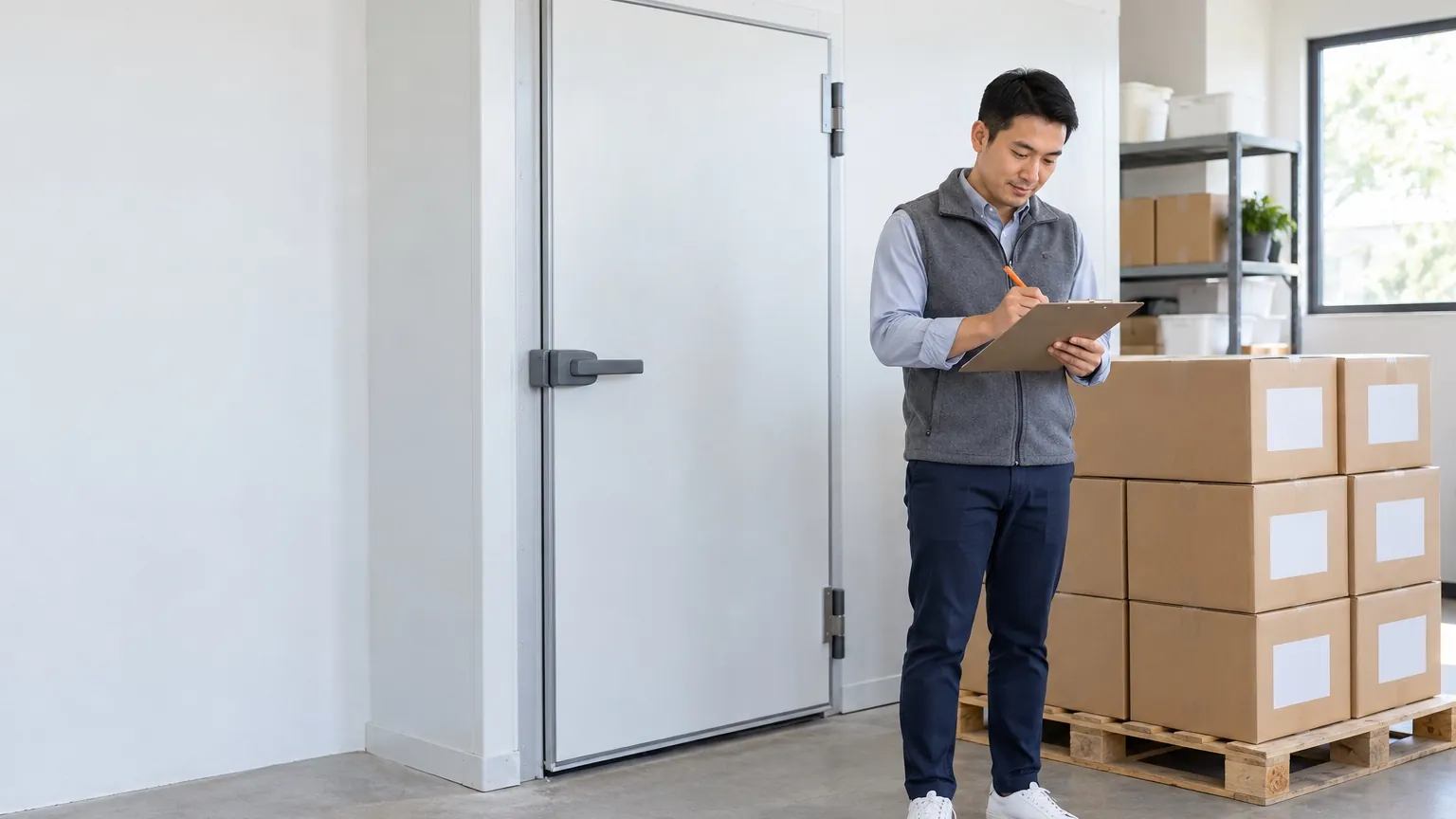
Using a third-party warehouse or rented cold store
Yes, you can. The Food Division checklist says that if the applicant does not own the premises, it needs a letter of consent to use them or a lease. This applies to rented offices and to logistics (3PL) warehouses alike, and the warehouse address is then named as storage premises in the licence.
Points to agree with the warehouse before signing:
- The allocated area must keep each food type separate and allow the required signs.
- Cold or freezer rooms must hold the required temperatures, with records you can show.
- Ask for a scaled floor plan and photos of every side of the room for your application.
- Agree that officers may inspect the area.
- If the provider plans to move your goods to another site, it must tell you first so you can file Or.10 in time.
A warehouse that stores goods under several laws in one place, or is otherwise complex, may fall into the non-standard route that goes to a working group first. If you are unsure whether your site falls into that category, ask the officers or an adviser before filing.
Documents for the Or.6 application
Combining Ministerial Regulation No. 2 and the Food Division checklist, the documents fall into three groups.
Applicant
- Master data documents for an individual or a juristic person
- Power of attorney appointing the operator, and copies of the operator's and directors' IDs
- Foreign Business Certificate or BOI certificate where foreign shareholding is 50 percent or more
Premises
- House registration of the import premises
- Sketch map of the import and storage premises
- Scaled floor plan of the food storeroom
- List of quality-preserving storage equipment, if any
- Letter of consent or lease if you do not own the premises
Declaration and photos
- Self-declaration for applications without a site inspection
- Colour photos of the front with its sign and every side of the storeroom
For renewal on Or.8, the Thai FDA guide says no extra attachments are needed, but you must file before the licence expires. Our import readiness checker asks about the applicant, premises and warehouse, then lists what is still missing on the Thai side before you file.
After the licence: what to check before the first shipment
Or.7 is only the first layer. Three things remain before goods actually arrive.
1. Product status
The Food Division's classification guidance starts by asking whether the product is food, then looks at the history of use and processing of the ingredients and whether a specific notification applies; only then do you know which kind of serial number is needed. Some foods need no serial number but are still imported under the import licence with details declared through the virtual-number system. Filing a product under the licence also links it to the foreign factory's manufacturing-system certificate; see GMP 420.
2. Border steps
The Thai FDA flowchart has the importer register with the Food and Drug import checkpoint office, request a License per Invoice (LPI) through the Customs Department's National Single Window, and use the LPI number on the import declaration.
3. Conditions for certain foods
- Foods designated as high-risk need a standards certificate from the responsible government agency of the country of origin, or a private body it recognises, covering every lot and shown to officers, under Ministerial Regulation No. 11 (2004).
- MOPH Notification No. 371 (2015) sets radioactivity conditions for wild boar, copper pheasant and sika deer meat from Japan: evidence of test results or a certificate of origin must be shown at the checkpoint on every import.
- Beef and bovine products follow the BSE risk-group conditions in Notification No. 459 (2025).
- Fresh fruit and vegetables are checked for pesticide residues and labels at the checkpoint every time, unless each lot comes with analysis results from a government agency or an ISO/IEC 17025 laboratory.
Duties of a food import licensee
- Import and store food only at the premises named in the licence; moving needs prior permission on Or.10 (section 20).
- Display the licence and premises signs where they are easily seen (sections 21–23).
- If the licence is lost or destroyed, apply for a replacement on Or.9 within 15 days.
- The licence runs until 31 December of the third year after issue. File for renewal before expiry; once filed, you may keep operating until the authority refuses renewal (section 18).
- Importing after expiry without having filed for renewal attracts a daily fine for as long as the licence has lapsed, and importing without a licence is punishable by imprisonment, a fine or both (sections 53 and 74).
- If the authority refuses a licence, renewal or a move, you may appeal in writing to the Minister within 30 days of being notified (section 19).
A simple habit helps a great deal: keep a licence calendar from day one, with the expiry date, the date to start preparing renewal, and every warehouse address listed in the licence. Whenever you change or add a warehouse, check against that list before moving any stock.
Checklist before you file Or.6
- The applicant is an individual or a company whose objectives include importing food for sale.
- With 50 percent or more foreign shareholding, a Foreign Business Certificate or BOI certificate is ready.
- Open ID and food-system access are set up.
- The import premises match the head office or branch in the commercial registration.
- At least one storage site that is clean, keeps foods separate and has equipment and temperatures for your storage conditions.
- Import premises and food storage signs are installed.
- A letter of consent or lease is in place if you use someone else's premises or warehouse.
- Map, scaled floor plan, self-declaration and unretouched colour photos are ready.
- You know which kind of serial number each product needs and whether border conditions apply.
Run a first check with our import readiness checker. If you would like our team to handle everything from setting up storage to the licence and serial numbers, see our import service; costs and timing are set out in the quotation.
- ✓Applicant's objectives include importing food for sale50 percent or more foreign shareholding needs a Foreign Business or BOI certificate
- ✓Food-system access set up
- ✓Import premises match the commercial registration
- ✓Storage meets the criteriaClean, separated, equipped, temperature-controlled
- ✓Import premises and food storage signs
- ✓Letter of consent or leaseIf you use someone else's premises or warehouse
- ✓Map, floor plan, declaration and unretouched photos
- ✓Product category and border conditions known
Frequently asked questions
How long is an Or.7 food import licence valid?
Until 31 December of the third year after issue. Renew on form Or.8 before it expires, under section 18 of the Food Act.
Once I have the import licence, can I start selling straight away?
Not in every case. The licence covers premises; each product still needs the right kind of serial number, and some foods have border conditions.
Can I store goods at a logistics company's warehouse?
Yes, with a letter of consent or a lease, provided the warehouse address is named as storage premises in the licence.
What temperatures must cold rooms hold?
The Thai FDA guide requires freezer rooms at -18 °C or below and chill rooms at no more than 10 °C.
What do I do if I move warehouse?
Get permission first by filing Or.10 with the new site's map and floor plan, because section 20 prohibits storing food outside the licensed premises.
Sources
- Food Act B.E. 2522 (1979) · Open source · Search our archive
- Food Act B.E. 2522, Chapter 2: licensing · Open source · Search our archive
- Ministerial Regulation No. 2 (1979) on licences to import food for sale · Open source · Search our archive
- Thai FDA public guide: food import licence and renewal (meeting the criteria) · Open source · Search our archive
- Thai FDA public guide: food import licence and renewal (not meeting the criteria) · Open source · Search our archive
- Food Division checklist for food import licence applications · Open source · Search our archive
- Food Division guidance on premises licensing under Notification No. 462 (2025) on bottled drinking water · Open source · Search our archive
- Food Division guidance on premises licensing under Notification No. 455 (2025) on jams, jellies and marmalades · Open source · Search our archive
- Food Division guidance on classifying food for licensing (August 2026 update) · Open source · Search our archive
- Thai FDA flowchart: virtual numbers and License per Invoice (LPI) for food importers · Open source · Search our archive
- Ministerial Regulation No. 11 (2004) on certificates for high-risk imported food · Open source · Search our archive
- MOPH Notification No. 371 (2015) on import conditions for food at risk of radioactive contamination · Open source · Search our archive
- MOPH Notification No. 459 (2025) on import conditions for food at risk from BSE · Open source · Search our archive
- Thai FDA explanatory note on surveillance of pesticide residues in fruit and vegetables (2020) · Open source · Search our archive
This article is for general information. It is not a Thai FDA ruling or legal advice, and rules change — check the latest notification or ask an expert before filing or producing.
Related articles
 ImportersImporting dietary supplements into Thailand: import licence, serial number and foreign manufacturer documentsHow to import dietary supplements into Thailand: the Or.7 import licence, foreign GMP certificates, food serial numbers, quality documents and Thai labels.

 Factories / OEMGMP 420 explained: key requirements, the inspection forms and how audits are scoredThailand's GMP 420 for food plants: the five basic categories, specific requirements, the TS.1–TS.5 audit forms, scoring, pass criteria and major defects.
 ImportersImporting Korean cosmetics into Thailand: steps and documents from the manufacturerImporting Korean cosmetics into Thailand: manufacturer documents, Korean translations, ampoule rules, product-name words Thailand rejects and Thai labels.