 FDA Thailand
 New regulations
Hermetically sealed food: new Notification 469 (2026)

What hermetically sealed food notification 469 is
Ministry of Public Health Notification No. 469 B.E. 2569 (2026) on food in hermetically sealed containers, the Thai hermetically sealed food notification 469, replaces Notification No. 355 B.E. 2556 (2013), which governed canned food and food in airtight packs for more than a decade. It was signed on 17 April 2026, published in the Royal Gazette on 18 May 2026 and took effect the next day, 19 May 2026.
The first visible difference is the commencement rule. No. 355 came into force 180 days after publication, while No. 469 took effect the day after publication. The official comparison table says this was done so the notification applies immediately. Businesses already permitted under No. 355 are covered by a transitional clause, explained below.
The new notification makes three main changes: the definition is narrowed to low-acid and acidified foods only, requirements that duplicated other notifications are removed in favour of those notifications, and the old exemption list for dry foods in laminated packs is dropped because those foods are no longer in scope. This summary is based on the notification itself, the official comparison table and the explanatory documents of the Food Division of the Thai FDA, all of which you can find in our regulation archive.
- No. 355 signedIn force 180 days after publication
- No. 469 signedReplaces No. 355 in full
- Royal GazetteVol. 143, Special Part 123 Ngor
- In forceExisting numbers continue under clause 14
- Food Division briefingNew definition and category moves explained
- Decision treeHelps decide whether a product is in scope
Source: MOPH Notifications No. 355 and 469 · Food Division briefing and decision tree
The new definition: low-acid and acidified foods only
Clause 4 defines food in a hermetically sealed container as food that has been heated to destroy or inhibit microorganisms before or after filling or sealing, including other food made in a similar way with a pH above 4.6 and a water activity (aw) above 0.85, held in a sealed metal or other rigid or non-rigid container that keeps outside air out, and that can be stored at ambient temperature.
The comparison table explains that this wording borrows the description of low-acid and acidified foods from GMP Notification No. 420. Under No. 355 there were two definitions. Clause 3 (1) covered heat-processed food in rigid containers, and clause 3 (2) covered food in laminated packs, glass jars with rubber-sealed lids or other moisture- and air-tight packs, which pulled in many dry foods that are never retorted like canned food.
No. 469 now recognises only two types:
- Low-acid: pH above 4.6 and aw above 0.85 (clause 6).
- Acidified: pH of 4.6 or below and aw above 0.85 (clause 7).
The Food Division's briefing slides of 25 May 2026 say other foods formerly under No. 355 move to processed or general food. The product permit guidance adds that the former acid type and former clause 3 (2) foods with aw of 0.85 or below become foods labelled under Notification No. 456 on certain processed foods, or general food.
The Food Division decision tree
A decision tree dated 25 August 2026 covers meat products, ready-to-cook food, ready-to-eat food and general food. Ask in order: is aw above 0.85; is the container airtight with a heating step, or a plastic container heated after filling; is the product stored at room temperature. A no at any point means the product stays in its original category. If all answers are yes and pH is above 4.6, it is low-acid. If pH is 4.6 or below, check the natural pH of the raw material: if it was already 4.6 or below, keep the original category; if not, it is acidified.
Notification 469 compared with No. 355
The comparison table published with the notification lists each change and the reason for it:
- Status: still a food with prescribed quality or standards (clause 3).
- General quality: unchanged. No abnormal colour, odour or taste; pathogens within the microbiological standards notification; no microbial toxins at harmful levels; contaminants within the contaminants notification (clause 5).
- Preservatives: the old ban on preservatives in food heated after filling is removed because the food additives notification already covers it. Additive use now follows that notification (clause 10).
- Acidified food microbiology: same figures. Microorganisms growing at 30 or 55 °C not more than 1,000 per gram, yeasts and moulds not more than 100 per gram, and coliforms not detected or below 3 per gram by the MPN method. The old 10,000 per gram limit for former clause 3 (2) foods is gone (clause 7).
- Containers: now governed by the packaging notification, keeping only the rules for (coated) metal containers: no lead, rust or other colour inside except lacquer or tin, tin or another barrier coating on steel, and no leaks or swelling (clause 9).
- Drained weight: the annex of minimum drained weights is repealed so that homogeneous or very viscous products are not forced into a test that does not fit them, but labels must still show drained weight for food whose solids can be separated (clause 12).
- Production method: instead of citing general GMP and low-acid GMP separately, the notification now simply requires compliance with the notification on production methods, equipment and storage (clause 11).
- Exemptions: only food made for export remains exempt. The old list of dry foods such as snacks, spice powders, flour, tablets and dried fruit, vegetables and meat is dropped because they fall outside the new definition (clause 13).
The enabling provisions in the preamble no longer cite section 6 (9) of the Food Act. What does not change at all is the sterilisation requirement for low-acid food, covered next.
Source: Comparison table of Notification No. 355 and No. 469
Which containers count as hermetically sealed
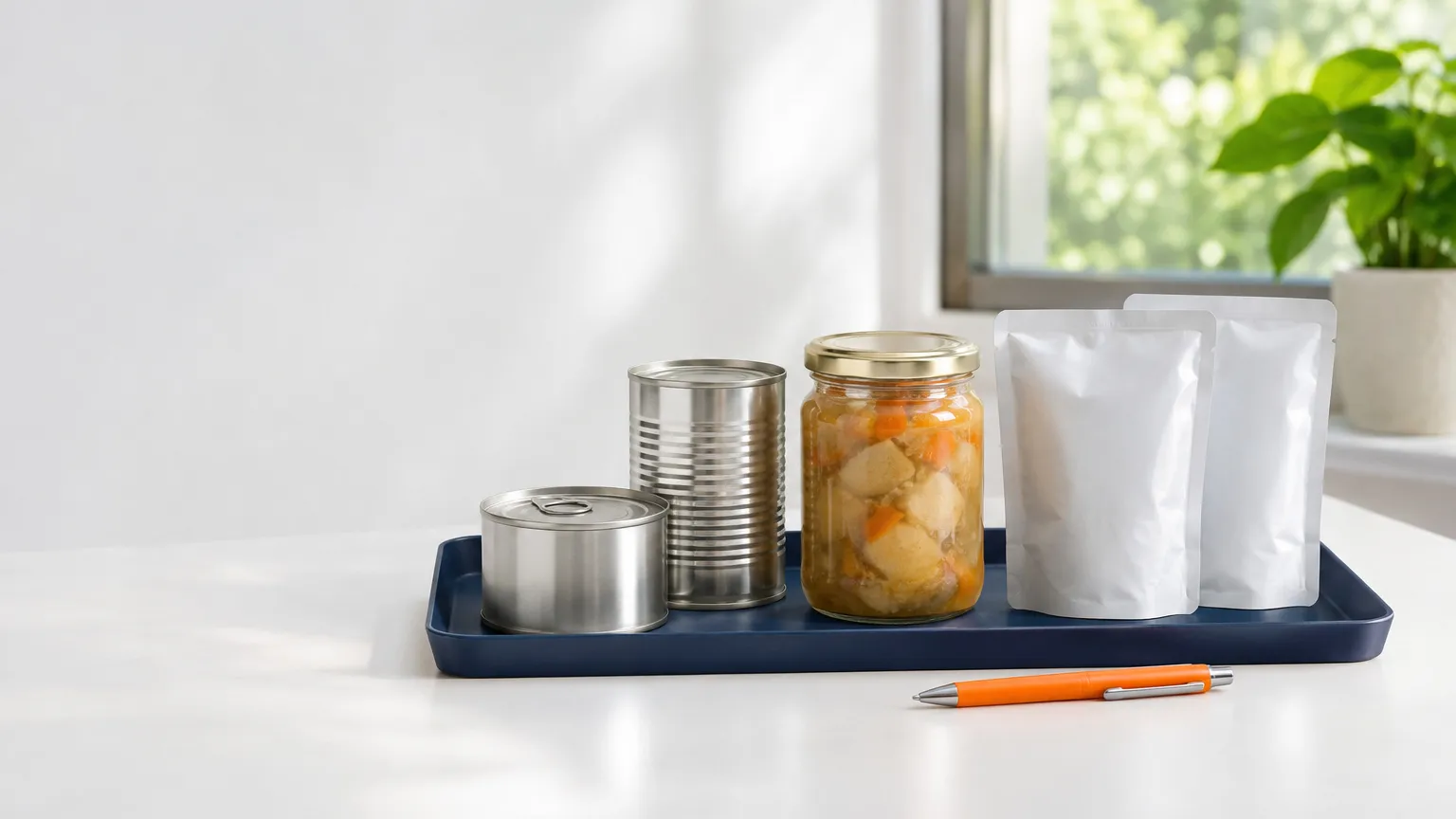
Because the new definition says rigid or non-rigid containers, the general food group of the Food Division issued a guide dated 26 May 2026 on which packs qualify:
- Metal cans, tins and drums closed with a double-seamed metal end, or with a closure of the kind used on glass jars.
- Plastic cups or tubs closed with a double-seamed metal end.
- Plastic bags, cups, trays or bottles heat-sealed with plastic film or aluminium foil, only when the food is heat-sterilised after sealing.
- Glass or metal bottles closed with a lid that has a sealing material (gasket, liner or plastisol), a plastic cap with a plug seal or inner stopper, or a heat-sealed film or laminated foil over the mouth.
- Bag-in-box, bag-in-drum and multilayer laminated cartons heat-sealed, when produced with an aseptic processing and packaging system.
The pack is only one test. A product falls under No. 469 only if the other conditions are also met: aw above 0.85, a heating step and ambient storage. Following the decision tree, a chilled product or a dry product with aw of 0.85 or below keeps its original category even in a glass jar with a metal lid or a foil pouch. Keep three facts together in your product file: the pack and its seal, measured pH and aw, and the storage condition stated on the label.
Low-acid and acidified foods: quality limits and sterilisation
For low-acid food, clause 6 requires that no microorganism can grow during storage at ambient temperature. Clause 8 gives producers two options:
- A scheduled heat process giving an F0 (sterilizing value) of at least 3 minutes, enough to destroy spores of Clostridium botulinum. The time and temperature must be supported by heat distribution and heat penetration studies carried out at that production site; or
- Acidification to pH 4.6 or below, with the method for reaching equilibrium pH and the heat process following criteria set by the Thai FDA.
The comparison table marks both options as unchanged. The real preparation work therefore sits in GMP Notification No. 420, whose specific requirement 3 covers low-acid and acidified food in hermetically sealed containers. These producers need a production supervisor trained on a Thai FDA course and a thermal process authority with a degree in food science or a related field who has passed a Thai FDA course or one run by a listed training body. See GMP 420 requirements for the full checklist.
Acidified food must meet the general quality rules in clause 5 and all three microbiological limits in clause 7. The Thai FDA regulation on food serial numbers of 2024 also requires food in hermetically sealed containers to submit quality test results when first produced or imported, so keep these results in the product file before you apply.
Who is affected: producers, importers and exporters
- Producers of low-acid or acidified canned food and retort pouches: sterilisation and microbiological limits are the same. Review certificates, labels and any formula built around the old preservative ban.
- Producers who registered products as sealed-container food that are neither low-acid nor acidified, such as dry foods in laminated packs: the products move to certain processed foods or general food, and the food types and processes on the premises licence may need updating.
- Importers: the Food Division's premises guidance says food import licences (Form Or.7) are defined by storage conditions, so no action is needed in e-Submission. On the product side, the transitional clause 14 applies to producers and importers alike.
- Exporters: clause 13 says the notification does not apply to sealed-container food made for export.
That export exemption belongs to this notification only. Premises licences, production standards, export certificates and the destination country's rules still apply separately. See exporting processed food from Thailand and Thai food export certificates.
Beverages in sealed containers have their own series of notifications, most recently amended by No. 473. See sealed beverages amendment 473.
Transitional rules and what to file
Clause 14 lets producers and importers permitted under No. 355 before No. 469 took effect keep using their existing food serial numbers. The comparison table confirms that existing holders do not need to re-notify, and the notification sets no end date for this right. Food Division guidance adds the following.
Products
- Electronic certificates (Sor Bor 5/1): the system updates the notification number and food type automatically.
- Paper certificates: file an amendment (Sor Bor 6) in e-Submission.
- Former acid-type and clause 3 (2) foods that left the notification keep their numbers and certificates. To change details, first ask the central Thai FDA to update the food type, then file Sor Bor 8 and download a new Sor Bor 7/1.
- Pending applications for foods that left the notification are returned or withdrawn and refiled as a food detail notification (Sor Bor 7).
- New low-acid or acidified products are registered with Sor Bor 5.
Premises
Processes listed under the sealed-container food type that used only the basic GMP requirements, such as aw reduction, repacking, mixing, fermentation and sterilising acid food, are cancelled. Only processes under specific requirement 3 remain, such as aseptic processing and packaging and sterilising low-acid or acidified food. For electronic licences the system removes cancelled types; the operator then files Sor 4 (factory premises) or Sor Bor 2 (non-factory premises) to add new types such as certain processed foods or general food that has passed inspection. Paper licences (Or.2 or Sor Bor 1/1) file Sor 4 or Sor Bor 2 with the previously approved documents; if other details also change, such as the operator, floor plan or machinery, the normal procedure applies.
The e-Submission guidance maps old types to new ones. For example, aw reduction, fermentation, size reduction or sterilising products with aw of 0.85 or below move to the certain processed foods type, while repacking, mixing and sterilising or pickling acid food keep their process names.
Labels for hermetically sealed food under No. 469
Clause 12 requires labels to follow the notification on labelling of prepackaged food, currently No. 450 B.E. 2567 (2024) as amended by No. 474 B.E. 2569 (2026, in force 31 October 2026), and to show drained weight only for food whose solids can be separated. The comparison table explains that drained weight is key information for food with separable liquid and protects consumers from being misled.
No. 355 allowed fruit cocktail and fruit salad to list main ingredients without percentages. That exemption does not appear in clause 12 of No. 469, so producers of these products should review their labels against the current labelling notification.
Products that moved to certain processed foods must also follow Notification No. 456. If sold as an ingredient to other manufacturers, Food Division guidance says the label must state that it is a raw material for food processing only, or words to that effect.
You can screen a draft with our label checker before asking an expert to review it, especially for products whose category changed.
Checklist for producers and importers
- Re-classify every product formerly under No. 355 with the decision tree: low-acid, acidified or another category.
- Check whether each product certificate is electronic or paper, and prepare amendments for paper ones.
- Check the food types and processes on the premises licence and add new types if old processes were cancelled.
- Check any preservative or other additive against the food additives notification.
- Review labels: drained weight for separable food and the items in labelling Notification No. 450 as amended by No. 474.
- For low-acid and acidified food, review GMP specific requirement 3 records, heat distribution and penetration studies and the named production supervisor.
If you need to change premises categories or set up GMP for low-acid food, our factory setup and GMP service can help, or talk to our team.
Frequently asked questions
When did Notification 469 take effect?
It was published in the Royal Gazette on 18 May 2026 and took effect the next day, 19 May 2026, repealing Notification No. 355 of 2013.
Do products registered under No. 355 need new numbers?
No. Clause 14 lets existing food serial numbers continue. Food Division guidance asks holders of paper certificates to file an amendment (Sor Bor 6) in e-Submission; electronic certificates are updated automatically.
Are snacks in foil bags still hermetically sealed food?
Not if their water activity is 0.85 or below. Food Division guidance moves these foods to certain processed foods or general food, depending on the product.
Does No. 469 apply to canned food made for export?
Clause 13 says it does not apply to sealed-container food made for export. Premises licensing, production standards and the destination country's rules still need to be checked separately.
Is drained weight still required on labels?
Yes, for food whose solids can be separated, under clause 12, even though the old annex of minimum drained weights was repealed.
Sources
ประกาศ กระทรวง สาธารณสุข (ฉบับที่ 469)พ.ศ.2569 เรื่อง อาหาร ในภาชนะ บรรจุที่ปิดสนิท · Open source · Search our archiveเปรียบ เทียบการปรับปรุง ประกาศ กระทรวง สาธารณสุข (ฉบับที่ 355)พ.ศ.2556 เรื่อง อาหาร ในภาชนะ บรรจุที่ปิดสนิท · Open source · Search our archiveการประชุมชี้แจง ประกาศ กระทรวง สาธารณสุข (ฉบับที่ 469)พ.ศ. 2569เรื่อง อาหาร ในภาชนะ บรรจุที่ปิดสนิท (เอกสาร ประกอบ การบรรยาย วันที่ 25พ.ค. 2569) · Open source · Search our archiveแนวทาง การดำเนิน การเกี่ยว กับการอนุญาต ด้านผลิตภัณฑ์ ประกาศ กระทรวง สาธารณสุข (ฉบับที่ 469)พ.ศ.2569 ออกตามความ ในพระราชบัญญัติ อาหาร พ.ศ.2522 เรื่อง อาหาร ในภาชนะ บรรจุที่ปิดสนิท · Open source · Search our archiveแนวทาง การดำเนิน การเกี่ยว กับการอนุญาต ด้านสถาน ที่นำหรือสั่งอาหาร เข้ามาในราช อาณาจักร และสถานที่ผลิตอาหาร · Open source · Search our archiveแนวทาง การเลือก ประเภท และกรรมวิธี การผลิตอาหาร ที่มีการเปลี่ยนแปลง ตามประกาศ กระทรวง สาธารณสุข (ฉบับที่ 469)พ.ศ. 2569ออกตามความ ในพระราชบัญญัติ อาหาร พ.ศ. 2522เรื่อง อาหาร ในภาชนะ บรรจุที่ปิดสนิท · Open source · Search our archiveแผนผัง การตัดสิน ใจอาหาร ในภาชนะ บรรจุที่ปิดสนิท (25ส.ค. 69) · Open source · Search our archiveชนิดภาชนะ บรรจุที่เข้าข่าย เป็นอาหาร ในภาชนะ บรรจุที่ปิดสนิท ตามประกาศ กระทรวง สาธารณสุข (ฉบับที่ 469)พ.ศ. 2569 (26พ.ค. 69) · Open source · Search our archiveฉบับที่ 355พ.ศ. 2556เรื่อง อาหารในภาชนะที่ปิดสนิท (No. 355) B.E. 2556 (2013) Title: Food in a Hermetically Sealed Container Repealบัญชีน้ำหนักเนื้ออาหาร /Annex of Minimum Drained Weightยกเลิก (Rep · Open source · Search our archiveประกาศ กระทรวง สาธารณสุข (ฉบับที่ 420)พ.ศ. 2563ออกตามความ ในพระราชบัญญัติ อาหาร พ.ศ. 2522เรื่อง วิธีการผลิต เครื่อง มือเครื่อง ใช้ในการผลิต และการเก็บรักษาอาหาร · Open source · Search our archive- 2)
ระเบียบ สำนักงาน คณะกรรมการ อาหาร และยา ว่าด้วยการดำเนิน การเกี่ยว กับเลขสารบบ อาหาร พ.ศ.2567 · Open source · Search our archive - 1)
ประกาศ กระทรวง สาธารณสุข (ฉบับที่ 450)พ.ศ.2567 เรื่อง การแสดง ฉลากอาหาร ในภาชนะบรรจุ · Open source · Search our archive ประกาศ กระทรวง สาธารณสุข (ฉบับที่ 474)พ.ศ. 2569เรื่อง การแสดง ฉลากของอาหาร ในภาชนะบรรจุ (ฉบับที่ 2) · Open source · Search our archive
This article is for general information. It is not a Thai FDA ruling or legal advice, and rules change — check the latest notification or ask an expert before filing or producing.
Related articles
 New regulationsSealed beverages amendment No. 4 (Notification 473, 2026)Thai Notification No. 473 on beverages in sealed containers (No. 4): what each clause changes, how it links to No. 465 and what beverage makers must check.
 ExportersExporting processed food from Thailand: licences, standards and the certificates buyers ask forWhat to prepare to export processed food from Thailand: licence, GMP 420, lab results, traceability, Thai FDA certificates, export labels and samples.
 ExportersHealth certificates for Thai food exports: which certificate, who issues it, what to fileWhat buyers mean by a health certificate for Thai food exports, the three Thai FDA export certificates, documents, labels and China's Decree 280.