 FDA Thailand
 Factories / OEM
Private-label lotion and perfume in Thailand: classification and notification

Private label lotion perfume Thailand: what to settle before hiring a factory
Building a private label lotion perfume Thailand line with a contract manufacturer is a common route for brand owners, because it avoids investing in a production site. Before discussing scents and packaging, three questions need answers: is the product a cosmetic under Thai law, who holds the notification, and does the formula pass the Thai FDA ingredient lists? Together they decide whether the product can actually go on sale and how hard it will be to change factories later.
Section 14 of the Cosmetics Act B.E. 2558 (2015) requires anyone who will manufacture for sale, import for sale or manufacture under contract to notify the cosmetic first, and production may start only after the notification receipt is issued. A receipt is valid for three years from issue. Production for export to a buyer's specification still needs notification and may not be sold in Thailand.
This article focuses on two products that are often made together: body lotion and perfume for the body. If your main product is a face cream, read more about the factory relationship in cream OEM: who owns the notification.
When lotion and perfume are cosmetics
Section 4 defines a cosmetic as something intended to be applied, rubbed, massaged, sprinkled, sprayed or otherwise used on the external parts of the human body for cleanliness, beauty, changing appearance, suppressing body odour or keeping it in good condition, and it includes perfumery for the skin. Body lotion and perfume sprayed on the skin or body fall squarely within this definition.
The Thai FDA cosmetic notification criteria (revised 2021) use a five-point test; failing any point means the product is not a cosmetic:
- the formula contains no prohibited substances, and restricted substances stay within legal limits;
- it is used on external parts of the body, or teeth and the mouth;
- its main purpose fits the cosmetic definition;
- it shows no purpose of curing or preventing disease;
- it has no lasting effect that restores or changes body functions through pharmacological, immunological or metabolic action.
For lotion and perfume, points 3 and 4 cause most trouble because they concern the marketing wording a brand wants to use. Point 1 is something the factory and brand must check together while developing the formula. If you are unsure, try the product classification tool.
Claims that take lotion or perfume out of the cosmetic category
The same criteria list products that are not cosmetics, and several match wording often seen on lotions and perfumes:
- Lotions claiming body effects, such as slimming, fat burning, cellulite removal, or relief of itching, aches or varicose veins.
- Mosquito or insect-repellent lotions are not cosmetics; skin products for repelling insects are hazardous substances.
- Essential oils claiming therapy, relaxation or better sleep are not cosmetics.
- Room sprays, fabric sprays and shoe sprays are not used on the body, so they fall outside the definition; room fragrances come under the Office of the Consumer Protection Board.
Once a product is not a cosmetic, the criteria say it falls into another category. A claim to relieve, prevent or cure disease makes it a drug or a herbal product, and it cannot be notified as a cosmetic.
The product name can also move it out
The criteria say trade names and cosmetic names must not suggest a drug or another product type, or imply effects beyond a cosmetic. Examples of words that cannot be used include CURE, MED, THERAPY, ANTISEPTIC and SLIMMING, and a registered trademark is no exception. A perfume or lotion named along the lines of "Aroma Therapy" should therefore be checked with your notification team before packaging is printed. For products meant for room diffusers or aroma oils, see essential oil classification.
✘Moves the product out of cosmetics
- Helps you sleep, relieves stress (aroma oil)
- Repels mosquitoes or insects
- Burns fat, slims the body
- Relieves itching or aches
- Name includes THERAPY or SLIMMING
✔Stays within cosmetics
- Leaves skin feeling moist and soft
- Gives the skin a pleasant scent
- Helps suppress body odour
- Contains plant extracts (stated as ingredients)
Examples to compare the idea; actual assessment looks at the name, formula, directions and all wording
Source: Thai FDA cosmetic notification criteria (revised 2021)
Lotion perfume manufacturer Thailand: what the factory must have
A factory making lotion and perfume under contract must be a notifier with premises that meet the rules. The 2018 MOPH Notification on criteria for manufacturing or importing cosmetics requires manufacturers for sale and contract manufacturers to follow Annex A, the minimum standard, for example:
- a solid building with easy-to-clean floors, walls and ceilings, and a permanent sign reading "cosmetic manufacturing site" in Thai;
- at least two separate rooms, one for production or filling and one for storing materials or products, separate from living quarters and not used as a walkway;
- production staff trained with records kept, and health checks at least once a year;
- water used in production at least as good as the standard for sealed bottled drinking water, which matters for water-based lotions;
- a master formula matching the notification, batch records for every run, batch numbers, quality checks with retained samples, and systems for complaints and recalls.
Beyond the minimum, the Thai FDA issues certificates under the ASEAN Cosmetic GMP guidelines to sites that apply. A brand owner should ask to see the certificate, its expiry date and whether its scope covers the forms being ordered, such as lotions or alcohol-based liquids for perfume. How to check a factory in detail is covered in cream OEM: who owns the notification.
Start a lotion brand Thailand: who holds the notification
When a brand owner hires a factory, the cosmetic notification system recognises two roles: the contract manufacturer (the factory) and the hiring party (the brand owner). The 2018 MOPH Notification on cosmetic notification says the manufacturer, contract manufacturer or importer files the notification on form JK.1, and its list of documents requires a contract manufacturer to attach the manufacturing contract.
The result is a contract-manufacturing notification receipt on which the factory is the notifier and the brand owner appears as the hiring party. The Thai FDA service chart includes a separate step for "registering details of a new hiring party", so brand owners should get their company details and address right from the start.
Applicant qualifications
Clause 2 of the notification says an individual applicant must be Thai and at least 20 years old, a company must be registered in Thailand, and the applicant must have manufacturing or import premises that meet the rules. A brand owner without its own site therefore does not file as a manufacturer, but appears as the hiring party on the factory's receipt.
The label must name the real manufacturer
The 2019 cosmetic label notice requires the name and address of the manufacturer or importer. Label designs that hide the actual factory should not be used. Points worth writing into the manufacturing contract include who keeps the formula and documents, who files amendments when the formula changes, and what happens if you move to another factory. See who owns the notification when you hire a factory.
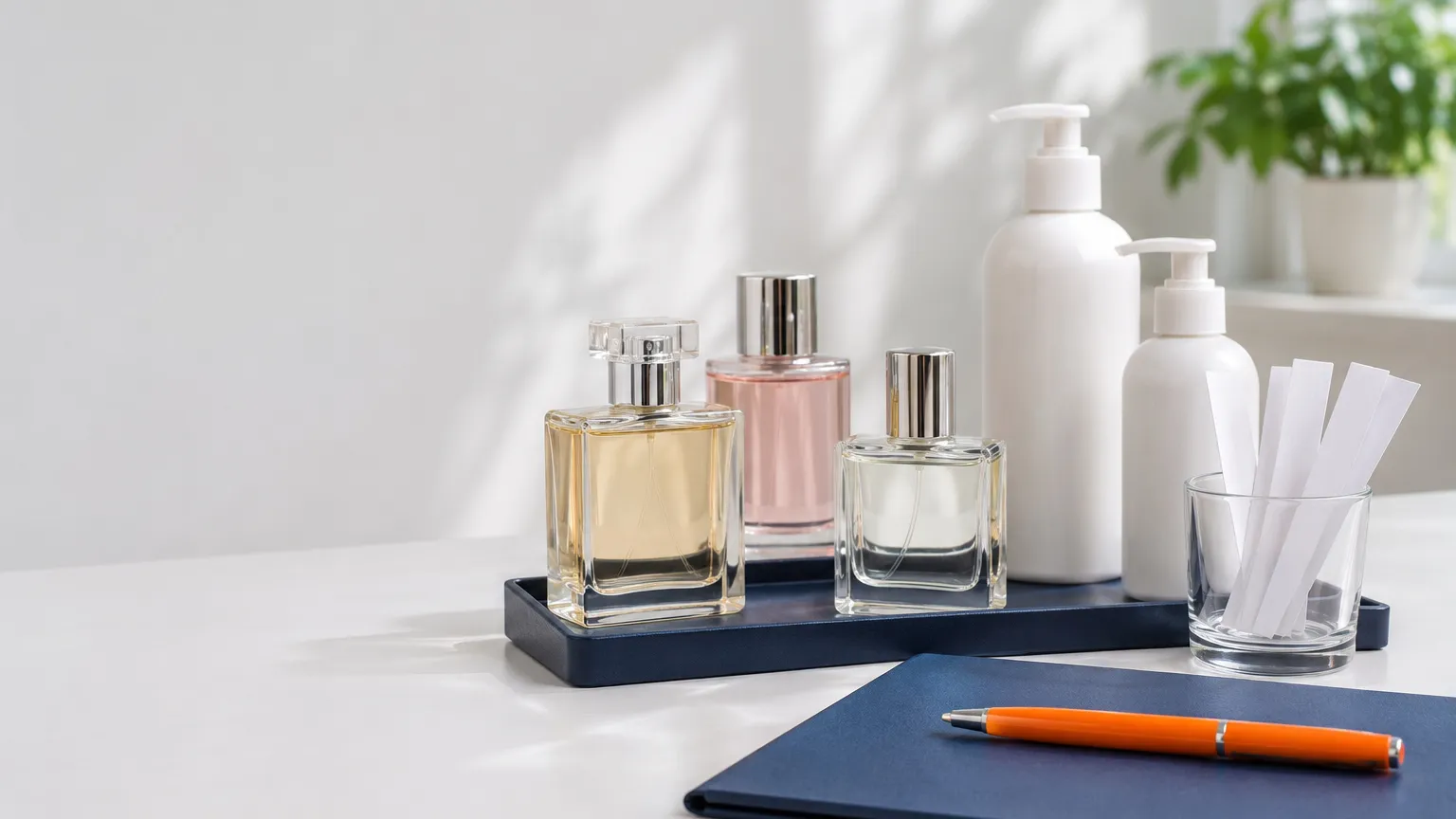
Perfume and lotion formulas: prohibited or restricted fragrance substances and IFRA
Perfumes and scented lotions use a fragrance compound from a fragrance house, which is a blend of many aroma substances. The first point of the five-point test says the formula must contain no prohibited substances and restricted substances must stay within legal limits, so the substances inside the fragrance compound must also pass the Thai lists, not just the ingredients the brand adds itself.
Examples from the Thai lists that concern aroma substances directly:
- Prohibited under the 2023 notification on prohibited substances, for example Musk ambrette, Atranol and Chloroatranol.
- Methyleugenol is on the prohibited list except for the amount naturally present in the natural essences used, within limits by product type: 0.01% in fine fragrance, 0.004% in eau de toilette, 0.002% in fragrance cream and 0.0002% in other leave-on products (which group a lotion falls into depends on the product).
- Musk ketone is on the list of restricted substances: up to 1.4% in fine fragrance, 0.56% in eau de toilette and 0.042% in other products.
These examples show that the limit for one substance differs between perfume and lotion. A fragrance compound that works in a perfume may not be usable at the same level in a lotion. When both products share one scent, ask the factory to calculate each product type separately.
Documents to request from the fragrance house
An IFRA certificate states the maximum use level of the fragrance compound in each product category under the international fragrance association's standards, and an allergen list for the compound helps with labelling questions when exporting. Neither replaces checking against the Thai substance lists, but they work well together. Read more in IFRA certificates and fragrance allergens, check a whole formula with the formula checker, or look up single substances in the Thai FDA ingredient search.
What lotion and perfume labels must show
Clause 1 of the 2019 Cosmetic Committee notice on cosmetic labels lists the required items:
- cosmetic name and trade name, larger than other text;
- cosmetic type;
- names of all ingredients in descending order; colours or ingredients below 1% need not be ordered but must follow those above 1%;
- directions for use;
- name and address of the manufacturer or importer, and country of manufacture;
- net quantity;
- batch number;
- month and year of manufacture;
- month and year of expiry, when shelf life is under 30 months;
- warnings, if any;
- notification number.
Labels must be in clear Thai; ingredient names may be in Thai, transliterated or in English. Small perfume bottles or roll-ons with less than 20 square centimetres of label space show a minimum set of items on the container and may put the rest on an insert or leaflet.
Clause 6 bans text, images or trademarks that are false, suggest ingredients that are not present, or exaggerate. Wording such as "lasts all day" should therefore be backed by data. For how to list fragrance on the ingredient list and how to align allergen listings with foreign markets, see the IFRA article, and for the full label picture see Thai cosmetic label requirements.
Lotion OEM Thailand: the order of work from brief to shelf
An order of work that reduces rework when you hire a factory for lotion and perfume:
- Brief the product and its wording. Decide where on the body it is used and what you will say when selling it, then test this against the five-point test before choosing a formula.
- Choose and check the factory. Ask for its standard certificate and confirm the scope covers lotion or perfume.
- Develop and screen the formula. Get the complete ingredient list, including the IFRA certificate and allergen list for the fragrance compound, and check it against the Thai lists by product type.
- Sign the manufacturing contract. Set out the contract manufacturer and hiring party roles, formula custody, amendments and recalls.
- File the notification. The factory files form JK.1 with the contract, and the brand registers as a new hiring party if needed.
- Label and launch. Print the notification number and real manufacturer, and keep advertising within cosmetic limits.
After launch, plan for renewal. Clause 7 of the notification rules says renewal is filed on form JK.2 within 180 days before expiry, and a formula change needs an amendment or a new notification depending on the case. Advertising must stay within the same limits as the label; see how to spot exaggerated ads. If you would like help screening a formula or preparing documents, see our registration and notification service or product development service.
- 1Brief product and wordingTest against the five-point cosmetic test
- 2Choose the factoryCheck its standard certificate and production scope
- 3Formula and screeningInclude the fragrance compound, checked by product type
- 4Manufacturing contractRoles, formula custody, amendments and recalls
- 5File the notificationFactory files JK.1 with the contract
- 6Label and launchNotification number, real manufacturer, cosmetic-level wording
Source: Cosmetics Act B.E. 2558 · Notification rules 2018 · Cosmetic label notice 2019
Frequently asked questions
Does a body perfume need cosmetic notification in Thailand?
Yes. Perfume used on the skin or body fits the cosmetic definition, which includes perfumery for the skin, so the manufacturer or contract manufacturer must notify before producing for sale. Room fragrances and fabric sprays are not cosmetics.
Whose name is on the notification when a factory makes my lotion?
The contract-manufacturing notification receipt is issued to the factory as contract manufacturer, with the brand owner named as the hiring party. The factory attaches the manufacturing contract when filing.
Can I use the same scent in a perfume and a lotion?
You can use the same fragrance compound, but the dose may need to differ because limits for some aroma substances depend on product type. Methyleugenol, for example, has a much higher limit in fine fragrance than in other leave-on products. Ask the factory to calculate each product separately.
Can a lotion that claims to repel mosquitoes be notified as a cosmetic?
No. The Thai FDA cosmetic notification criteria say mosquito repellents are not cosmetics; skin products that repel insects are hazardous substances.
How long is a cosmetic notification receipt valid?
Three years from issue. Renewal is filed on form JK.2 within 180 days before expiry.
Sources
- (1)
พระราชบัญญัติเครื่องสำอาง พ.ศ. 2558 · Open source · Search our archive หลักเกณฑ์ การพิจารณา การจดแจ้งเครื่อง สำอาง (ฉบับปรับปรุง พ.ศ. 2564) · Open source · Search our archive- 6.1
ประกาศ กระทรวง สาธารณสุข เรื่อง หลักเกณฑ์ วิธีการ และเงื่อนไข ในการผลิตหรือ นำเข้าเครื่อง สำอาง พ.ศ. 2561ลงวันที่ 4พฤษภาคม 2561 · Open source · Search our archive - 4.1
ประกาศ กระทรวง สาธารณสุข เรื่อง การจดแจ้ง การออกใบรับจดแจ้ง การต่ออายุใบรับจดแจ้ง การแก้ไข รายการ ใบรับจดแจ้ง และการออกใบ แทนใบรับ จดแจ้งเครื่อง สำอาง ลงวันที่ 22สิงหาคม 2561 · Open source · Search our archive กระบวน งานที่ให้บริการ ด้านเครื่อง สำอาง ในส่วนกลาง และส่วนภูมิภาค · Open source · Search our archive- 4.15
การขอหนังสือ รับรอง มาตรฐาน การผลิตตามแนวทาง วิธีการที่ดีในการ ผลิตเครื่อง สำอาง (ASEAN COSMETIC GMP)กรณีตรวจ ประเมิน โดยสำนักงาน คณะกรรมการ อาหาร และยา (UPDATE 28/10/67) · Open source · Search our archive - 14.1
ประกาศ คณะกรรม การเครื่อง สําอาง เรื่อง ฉลากของเครื่องสําอาง พ.ศ. 2562ลงวันที่ 14มิถุนายน 2562 · Open source · Search our archive - (8)
ประกาศ กระทรวง สาธารณสุข เรื่อง ชื่อวัตถุที่ห้ามใช้ เป็นส่วนผสมใน การผลิตเครื่อง สำอาง พ.ศ. 2566ลงวันที่ 24พฤษภาคม 2566 · Open source · Search our archive - (1)
ประกาศ กระทรวง สาธารณสุข เรื่อง กําหนดชื่อ ปริมาณ และเงื่อนไข ของวัตถุที่อาจ ใช้เป็นส่วนผสม ในการผลิตเครื่อง สําอาง พ.ศ. 2561ลงวันที่ 29เมษายน 2561 · Open source · Search our archive
This article is for general information. It is not a Thai FDA ruling or legal advice, and rules change — check the latest notification or ask an expert before filing or producing.
Related articles
 Factories / OEMContract cream manufacturing: what the factory must haveContract cream manufacturing in Thailand: what the factory must have, how to check GMP, whose notification it is, changing factories and contract terms.

 Brand ownersSelling essential oils in Thailand: cosmetic, herbal product or hazardous substance?Essential oil Thailand rules: when an oil is a cosmetic, herbal product, hazardous substance or OCPB product, plus banned fragrance materials, Piperonal.

 ExportersFragrance allergens and IFRA certificates: the EU 81-entry list, IFRA 51st/52nd Amendments and Thai rulesFragrance allergens explained for Thai exporters: what an IFRA certificate must state, the 51st and 52nd Amendments, the EU list and Thai FDA label rules.