 FDA Thailand
 Brand owners
Sleep supplements and melatonin in Thailand: which ingredients are permitted
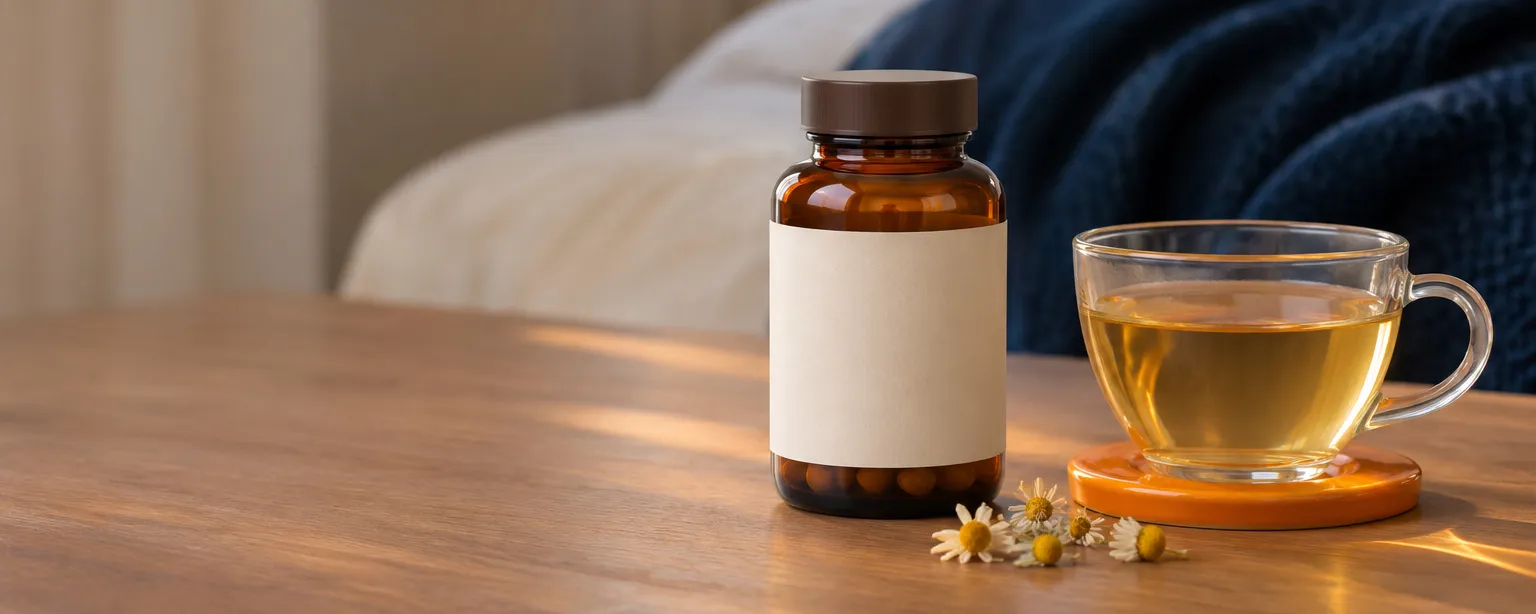
Sleep supplement ingredients in Thailand: start with the lists
Sleep supplement ingredients in Thailand are one of the most common questions we get from brand owners, importers and contract manufacturers planning a sleep, relaxation or stress formula. Before designing a formula or ordering stock, the first question is whether each ingredient is on a list that the Thai Food and Drug Administration (Thai FDA) accepts for food supplements. Several ingredients that are mainstream abroad have a very different status in Thailand.
Food supplements in Thailand fall under Ministry of Public Health (MOPH) Notification No. 293 of 2005 on food supplements and its amendments. For choosing key ingredients, Thai FDA publishes the document actually used when filing for a food registration number: the Thai FDA announcement on guidance for the use of key ingredients in food supplements, dated 8 July 2024. This article calls it the “advisory list”. It names each ingredient, the plant part, the preparation method and the normal maximum daily amount.
One point matters from the start. The advisory list is Thai FDA guidance, not a ministerial notification. Its figures are the ceilings you can normally file under. Using more than that, or using an ingredient that is not on the list, is not automatically prohibited, but it requires a safety assessment before the product can be approved. Below, common sleep ingredients are grouped into four categories: listed and usable, usable under specific conditions, not permitted in food, and not yet on any Thai list. A summary table and a formula-check routine follow.
●Permitted on the lists
- L-theanineup to 200 mg per day
- GABAup to 250 mg per day
- Chamomileflower powder up to 100 mg per day
- Lemon balmleaf extract up to 20 mg per day
- Magnesiumup to 350 mg per day from all sources
●Conditional or needs assessment
- L-tryptophanonly under an approved safety assessment
- 5-HTPnot on any Thai list
- Valerian rootnot on any Thai list
- Black cohoshnot on any Thai list
●Not permitted in food
- Melatoninonly as a registered prescription medicine
- Kava kavaon the list of plants prohibited in food, Notification No. 424
- Prescription medicinese.g. sleeping pills, anti-anxiety drugs, antidepressants
Amounts are the daily ceilings in the Thai FDA advisory list for food registration · see the summary table in the article for sources
Listed sleep ingredients: L-theanine, GABA, chamomile and lemon balm
These are the ingredients a brand can use with the most confidence, because each appears on the advisory list with a clear daily maximum. Formulation is straightforward: calculate the daily intake from the directions on the label and compare it with the ceiling for each ingredient.
L-theanine
L-theanine is an amino acid found naturally in tea leaves. It is item 442 on the advisory list, at up to 200 mg per day. It can also enter a formula through green or white tea extract under item 63, which limits tea extract to 5 g per day and total L-theanine to 200 mg per day. If a formula contains both pure L-theanine and tea extract, add the L-theanine from both sources before comparing with the ceiling.
Gamma-aminobutyric acid (GABA)
Gamma-aminobutyric acid, usually called GABA, is item 331 on the advisory list, at up to 250 mg per day. The entry also describes the raw material: more than 80 percent gamma-aminobutyric acid produced by fermentation with the strain Lactobacillus hilgardii K-3. Ask the supplier for a certificate of analysis and compare it with this description before ordering. If the material is made another way, check with Thai FDA whether an additional safety assessment is needed.
Chamomile
The advisory list has two chamomiles. Roman chamomile (Chamaemelum nobile) is item 77, with ground flower powder up to 100 mg per day. German chamomile (Matricaria chamomilla) is item 196, with ground flower powder up to 100 mg per day and water extract up to 108 mg per day. Both flowers are also on the list of plants permitted for herbal tea under MOPH Notification No. 426 of 2021, amended by No. 471 of 2026, with the condition that the label carries the statement “people allergic to pollen should not consume this product”. If a brand sells both capsules and a tea in the same line, use the same statement across the range.
Lemon balm
Lemon balm (Melissa officinalis) has two routes. In supplements it is item 198 on the advisory list, listed as “balm”, with leaf extract made with water or water and ethanol at up to 20 mg per day. It is also item 120 on the list of plants permitted for herbal tea, where the leaf is used as a tea ingredient. The 20 mg figure is low, so formulas copied from overseas usually need to be scaled down.
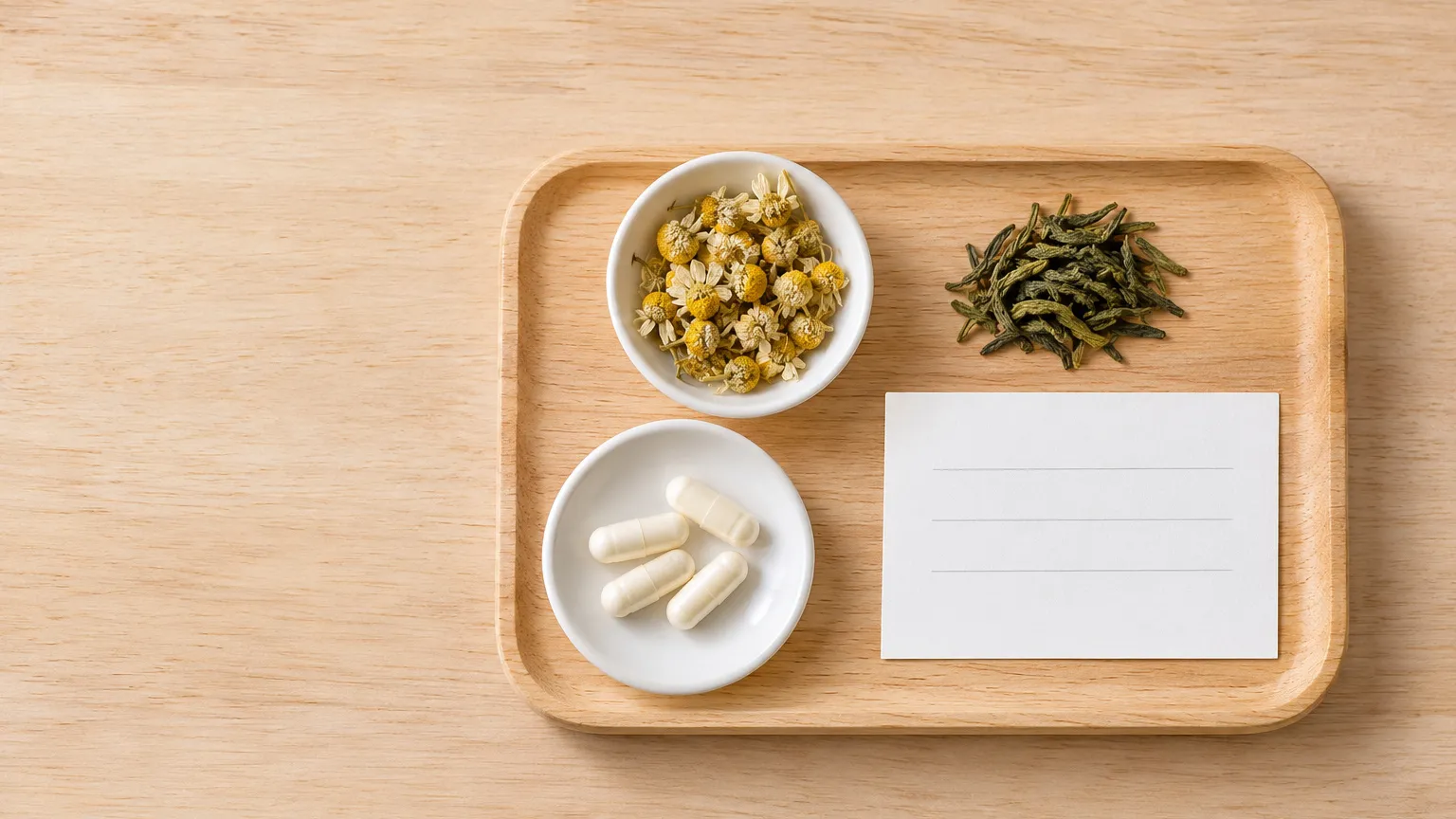
Magnesium and L-tryptophan: usable, but under different conditions
Consumers often search for “vitamins that help you sleep”, but no vitamin on the Thai FDA lists is designated for sleep. The closest options are the mineral magnesium and the amino acid L-tryptophan, both of which can go into dietary supplements under their own conditions. Any sleep-related wording on the label still has to follow the claim rules covered in the labels and advertising section below.
Magnesium
Magnesium is a mineral, so it follows the vitamin and mineral rules rather than the advisory list for herbs and other substances. MOPH Notification No. 448 of 2023 sets the maximum magnesium in a food supplement at 350 mg per day, based on the recommended intake on the label. Permitted magnesium salts are listed in the Thai FDA guidance on vitamin and mineral forms used as key ingredients, and the calculation must be made as elemental magnesium, not as the weight of the whole salt.
A sleep formula that combines magnesium with red marine algae or another mineral-rich natural ingredient must add the magnesium from every source. Advisory list item 185 for red marine algae states plainly that total magnesium must not exceed 350 mg per day.
L-tryptophan
L-tryptophan is a common amino acid in overseas sleep formulas. In Thailand it appears on the list of food safety assessments passed under the “not novel food” route. That means at least one company has filed and passed an assessment, but Thai FDA sends the result, including quality, specifications and the maximum amount, only to the company that filed.
In practice, another company has two options: obtain a letter of consent from the company that holds the assessment, for example by buying the raw material from that holder, or file its own safety assessment. L-tryptophan can be used, but it is not an ingredient you can simply add to a formula the way you can with the first group.
Melatonin supplements and kava kava: not permitted in food
Melatonin
Melatonin is the ingredient importers ask about most, because it is sold as an ordinary supplement in some countries. In Thailand, melatonin is not permitted as an ingredient of food or food supplements. A Thai FDA deputy secretary-general has stated in the media that melatonin is a hormone and is not allowed as a food ingredient, and Thai FDA has found melatonin in sleep gummies and issued consumer warnings.
The only melatonin products sold in Thailand are registered medicines dispensed on prescription. A brand that wants an overseas-style sleep gummy or capsule must remove melatonin and choose ingredients from the listed group instead. Importers must check every overseas label, because melatonin often sits in the ingredient list without appearing in the product name.
Kava kava
Kava kava (Piper methysticum) is on the list of plants and plant parts prohibited in food under MOPH Notification No. 424 of 2021 on food prohibited from production, import or sale, item 62, covering the whole plant and its extracts. It therefore cannot be used in any food or food supplement. Kava kava is also on the list of substances prohibited in herbal products, both herbal medicines and herbal health products, so switching to a herbal product registration is not a workaround.
For consumers: What is melatonin, and why it cannot be sold as a supplement in Thailand
5-HTP, valerian and black cohosh: not yet on any Thai list
These ingredients are common in overseas sleep and relaxation formulas: 5-hydroxytryptophan, or 5-HTP, extracted from Griffonia simplicifolia seed; valerian root; and black cohosh. Searching the Thai lists, including the supplement advisory list, the list of plants permitted for herbal tea and the list of passed safety assessments, returns no entry for any of them.
Not being listed is not the same as being prohibited like kava kava. It means there is no normal filing route yet. A brand that wants to use one of them must first submit a safety assessment to Thai FDA. Depending on whether there is a sufficient history of safe consumption as food, it may fall under MOPH Notification No. 376 of 2016 on novel food, or under the “not novel food” assessment route. The assessment result decides whether the ingredient can be used, and at what amount.
For brands that need to launch quickly, the shorter path is to build the formula from listed ingredients first and plan the assessment of a new ingredient for a later version. Importers holding an overseas product with one of these ingredients should know that it cannot get a food registration number through the normal route until an assessment has been passed.
Source: Thai FDA advisory list dated 8 July 2024 · MOPH Notifications No. 424, 426, 448, 471
Sleeping pills and anti-anxiety drugs in supplements: no longer food
One more group needs to be stated plainly: modern medicines such as clonidine, fluoxetine and etifoxine, as well as other sleeping pills, anti-anxiety drugs and antidepressants. These are drugs under the Drug Act of 1967. They cannot be ingredients of food or food supplements at any amount. A product that contains them is no longer a food supplement; it is a product adulterated with a drug.
Our team has seen people search for these drug names alongside sleep ingredients on our site, so we will say it directly: there is no route that turns a drug into a food ingredient. If a formula from a factory or an overseas partner contains a name you do not recognise, look it up first, and ask for a raw material analysis that states clearly that no drug substances are present.
For contract manufacturers, accepting a raw material described only by a trade name or a blend name without a full ingredient breakdown is a risk that should be closed at the order stage. Ask for every component with its amount, then check each one against the Thai FDA lists.
Labels and advertising for sleep supplements: what you can say
Once the formula clears the ingredient stage, the next hurdle is what the label and advertising say. A food supplement is a food, so it cannot claim to treat insomnia, cure stress disorders or replace sleeping pills. Phrases such as “ends insomnia”, “get off sleeping pills” or “use instead of medicine” are drug-style claims, and a food cannot make them.
Every food supplement label must carry the warnings required by MOPH Notification No. 411 of 2019, including the statement that the product “has no effect in preventing or treating disease”. That statement already sets the product’s limits, so the rest of the label should not contradict a warning printed on the same box.
On advertising, food supplements need advertising approval before publication under the Thai FDA criteria for food advertising of 2026. Messages about relaxation or rest must be supported by evidence and must not exaggerate. Before sending ad copy or sales captions to the marketing team, paste them into the ad copy pre-check tool to spot risky wording first.
Importing sleep supplements: what to check before you order
Importers tend to hit the same problem: the product sells well abroad, but the formula does not match the Thai lists. Before ordering the first lot, check four things.
- The full ingredient list. Ask the manufacturer for the complete formula breakdown, not just the back label, because some ingredients sit inside blends listed under a single name.
- Ingredients that are not permitted. If the product contains melatonin, kava kava or any drug, it cannot be imported and sold as food. Ask the manufacturer for a Thailand-specific formula.
- Ingredients that are not listed. If it contains 5-HTP, valerian root or black cohosh, remove them or file a safety assessment first.
- Daily amounts. Calculate from the directions on the label. If the dose is 2 capsules a day, multiply the amount per capsule by 2 and compare every ingredient with its ceiling.
Once the formula passes all four checks, start preparing the documents for a food registration number. The full process is in our guide to importing dietary supplements and guide to registering a dietary supplement. For the Thai label, see Thai supplement label requirements.
- 1Is it a medicine or a hormone?If yes, such as melatonin, it cannot go into a supplement
- 2Is it named on a Thai FDA list?Search the ingredient; not listed means a safety assessment first
- 3Is the amount within the daily ceiling?Run the whole formula through the formula checker
- 4No disease claims on the label or in adsNever say it treats insomnia; check the copy with the ad checker
Check a sleep supplement formula with the site's tools
The formula check our team uses can be done on your own, without signing up. Start by searching each ingredient in the substance search, which brings together the supplement advisory list, the list of plants permitted for herbal tea, the list of food prohibited from production, import or sale, and the list of passed safety assessments. You can search by Thai name, English name or scientific name.
Next, paste the whole formula into the formula checker. It matches each ingredient against the lists and flags anything over its ceiling or not found. For specific questions, such as whether a particular supplier's GABA meets the listed description, or how to count a formula that has both tea extract and pure L-theanine, ask the regulatory question assistant.
Importers who already have a product and want to know whether the food registration number on the label is genuine can use the Thai FDA number checker straight away. If you would like our consultants to adjust a formula, prepare documents or plan a safety assessment for an unlisted ingredient, contact our team.
- ✓
- ✓
- ✓
- ✓
- ✓
- ✓
Frequently asked questions
Can melatonin be used in a sleep supplement in Thailand?
No. Melatonin is not permitted as an ingredient of food or food supplements. Thai FDA has stated that it is a hormone. In Thailand, melatonin is available only as a registered medicine dispensed on prescription.
What is the maximum L-theanine in a Thai food supplement?
Up to 200 mg per day under the Thai FDA advisory list. If you also use green or white tea extract, total L-theanine from all sources must stay within 200 mg per day, and the tea extract within 5 g per day.
How much GABA can a food supplement contain?
Up to 250 mg per day under advisory list item 331, which describes a raw material with more than 80 percent gamma-aminobutyric acid produced by fermentation. Compare the supplier's certificate of analysis before ordering.
Can valerian root or 5-HTP be used in a supplement?
They are not on the Thai ingredient lists or the lists of plants used as food, so there is no normal filing route. A safety assessment must be submitted to Thai FDA first, and its result decides whether they can be used.
Can the label say the product helps treat insomnia?
No. A food supplement cannot claim to treat disease or replace medicine, and the label must already carry the warning that it has no effect in preventing or treating disease. Advertising needs approval before publication.
Can kava kava be registered as a herbal product instead?
No. Kava kava is on the list of plants prohibited in food under Notification No. 424 and on the list of substances prohibited in herbal products.
Sources
- MOPH Notification No. 293 B.E. 2548 (2005) on food supplements · Open source · Search our archive
- Thai FDA announcement on guidance for the use of key ingredients in food supplements (dated 8 July 2024) · Open source · Search our archive
- MOPH Notification No. 448 B.E. 2566 (2023) on food supplements (No. 5) · Open source · Search our archive
- Thai FDA announcement on guidance for vitamin and mineral forms used as key ingredients in food · Open source · Search our archive
- MOPH Notification No. 411 B.E. 2562 (2019) on food supplements (No. 4) · Open source · Search our archive
- MOPH Notification No. 426 B.E. 2564 (2021) on herbal tea · Open source · Search our archive
- MOPH Notification No. 471 B.E. 2569 (2026) on herbal tea (No. 2) · Open source · Search our archive
- MOPH Notification No. 424 B.E. 2564 (2021) on food prohibited from production, import or sale · Open source · Search our archive
- MOPH Notification on substances prohibited in herbal products (No. 2) B.E. 2566 (2023) · Open source · Search our archive
- Thai FDA list of food safety assessments passed: novel food and not novel food · Open source · Search our archive
- MOPH Notification No. 376 B.E. 2559 (2016) on novel food · Open source · Search our archive
- Drug Act B.E. 2510 (1967) · Open source · Search our archive
- Thai FDA criteria for food advertising B.E. 2569 (2026) · Open source · Search our archive
This article is for general information. It is not a Thai FDA ruling or legal advice, and rules change — check the latest notification or ask an expert before filing or producing.
Related articles
 Brand ownersThai dietary supplement labels: mandatory text, warnings, vitamin limits and restrictionsThai supplement label rules: mandatory items, the four warnings, ingredient warnings, vitamin limits, font sizes and restricted wording.
 Brand ownersRegistering a dietary supplement in Thailand: steps, documents and common sticking pointsHow to register a dietary supplement in Thailand: who can file, Sor Bor 5 steps, raw material and analysis documents, quality limits and common pitfalls.
 ConsumersWhat is melatonin, and why can't it be sold as a supplement in Thailand?Melatonin Thailand guide: what melatonin is, why it is not permitted in supplements, why it is prescription-only, and how to check sleep gummies.