 FDA Thailand
 Brand owners
Thai FDA registration for snacks, chili paste and beverages: which category and which form
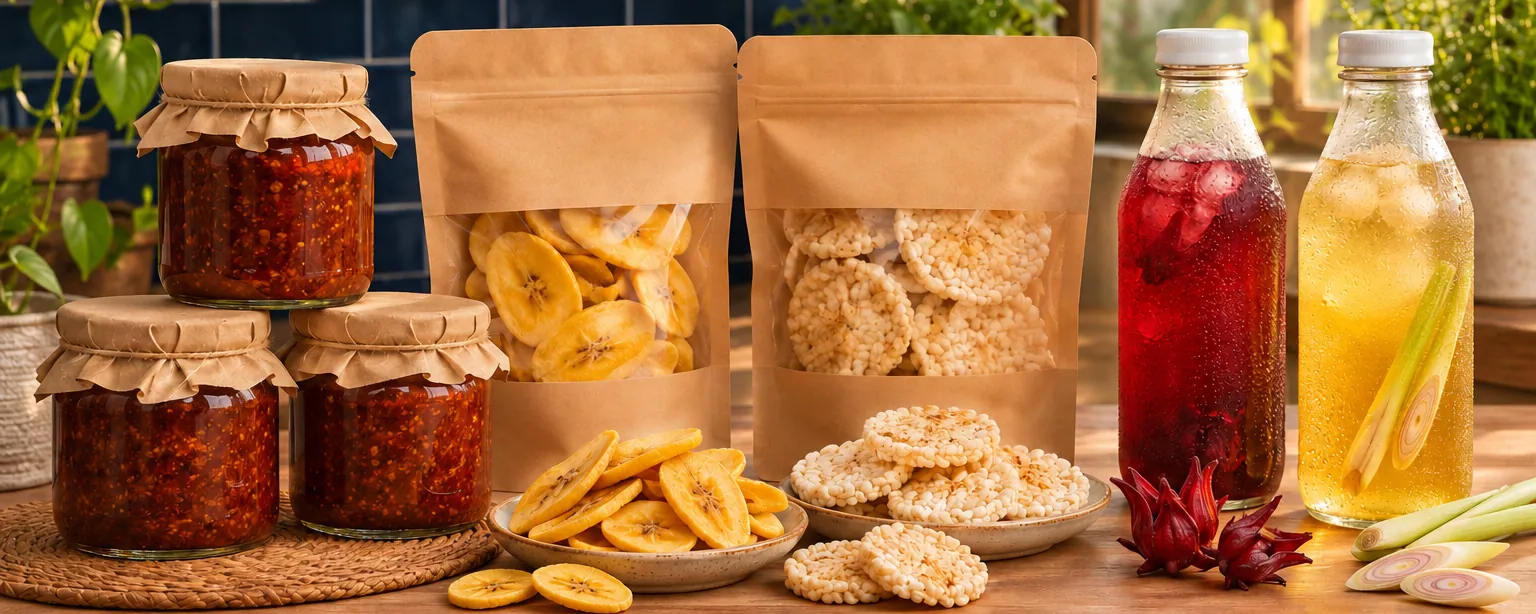
Thai FDA registration for snacks, chili paste and beverages: start with the food category
Small producers, online sellers and foreign brands launching a snack, a chili paste (nam prik) or a drink in Thailand usually ask the same question: which Thai FDA route applies? This guide to Thai FDA registration for snacks, chili paste and beverages starts where the regulator starts, with the legal food category. The category decides which application form you file, whether you must submit test results, and what the label must carry. Two snacks that look alike, or two jars of nam prik on the same shelf, can fall into different categories and use different forms.
The Thai FDA Regulation on the Food Serial Number B.E. 2567 (2024) lists four groups of food that need a food serial number (the 13-digit "Or Yor" number):
- Specially controlled food, such as infant food, weight-control food and food additives, which needs recipe registration. Ordinary snacks, chili pastes and drinks are not in this group.
- Quality or standard-specified food, meaning products with their own Ministry of Public Health notification, such as sealed-container beverages, drinking water, tea, coffee, certain sauces and semi-processed food.
- Food requiring a label, such as "certain processed foods" under Notification No. 456, which covers snacks, baked goods and ready-to-eat food.
- General food with no specific notification. A serial number is not compulsory, although a producer whose premises have passed inspection may still request one.
In practice, small brands meet two forms most often. The Food Division's classification manual for the Sor Bor 7 group (revised 20 August 2026) sorts them as follows:
- Form Sor Bor 5 (food registration) for food that must disclose its formula, such as sealed-container beverages, food in hermetically sealed containers, coffee mixes, instant coffee mixes, ready-to-drink coffee and electrolyte drinks.
- Form Sor Bor 7 (food detail notification) for food that does not, such as drinking water, natural mineral water, tea, herbal infusions, pure coffee, certain sauces, semi-processed food and certain processed foods.
The sections below go product by product: which category, which form, which level of good manufacturing practice (GMP) the premises need, and what goes on the label. For the filing steps and document list in detail, see Thai FDA food registration number.
Source: Food Division classification manual for the Sor Bor 7 group (20 Aug 2026), Ministry of Public Health product notifications and Notification No. 420
Before the product number: home-based premises (Sor Bor 1/1) or a factory licence (Or 2), and GMP 420
A food serial number is issued under a licensed production or import site, so the 13 digits identify where the product is made, not the brand. Before you can file for any product you need a licensed site whose licence covers that food category, or a contract manufacturer whose licence covers your product.
Non-factory premises versus factories
The Food Division's Food Product Licensing Manual (5th printing, 2026) splits production sites by size:
- Not a factory: machinery under 50 horsepower in total and fewer than 50 workers. You file Form Sor Bor 1 and receive a Sor Bor 1/1 certificate for food production premises that are not a factory, which does not expire. Most small snack and chili-paste kitchens fall here.
- Factory: machinery of 50 horsepower or more, or 50 workers or more. You file Form Or 1 and receive a food production licence (Form Or 2), which must be renewed.
Both are filed through the Thai FDA e-Submission system after the site passes inspection. The 2024 serial-number regulation also states that if a Sor Bor 1/1 or Or 2 is revoked, every serial number issued under it lapses. Producing at home is therefore possible, but the space has to genuinely meet the criteria. See home-based food production in Thailand and food production licence in Thailand.
GMP 420: basic and specific requirements
Ministry of Public Health Notification No. 420 B.E. 2563 (2020) requires all food produced for sale to follow good manufacturing practice, with limited exceptions such as restaurants cooking for immediate consumption and street stalls. The requirements come in two levels:
- Basic requirements apply to every site, in five chapters: premises and buildings, equipment, production control, sanitation, and personal hygiene. Snacks, ordinary chili pastes, tea, coffee and most drinks fall under this level.
- Specific requirements are added for three groups: drinking water, natural mineral water and filtered ice in sealed containers; liquid pasteurised milk; and low-acid and acidified food in hermetically sealed containers. These producers must appoint a production supervisor trained under the prescribed course.
The basic requirements also call for finished products to be tested by a government or accredited laboratory at least once a year, with records kept for at least one year after the expiry date on the label. All chapters are covered in GMP 420 requirements.
- 1Classify the productCheck specific notifications, measure pH and aw, check the container
- 2Prepare the siteMeet GMP 420 or choose a contract manufacturer
- 3Obtain Sor Bor 1/1 or Or 2After the site inspection
- 4Prepare formula and label100 percent formula, process, Thai label
- 5File Sor Bor 5 or Sor Bor 7Through e-Submission
- 6Maintain after approvalTest results, GMP records, label updates when rules change
Source: Thai FDA Regulation on the Food Serial Number B.E. 2567 and Food Product Licensing Manual (2026)
Snacks: chips, baked goods, Thai desserts, bread and jelly
Snacks are not covered by a single notification, so first decide what kind of snack you make. Notification No. 456 B.E. 2568 (2025) on labelling of certain processed foods, in force since 3 May 2025, merged seven older product notifications into one group called "certain processed foods" and made it food requiring a label. It has eight types: brown rice flour, ready-made jelly and jelly desserts, sauces in hermetically sealed containers, bread, chewing gum and candy, meat products, ready-to-eat food, and ready-to-cook food. All of them are filed on Form Sor Bor 7.
Chips, baked goods and ready-to-eat Thai desserts
The Sor Bor 7 classification manual describes ready-to-eat food as food that has been processed, can be eaten straight away and is packed ready for sale. Its examples include cookies, crispy rice cakes with watermelon syrup, and fried rice crackers. The Thai FDA's published label examples place snacks such as fried seaweed and baked goods such as banana cake in this type, and also show a Thai dessert of glutinous rice balls in coconut milk.
Bread, jelly, candy and products still to be cooked
- Bread and chewing gum and candy are separate types within Notification No. 456.
- Ready-made jelly and jelly desserts must carry "children should eat only small amounts" in red letters at least 5 mm high in a white box. Notification No. 457 B.E. 2568 bans making, importing or selling jelly containing glucomannan or konjac flour in mini cups whose widest diameter is 4.5 cm or less.
- Ready-to-cook food, such as uncooked rice crackers or custard powder that only needs water, also sits under Notification No. 456. A baking mix to which the buyer must add milk, butter and eggs is classed by the manual as general food, which does not require a serial number.
- Chocolate has its own notification and belongs to the Sor Bor 7 group.
When a snack becomes hermetically sealed food
Notification No. 456 excludes meat products, ready-to-eat food and ready-to-cook food that fall under the hermetically sealed food notification, No. 469. Dry, crisp snacks do not qualify, but a moist product such as a dessert in syrup that is canned and heat-processed after sealing should be checked against the criteria in section 5. If you buy finished snacks and repack them under your own brand, see repacking food for sale in Thailand.
Chili paste (nam prik): curry paste, ready-to-eat nam prik and chili sauce sit in different groups
"Nam prik" covers many different products, so there is no single answer to how a chili paste is registered. What decides the category is how the paste is eaten, its acidity and water activity, and the container. No notification is titled "nam prik"; you have to match the product to the closest notification.
Curry paste: semi-processed food
Notification No. 210 B.E. 2543 (2000) on semi-processed food makes semi-processed food a quality or standard-specified food and names "curries and curry pastes" as one of its four types. Semi-processed food has been partly processed and seasoned and is finished at home by a quick, simple step such as boiling or adding other food. Green curry paste, red curry paste or tom yum paste that is stir-fried or boiled with meat falls here and is filed on Form Sor Bor 7.
Ready-to-eat nam prik: ready-to-eat food
Chili pastes eaten straight with rice or vegetables, such as roasted chili paste, dried chili dips or grilled-fish chili paste, are finished, ready-to-eat products. The explanatory note to Notification No. 456 lists nam prik in its table of microbiological criteria for ready-to-eat food, separating pastes with water activity (aw) below 0.85 from those above 0.85. Dry and oil-fried pastes with low aw therefore sit in "certain processed foods", ready-to-eat type, and are filed on Form Sor Bor 7.
Jarred pastes of this kind used to fall under the old hermetically sealed food notification, No. 355; the Thai FDA's label example for its clause 3(2) type was a roasted chili paste. The Food Division's guidance on Notification No. 469 states that this type (aw of 0.85 or less) has moved to certain processed foods or general food. Products already holding a number may keep it.
Chili sauce, dipping sauces and simple seasonings
- Chili sauce, a smooth liquid or thick seasoning, is covered by Notification No. 201 B.E. 2543 on certain sauces, together with tomato sauce, papaya sauce and mixed sauces. It is quality or standard-specified food filed on Form Sor Bor 7.
- Dipping sauces and fermented soybean paste are classed by the manual as sauces in hermetically sealed containers, a type of certain processed foods, filed on Form Sor Bor 7.
- Simple seasonings such as chili salt, chili in vinegar or fried garlic oil are not counted as sauces in hermetically sealed containers, and the classification guide cites uncomplicated seasonings and spices as examples of general food.
The name on the pack does not settle the category. The manual itself uses "shrimp paste chili dip" as an example of a product name that may have to be adjusted to match the category once classification is done.
Chili paste in sealed jars or cans: when Notification No. 469 applies
Registering a chili paste becomes much harder when it falls under Notification No. 469 B.E. 2569 (2026) on food in hermetically sealed containers, in force since 19 May 2026, which replaced No. 355. The new notification only covers low-acid and acidified food, and uses pH and aw as the criteria.
Four conditions that must all be met
- The food is heat-processed to destroy or inhibit microorganisms, before or after filling.
- pH is above 4.6 and water activity (aw) above 0.85. If acid is added to bring pH to 4.6 or below but the raw material was above 4.6, the product is "acidified" and still covered.
- It is packed in an airtight, hermetically sealed container.
- It can be stored at ambient temperature.
A moist, non-sour chili paste in a screw-cap glass jar that is heat-processed and sold off the shelf may meet these conditions. A dry paste with aw of 0.85 or less, or a paste that must stay refrigerated, does not.
Which containers count as hermetically sealed
A Food Division briefing (26 May 2026) gives examples: glass jars count when the lid has a sealing gasket, liner or plastisol, or when the mouth is heat-sealed with film or foil. Heat-sealed plastic pouches, cups or bottles count only when heat-processed after sealing. Metal cans count when closed with a double-seam lid or a lid of the type used on glass jars.
What changes if you are covered
- You file Form Sor Bor 5 (registration) instead of Sor Bor 7.
- Low-acid products must reach an F0 of at least 3 minutes, backed by heat-distribution and heat-penetration studies at that site, or be acidified to pH 4.6 or below.
- The site must meet the GMP 420 specific requirements for low-acid and acidified food, with a production supervisor and a thermal process authority who holds a bachelor's degree in food science or a related field and has passed the prescribed course.
- The 2026 amendment to the serial-number regulation requires test results under the product notification when the product is first made for sale.
For a small brand, the easier path is often to adjust the recipe or process so the product falls outside the criteria, for example by drying it to aw of 0.85 or less, or to use a contract manufacturer that already has retorts and a process authority. Full criteria are in hermetically sealed food: Notification No. 469.
Beverages: drinking water, tea, coffee, herbal infusions and bottled drinks
Drinks are also sorted by type. Some have their own notification; the rest fall under the sealed-container beverage notification. The classification manual explains that this notification applies to drinks without a specific notification, for example anything that is not tea, coffee, soy milk or a herbal infusion.
Bottled drinking water and mineral water
Notification No. 462 B.E. 2568 (2025) on drinking water in sealed containers, in force since 12 December 2025, includes water named by source (spring water) and carbonated water or soda, but not natural mineral water. Its explanatory note states that water with added minerals, vitamins or flavour becomes a sealed-container beverage. Drinking water and natural mineral water are filed on Form Sor Bor 7, but the site must meet both the basic and specific requirement 1 of GMP 420 and have a production supervisor. Labels and advertising must not suggest that the water prevents or alleviates disease. See GMP for bottled drinking water.
Tea, herbal infusions and herbal tea blends
- Tea under Notification No. 196 means leaves, buds and young stems of the Camellia tea plant, including instant tea and ready-to-drink tea. It is quality or standard-specified food filed on Form Sor Bor 7.
- Herbal infusions under Notification No. 426, as amended by No. 471 B.E. 2569 (2026), are dried parts of plants or mushrooms for boiling or steeping. Only plants on the annexed list of 300 entries may be used, moisture must not exceed 10 percent, and no sugar, salt or additives may be added. They are filed on Form Sor Bor 7. No. 471 removed liquorice from the list.
- When tea becomes a beverage. A Food Division classification chart states that a blend with at least 90 percent Camellia tea and up to 10 percent other plants for aroma is tea; a blend of listed plants without added flavour is a herbal infusion; but anything flavoured, made with unlisted plants, or boiled and turned into an instant powder is a sealed-container beverage on Form Sor Bor 5. The manual's example is jasmine-flavoured green tea with added vitamin C, which is not tea because vitamin C is not a flavour.
Coffee
Notification No. 197 B.E. 2543 on coffee splits roasted coffee into six types and also covers flavoured ready-to-drink coffee in sealed containers. The classification manual separates the forms: pure coffee, decaffeinated coffee and instant coffee go on Form Sor Bor 7, while coffee mixes, instant coffee mixes (such as 3-in-1 sachets) and ready-to-drink coffee go on Form Sor Bor 5.
Juices, herbal drinks and powdered drinks
Notification No. 356 B.E. 2556 (2013), as amended by No. 465 B.E. 2568, divides sealed-container beverages into four types: (1) made from fruit, plants or vegetables; (2) made from other ingredients; (3) concentrates to be diluted; and (4) dry powders. They are quality or standard-specified food filed on Form Sor Bor 5. Fresh juices, roselle or lemongrass drinks and most instant drink powders fall here; bottled milk tea may instead be ready-to-drink tea under the tea notification, so check first.
The Food Product Licensing Manual also exempts soy milk in sealed containers made at non-factory premises and sold directly to consumers by the producer. Selling through another shop takes it outside that exemption.
Registering a sealed-container beverage: test results, product names and caffeine statements
A sealed-container beverage is filed on Form Sor Bor 5, which needs the full 100 percent formula and more detail than Sor Bor 7. These are the points where drinks differ from snacks and chili paste.
Test results for the first batch
The 2026 amendment to the serial-number regulation requires producers and importers of sealed-container beverages and food, coffee and electrolyte drinks to submit test results under the product notification (the original set) when the product is first made or imported for sale. Results must come from a government body, a body authorised or recognised by the state, or a laboratory accredited to international standards.
The product name must match the fruit content
Notification No. 473 B.E. 2569 (2026), the latest amendment to the sealed-container beverage notification, sets naming rules. Pure juice is "... juice 100%"; drinks with at least 20 percent fruit use "... juice ...%"; drinks with less than 20 percent use "...-flavoured juice ...%"; and drinks with synthetic flavour are named as a flavoured syrup drink. Concentrates must include the word "concentrate" and state the juice content after dilution, and dry powders must state the juice content after dissolving.
Caffeine
- Type (2) drinks that use flavourings naturally containing caffeine may contain no more than 15 mg of caffeine per 100 ml and must say "contains caffeine" in letters at least 2 mm high near the product name (No. 473).
- Other caffeinated drinks must carry a warning against drinking more than two bottles or cans a day, in red letters in a white box (No. 402).
- Liquid ready-to-drink tea must state its caffeine content in mg per 100 ml in a white box next to the product name (tea notification).
Process water and ingredients
Notification No. 356 requires the water used to meet the standard for drinking water in sealed containers, and fruit, plant or vegetable ingredients to meet the quality the Thai FDA accepts. The Food Division's classification guide refers to an ingredient list for sealed-container beverages as a first check on whether a plant has a history of use in drinks. Plants with neither a listing nor a history of consumption need to be added or assessed first. The latest amendment is explained in sealed-container beverages: Notification No. 473.
Labels for snacks, chili paste and drinks: general label rules, GDA and online sales
Whatever the category, the label must follow Notification No. 450 B.E. 2567 (2024) on labelling of food in containers, as amended by No. 474 B.E. 2569 (in force 31 October 2026), plus any statements required by the product's own notification.
Core label items
The label must be in Thai, with other languages allowed alongside, and must show at least the food name, the food serial number, the producer's name and address, net quantity, main ingredients as approximate percentages, allergen information, food additives (function class with specific name or INS number), any flavouring statement, and the expiry or best-before date. No. 474 revised the allergen list, for example adding sesame and naming nine tree nuts. If you use colours or preservatives, read food additives and INS numbers in Thailand before designing the label.
GDA labels for snacks and drinks
Notification No. 394 (2018) names 13 food groups that must show a nutrition label plus energy, sugar, fat and sodium in guideline daily amount (GDA) format on the front of the pack. The groups relevant here are:
- Snacks: fried or baked potato chips, popped or fried corn, fried or baked rice crackers, fried, roasted or salted nuts, fried or seasoned seaweed, and fried or seasoned meat strips or sheets.
- Baked goods: crackers, biscuits, filled wafers, cookies, cakes, pies and pastries.
- Chocolate, sealed-container beverages, ready-to-drink tea, ready-to-drink coffee and instant noodles or porridge.
Snacks, chocolate and baked goods must also carry the Thai statement "eat in moderation and exercise for health" in bold. Ready-to-eat nam prik is not on the GDA list and needs no nutrition label unless it makes a nutrition or health claim or uses nutritional value in promotion, such as "low sodium"; Notification No. 445 then requires a nutrition label, and No. 467 requires a white background for the panel. Formats are shown in Thai GDA label.
Selling online yourself: is a label still needed?
No. 474 keeps the label exemption for producers selling directly to consumers, including through their own e-commerce channels, but lists nine groups that are not exempt, such as food containing additives, food with added extracts, nutrients or synthetic substances, and food that must follow the GMP notification. Snacks, chili pastes and drinks with preservatives, colours or sweeteners therefore need a label even when sold online by the producer. The Food Division's manual states that products sold through marketplace platforms or other shops must carry a label.
Step-by-step filing and common mistakes
The order of work is the same for snacks, chili paste and drinks; only the form and supporting documents differ. Following the Food Division's manual: classify the product, prepare the site to meet GMP 420, obtain a Sor Bor 1/1 or Or 2, then file for each product's serial number through e-Submission. After approval, keep the 100 percent formula, process description and container type at the production site for inspection.
Common mistakes
- Wrong category from the start. In practice, an application filed under the wrong category may have to be withdrawn and filed again. Chili pastes and herbal teas can fit several categories, so measure the real product's pH and aw before choosing.
- Premises licence does not cover the category. Adding a new category requires an amendment (Sor Bor 2 for non-factory premises, Sor 4 for factories) first. When using a contract manufacturer, ask to see that its licence covers your product.
- Medicinal claims on the label. Herbal drinks, herbal infusions or chili pastes described as lowering blood sugar, strengthening the kidneys or curing illness are making drug-like claims, which the serial-number regulation lists as grounds for revoking a number. Health claims must be assessed before use.
- Food additives. Colours, preservatives and sweeteners must be of a type and level permitted for that food category under the food additive notification, and must be declared on the label.
- Ingredients without a history of use. The classification guide expects ingredients to have at least 15 years of history as food; otherwise you must check whether the product is novel food before filing.
- Old labels after a rule change. Products numbered before Notification No. 456 may use old labels for no more than two years from 3 May 2025, and existing drinking-water producers must bring quality and labels in line with No. 462 within two years of 12 December 2025.
Run a first classification with the product classification tool or ask a product-specific question with the online Thai FDA advisor. If you would like our team to classify, prepare documents and file for you, see registration and notification services. Costs depend on the application type and are set out in a quotation.
- ✓Know the product's specific notification, or confirm it is general food
- ✓pH and aw values for chili pastes and moist snacks
- ✓Premises licence covers the food category
- ✓100 percent formula with additives permitted for that food category
- ✓Complete Thai label, plus GDA if in one of the 13 groups
- ✓No medicinal claims on the label or in sales material
Frequently asked questions
Do homemade snacks sold online need a Thai FDA number?
If the snack is ready-to-eat food or another type under Notification No. 456, it is food requiring a label and needs a food serial number on Form Sor Bor 7 under a licensed site. The label exemption for producers selling directly through their own online channels does not cover snacks containing food additives, and marketplace sales are not exempt.
How is chili paste (nam prik) registered?
It depends on the paste. Curry paste is semi-processed food under Notification No. 210; low-aw ready-to-eat nam prik is certain processed food under No. 456; both use Form Sor Bor 7. A paste with pH above 4.6 and aw above 0.85, in a hermetically sealed container, heat-processed and stored at ambient temperature, is food in hermetically sealed containers under No. 469 and needs Form Sor Bor 5.
Can I make chili paste or snacks at home and register them?
Yes, if your machinery totals less than 50 horsepower and you have fewer than 50 workers. You file Form Sor Bor 1 for a Sor Bor 1/1 certificate, but the production area must meet GMP 420, for example being separated from living and dining areas.
Do all beverages use Form Sor Bor 5?
No. Sealed-container beverages, coffee mixes, instant coffee mixes and ready-to-drink coffee use Sor Bor 5. Drinking water, natural mineral water, tea, herbal infusions, pure coffee and instant coffee use Sor Bor 7, according to the Food Division's classification manual.
Is a flavoured herbal tea still a herbal infusion?
No. Herbal infusions may contain only listed plants or tea leaves. Anything flavoured, made with unlisted plants, or boiled and turned into an instant powder is a sealed-container beverage and is filed on Form Sor Bor 5.
Which snacks need a GDA label?
Notification No. 394 requires snacks such as potato chips, rice crackers, roasted nuts and fried seaweed, baked goods such as cookies, cakes, crackers and pies, and chocolate to show a front-of-pack GDA label and the statement "eat in moderation and exercise for health".
Sources
- Food Act B.E. 2522 (1979) · Open source · Search our archive
- Thai FDA Regulation on the Food Serial Number B.E. 2567 (2024) · Open source · Search our archive
- Thai FDA Regulation on the Food Serial Number (No. 2) B.E. 2569 (2026) · Open source · Search our archive
- Guideline on food classification for licensing (August 2026) · Open source · Search our archive
- Food classification manual for the Sor Bor 7 group (revised 20 Aug 2026) · Open source · Search our archive
- Food Product Licensing Manual (Food Division, 5th printing, 2026) · Open source · Search our archive
- MOPH Notification No. 420 B.E. 2563 on production methods, equipment and storage of food (GMP) · Open source · Search our archive
- MOPH Notification No. 456 B.E. 2568 on labelling of certain processed foods · Open source · Search our archive
- Explanatory note to MOPH Notification No. 456 B.E. 2568 · Open source · Search our archive
- Principles of MOPH Notifications No. 456 and No. 457 B.E. 2568 · Open source · Search our archive
- MOPH Notification No. 210 B.E. 2543 on semi-processed food · Open source · Search our archive
- MOPH Notification No. 201 B.E. 2543 on certain sauces · Open source · Search our archive
- MOPH Notification No. 469 B.E. 2569 on food in hermetically sealed containers · Open source · Search our archive
- Product licensing guidance under Notification No. 469 B.E. 2569 · Open source · Search our archive
- Container types counted as hermetically sealed under Notification No. 469 (26 May 2026) · Open source · Search our archive
- Label example: hermetically sealed food, clause 3(2) type (roasted chili paste) · Open source · Search our archive
- Label example: ready-to-eat food, snacks · Open source · Search our archive
- Label example: ready-to-eat food, baked goods · Open source · Search our archive
- Label example: ready-to-eat food, other · Open source · Search our archive
- MOPH Notification No. 462 B.E. 2568 on drinking water in sealed containers · Open source · Search our archive
- Explanatory note on drinking water in sealed containers · Open source · Search our archive
- Premises licensing guidance under Notification No. 462 B.E. 2568 · Open source · Search our archive
- MOPH Notification No. 196 B.E. 2543 on tea · Open source · Search our archive
- MOPH Notification No. 426 B.E. 2564 on herbal infusions · Open source · Search our archive
- MOPH Notification No. 471 B.E. 2569 on herbal infusions (No. 2) · Open source · Search our archive
- Guidance on Notification No. 471 B.E. 2569 on herbal infusions (No. 2) · Open source · Search our archive
- Classification of herbal infusions, beverages and tea (Food Division) · Open source · Search our archive
- MOPH Notification No. 197 B.E. 2543 on coffee · Open source · Search our archive
- MOPH Notification No. 356 B.E. 2556 on beverages in sealed containers · Open source · Search our archive
- MOPH Notification No. 402 B.E. 2562 on beverages in sealed containers (No. 2) · Open source · Search our archive
- MOPH Notification No. 465 B.E. 2568 on beverages in sealed containers (No. 3) · Open source · Search our archive
- MOPH Notification No. 473 B.E. 2569 on beverages in sealed containers (No. 4) · Open source · Search our archive
- MOPH Notification No. 450 B.E. 2567 on labelling of food in containers · Open source · Search our archive
- MOPH Notification No. 474 B.E. 2569 on labelling of food in containers (No. 2) · Open source · Search our archive
- MOPH Notification No. 394 (2018) on foods requiring nutrition and GDA labels · Open source · Search our archive
- Explanatory note to MOPH Notification No. 394 on GDA labelling · Open source · Search our archive
- MOPH Notification No. 445 B.E. 2566 on nutrition labelling · Open source · Search our archive
- MOPH Notification No. 467 B.E. 2568 on nutrition labelling (No. 2) · Open source · Search our archive
- MOPH Notification No. 281 B.E. 2547 on food additives · Open source · Search our archive
This article is for general information. It is not a Thai FDA ruling or legal advice, and rules change — check the latest notification or ask an expert before filing or producing. Spotted an error? Tell us and we will correct it
Related articles
 Brand ownersGetting a Thai FDA food serial number: what you need, step by stepHow to get a Thai FDA food serial number: which form fits your food group, foods that need none, the e-Submission steps, documents, and duties afterwards.
 Brand ownersGDA labels in Thailand: which foods need them and how to make one correctlyThe Thai GDA label explained: the 13 food groups that need it, the four-cylinder format, reference values, placement, and online or export cases.
 Brand ownersFood additives (INS numbers) in Thailand: limits and labellingWhat food additives and INS numbers mean in Thailand, how to read maximum levels under Notification No. 468, combining additives, and label rules.