 FDA Thailand
 Brand owners
Herbal product notification in Thailand: what qualifies

What Thai herbal product notification is
Thai herbal product notification (jod jaeng) is the simplest of the three routes for authorising a herbal product under the Herbal Products Act B.E. 2562 (2019). It applies only to products whose formula, manufacturing method and claims match an entry the Ministry of Public Health (MOPH) has already published. Each listed entry fixes the formula, claims, dose and warnings in advance, and under the 2022 notification on items to be submitted, product samples are required for registration and detailed notification but not for notification.
The Act sets three levels of product authorisation: a formula registration certificate (section 34), a detailed notification receipt, and a notification receipt (section 45). Every level must be obtained before producing or importing for sale, and section 6 lets the Minister decide by notification which products take which route. The Act itself therefore does not tell you whether your product can be notified; you always read it together with the notifications issued under section 6.
Keep product notification separate from premises licensing. Notification authorises the product, while production or import must be done by someone holding a herbal product manufacturing or import licence and meeting the site standard. For the factory side, see herbal product GMP in Thailand.
Herbal Products Act Thailand: what falls under it
Section 4 of the Herbal Products Act defines a herb as a natural product from plants, animals, microbes or minerals, and splits herbal products into four groups:
- Herbal medicines, including Thai traditional medicines, medicines developed from herbs, traditional medicines for humans and alternative-medicine remedies.
- Herbal health products: ready-to-use products whose main components are, or are derived from, herbs, intended to improve health or body function, strengthen body structure or reduce disease risk factors.
- Materials used as ingredients in herbal products.
- Other items named by the Minister.
Brand owners often miss what the definition excludes. Section 4 leaves out modern drugs, food, cosmetics, medical devices, hazardous substances and several other groups. A product that contains herbs but is a cosmetic or a food is therefore not a herbal product and is not notified in this system. A lotion with turmeric extract used for appearance is a cosmetic; an ordinary herbal drink is governed by food law.
Section 3 adds that a herbal product handled under this Act does not also need to go through the drug or food laws. If you are unsure which law your product falls under, try the product classification tool.
What qualifies for notification: matching the official lists
Clause 4 of the 2021 MOPH Notification on the names, types and kinds of herbal products requiring registration, detailed notification or notification says that the following need a notification receipt:
- List 1: Thai traditional medicine formulas;
- List 2: medicines developed from herbs;
- List 3: herbal health products.
The lists have been extended several times. Most recently, Amendment No. 4 of 2026 (gazetted 9 February 2026) replaced all three lists. The new lists contain 208 Thai traditional formulas, 15 developed herbal medicines and 88 herbal health products. Each entry sets the formula, source of the formula, manufacturing method, claims, dose and directions, contraindications and warnings. The same amendment says pack sizes for listed products follow what the Thai FDA sets.
An example from List 3 is garlic in tablet or capsule form, where the entry sets the daily dose, the active-compound amount if one is stated, and a warning for children and pregnant women. A product to be notified must use the entry's formula and wording, not merely the same herb.
Product names
Amendment No. 3 of 2023 added clause 9: the name of a notified product must be the formula or product name in the list. It may also show a foreign-language name, the dosage form, and a suffix such as strength, trademark or applicant name. A brand name therefore takes the form "listed name + trade name" rather than a wholly new name.
Notification receipts issued before Amendment No. 4 took effect stay valid until they expire.
Slightly different or not on the list: detailed notification or registration
Clause 5 of the 2021 notification provides a middle route. If a product differs from a listed entry, without affecting quality, efficacy or safety, in one of the following six respects, it needs a detailed notification receipt instead:
- name;
- non-active ingredients;
- manufacturing method;
- dose and directions, with the daily dose not above the maximum in the list;
- claims within the original scope;
- pack size.
Clause 6 says herbal medicines and herbal health products that fit neither notification nor detailed notification must go through formula registration. Registration, like detailed notification, requires product samples with the application, and the 2020 Ministerial Regulation sets a separate review process for these two routes.
A simple way to think about it: find the closest entry on the list. If everything matches, notify. If only the six items above differ, file a detailed notification. If the active formula or claims go beyond the entry, register. A small formula tweak made to stand out from competitors can quietly move a product to a different route.
Source: MOPH Notification on names, types and kinds of herbal products (2021) and amendments up to No. 5 (2026)
Products needing no product authorisation: compresses, foot soaks and herbal steam
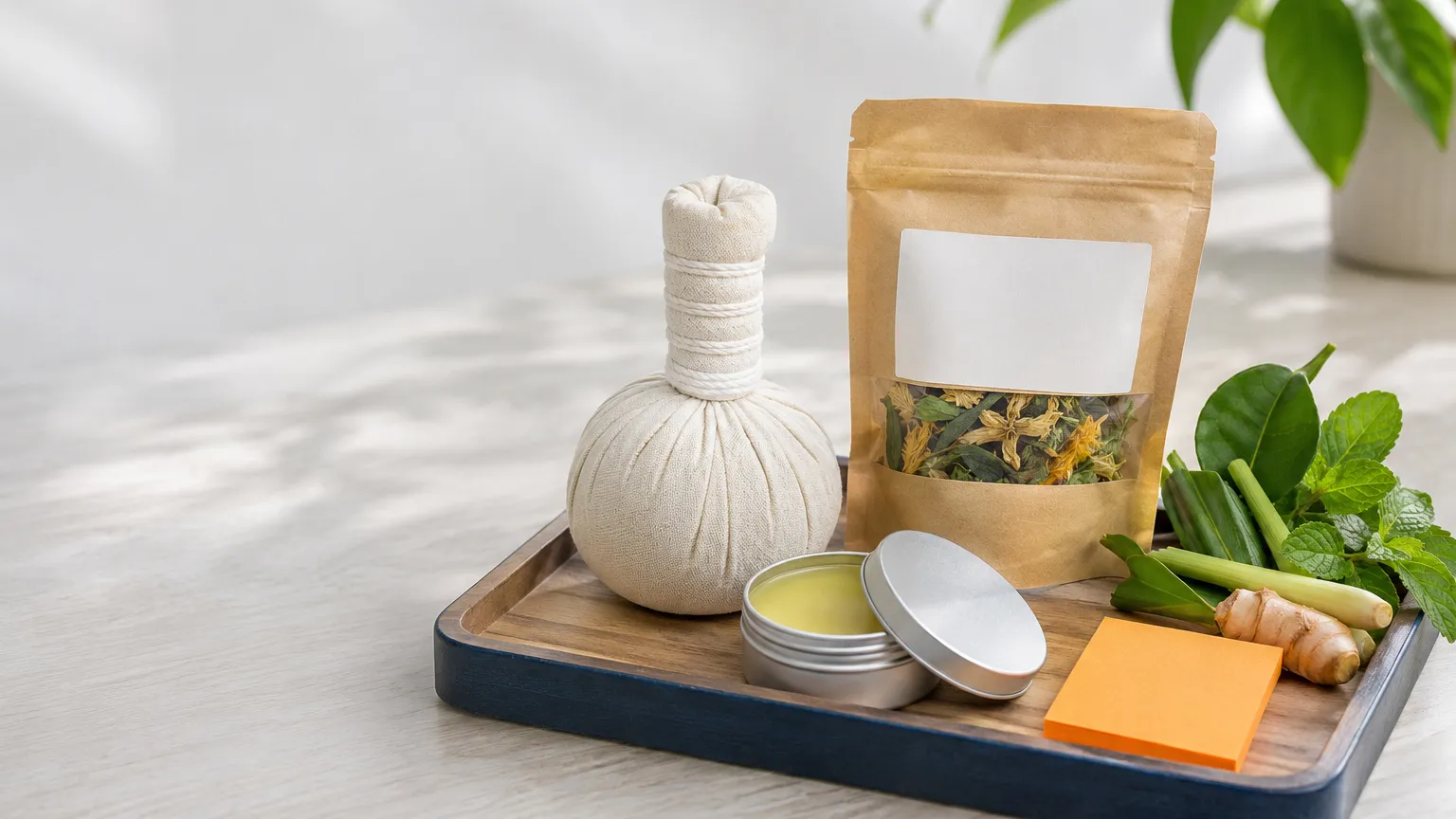
Clause 7 of the 2021 notification originally exempted only herbal compresses. Amendment No. 5 of 2026 (dated 14 August 2026) rewrote clause 7 so that herbal compresses, herbs for foot soaking and herbs for body steaming need no registration certificate, detailed notification receipt or notification receipt. The Thai FDA Secretary-General, with the committee's approval, may set further criteria.
This exemption concerns the product. The manufacturing licence is a separate matter. Amendment No. 2 of 2025 to the notification on herbal products requiring a licence, and the Thai FDA notification issued under it, exempt manufacturing only when the maker is a community enterprise or small farmer meeting the criteria, and the product is pieces of herbs for external use, in the relief-of-body-aches claim group, with directions to heat before use. Other manufacturers should check the licence conditions separately from the notification question.
General-sale herbal products and those sold only to health facilities
Besides the product authorisation route, herbal products are also grouped by sales channel, which affects the label and who may sell them.
General-sale herbal products
The 2026 MOPH Notification on general-sale herbal products replaces four earlier notifications. It defines them as products any seller may sell without a sales licence: medicines in its List 1, or medicines for conditions people can recognise themselves with claims in List 2, which must be simple to use, need no professional follow-up and not cause serious reactions. It also covers herbal health products meeting similar conditions and products made by simple processing of herbs. Products registered or notified before the notification took effect are treated as general-sale products, and pack sizes for these herbal medicines follow the Thai FDA notification on pack sizes of 2026, by claim group.
Products sold only to health facilities
The 2023 notification on herbal products sold only to health facilities requires manufacturers or importers to sell these products only to health facilities, or to licensed sellers who pass them on to health facilities. Amendment No. 2 of 2026 replaced List 1 with 18 Thai traditional formulas. These products do not suit a brand planning online or ordinary retail sales.
The sales channel must appear on the label. Under the 2025 committee notice on names and labels, general-sale products use a green frame and health-facility-only products a red frame.
Who can file and what documents to prepare
The 2020 Ministerial Regulation on registration, detailed notification and notification of herbal products allows two kinds of applicant: a holder of a herbal product manufacturing or import licence, and a person who hires such a licence holder. A brand owner without a factory can therefore file as the hiring party. Filing is mainly electronic, and the regulation says a notification receipt is issued when the formula matches the listed entry.
Section 47 of the Act requires a notification or detailed notification to include the product name, formula, container and pack size, certificate of analysis, label and leaflet. The 2022 notification on items to be submitted adds, for example:
- the application form attached to the Thai FDA notification (notification uses form JJ.1);
- for a hiring party: a certificate of hire and proof of the hirer's qualifications under section 19;
- documents for the authorised representative if the applicant is a company;
- an undertaking on post-market safety monitoring;
- colour photographs of the product;
- for imports: the Thai FDA letter on equivalence of the overseas manufacturing site;
- Thai translations of documents not in English, with a translation certificate.
To make samples before filing, the 2021 notification on producing or importing herbal products as samples lets a licensee notify on form TY.1 and produce or import the notified quantity, with labels stating clearly that the items are samples only.
- 1Confirm it is a herbal productNot a cosmetic, food or modern drug
- 2Find the matching entryCompare formula, method, dose and claims with the latest list
- 3Choose a licensed makerFile yourself as the hiring party, with a certificate of hire
- 4Prepare documentsFormula, pack size, analysis, label, leaflet and product photos
- 5Name and labelListed name plus trade name; label under the 2025 notice
Source: Herbal Products Act B.E. 2562 section 47 · Ministerial Regulation 2020 · Notification on items to be submitted 2022
Names and labels for notified herbal products
The Herbal Products Committee notice of 2025 on product names and on labels and leaflets of herbal products replaces the 2021 version. Main points:
- Name: must be in Thai, not numbers only, not mixing Thai and foreign letters, transliterated according to Royal Society rules, not boastful, misleading or similar to another product, and any claim word in the name must match what was authorised.
- Label: herbal medicines and herbal health products need 17 items, such as name, active ingredients and amounts, claims, manufacturer or importer, product type, sales channel, registration number, manufacture date and expiry date.
- Products that are not for oral use must carry the words "do not ingest" (in Thai) in red.
- Text size: the product name and registration number at least 2 millimetres high, and a foreign-language name no larger than the Thai name.
The Herbal Products Division Q&A on this notice adds that manufacture and expiry dates must show day, month and year; notified herbal health products may have a shelf life of up to 2 years for oral liquids and 3 years for other forms; and old-format labels may be used until 27 December 2028, or a label amendment can be filed at any time.
Label wording must match the claims in the notified entry. Claims not in the list, such as saying a product prevents or cures a disease the entry does not mention, cannot be added through the notification route.
Herbal soap Thai FDA rules and other common mix-ups
Searches about herbal soap and the Thai FDA often come from the belief that adding herbs makes a product a herbal product. Section 4 of the Herbal Products Act excludes cosmetics, so a soap used to clean the skin for hygiene or appearance is a cosmetic and is notified under cosmetics law, whatever herb it contains. See does soap need Thai FDA notification.
Similar mix-ups:
- Essential oils and massage oils may be cosmetics or herbal products depending on use and claims; see essential oil classification.
- Herbal teas and drinks sold as ordinary beverages are food, which the Herbal Products Act excludes, but some herbs, such as roselle, were added to the herbal health product list in 2022, so form, directions and claims matter.
- Products claiming symptom relief, such as relief of aches or itching: the Thai FDA cosmetic notification criteria say these are not cosmetics and fall under drugs or herbal products, so check whether they match a listed entry.
If your product is a herbal product and you plan to sell abroad, continue with exporting herbal products from Thailand.
Validity and renewal of a notification receipt
Section 49 of the Act gives detailed notification and notification receipts a five-year life. The Thai FDA notification on renewing registration certificates, detailed notifications and notifications of herbal products (dated 27 March 2026) sets out renewal:
- apply through the Thai FDA electronic system before the expiry date;
- if filed within one month after expiry, submit a request for leniency with reasons, and a statutory penalty applies;
- more than one month after expiry, the receipt cannot be renewed; a new notification is required and production or import must stop until it is granted;
- the existing receipt stays valid until a new one is issued or renewal is refused.
Plan for list changes too. When a new amendment is issued, an entry you notified under may change its formula, name or pack size. Your existing receipt stays valid until it expires, but compare the product with the latest list at renewal or when filing again. Find the latest notifications in our regulation archive, or ask our team to prepare the file through the registration and notification service.
Frequently asked questions
Does my herbal product need notification, detailed notification or registration?
Compare it with the latest lists. If the formula, method and wording match an entry, notify. If it differs only in name, non-active ingredients, method, dose, claims within the original scope or pack size, file a detailed notification. Anything beyond that needs formula registration.
Can a brand owner without a factory file a herbal product notification?
Yes, as the hiring party. The 2020 Ministerial Regulation lets a person who hires a licensed manufacturer or importer file, with a certificate of hire and proof of the qualifications set in the notification.
Does herbal soap need herbal product notification?
Generally no. Soap used to clean the skin is a cosmetic, and the Herbal Products Act excludes cosmetics, so herbal soap is notified under cosmetics law.
Do herbal compresses or foot-soak herbs need notification?
Amendment No. 5 of 2026 exempts herbal compresses, foot-soak herbs and body-steam herbs from registration, detailed notification and notification. The manufacturing licence is covered by a separate notification, which exempts only community enterprises and small farmers meeting its conditions.
How long is a herbal product notification receipt valid?
Five years under section 49 of the Act. Renew before expiry; more than one month after expiry it cannot be renewed and a new notification is needed.
Sources
พระราชบัญญัติ ผลิตภัณฑ์ สมุนไพร พ.ศ.2562 · Open source · Search our archiveกฎกระทรวง การขึ้นทะเบียน ตำรับผลิตภัณฑ์ สมุนไพร การแจ้งรายละเอียด และการจดแจ้ง ผลิตภัณฑ์ สมุนไพร พ.ศ. 2563 · Open source · Search our archiveประกาศ กระทรวง สาธารณสุข เรื่อง ชื่อ ประเภท ชนิดหรือลักษณะ ของผลิตภัณฑ์ สมุนไพร ซึ่งการผลิตหรือ นำเข้าเพื่อขาย ต้องได้รับใบสำคัญ การขึ้นทะเบียนตำรับ ใบรับแจ้งราย ละเอียด หรือใบรับ จดแจ้ง และชื่อ ปริมาณ และเงื่อนไข ของวัตถุที่อาจใช้ · Open source · Search our archiveประกาศ กระทรวง สาธารณสุข เรื่อง ชื่อ ประเภท ชนิดหรือลักษณะ ของผลิตภัณฑ์ สมุนไพร ซึ่งการผลิตหรือ นำเข้าเพื่อขาย ต้องได้รับใบสำคัญ การขึ้นทะเบียนตำรับ ใบรับแจ้งราย ละเอียด หรือใบรับ จดแจ้ง และชื่อ ปริมาณ และเงื่อนไข ของวัตถุที่อาจใช · Open source · Search our archiveประกาศ กระทรวง สาธารณสุข เรื่อง ชื่อ ประเภท ชนิดหรือลักษณะ ของผลิตภัณฑ์ สมุนไพร ซึ่งการผลิตหรือ นำเข้าเพื่อขาย ต้องได้รับใบสำคัญ การขึ้นทะเบียนตำรับ ใบรับแจ้งราย ละเอียด หรือใบรับ จดแจ้ง และชื่อ ปริมาณ และเงื่อนไข ของวัตถุที่อาจใช้ · Open source · Search our archiveประกาศ กระทรวง สาธารณสุข เรื่อง ชื่อ ประเภท ชนิดหรือลักษณะ ของผลิตภัณฑ์ สมุนไพร ซึ่งการผลิตหรือ นำเข้าเพื่อขาย ต้องได้รับใบสำคัญ การขึ้นทะเบียนตำรับ ใบรับแจ้งราย ละเอียด หรือใบรับ จดแจ้ง และชื่อ ปริมาณ และเงื่อนไข ของวัตถุที่อาจใช้ · Open source · Search our archiveประกาศ กระทรวง สาธารณสุข เรื่อง ชื่อ ประเภท ชนิดหรือลักษณะ ของผลิตภัณฑ์ สมุนไพร ซึ่งการผลิต นำเข้า หรือขายต้องได้รับใบอนุญาต (ฉบับที่ 2)พ.ศ.2568 · Open source · Search our archiveประกาศ สำนักงาน คณะกรรมการ อาหาร และยา เรื่อง หลักเกณฑ์ และเงื่อนไข สำหรับ วิสาหกิจ ชุมชนและเกษตรกร รายย่อยที่ไม่ต้อง ขอใบอนุญาต ผลิตผลิตภัณฑ์ สมุนไพร ประเภทลูกประคบ สมุนไพรสำหรับแช่เท้า สมุนไพรสำหรับอบตัว พ.ศ. 2568 · Open source · Search our archiveประกาศ กระทรวง สาธารณสุข เรื่อง หลักเกณฑ์ วิธีการ และเงื่อนไข ของผลิตภัณฑ์ สมุนไพร ขายทั่วไป พ.ศ. ๒๕๖๙ · Open source · Search our archiveประกาศ สำนักงาน คณะกรรมการ อาหาร และยา เรื่อง ขนาดบรรจุ ของยาจากสมุนไพร สำหรับ ผลิตภัณฑ์ สมุนไพร ขายทั่วไป พ.ศ.2569 · Open source · Search our archiveประกาศ กระทรวง สาธารณสุข เรื่อง หลักเกณฑ์ วิธีการ และเงื่อนไข ของผลิตภัณฑ์ สมุนไพร ที่ขายเฉพาะ ให้กับสถาน พยาบาล พ.ศ.2566 · Open source · Search our archiveประกาศ กระทรวง สาธารณสุข เรื่อง หลักเกณฑ์ วิธีการ และเงื่อนไข ของผลิตภัณฑ์ สมุนไพร ที่ขายเฉพาะ ให้กับสถาน พยาบาล (ฉบับที่ 2)พ.ศ. 2569 · Open source · Search our archiveประกาศ กระทรวง สาธารณสุข เรื่อง กำหนด รายการ ที่ต้องยื่นในการ ขอขึ้นทะเบียนตำรับ แจ้งรายละเอียด และจดแจ้งผลิตภัณฑ์สมุนไพร พ.ศ. 2565 · Open source · Search our archiveประกาศ กระทรวง สาธารณสุข เรื่อง กำหนด หลักเกณฑ์ วิธีการและเงื่อนไข เกี่ยวกับการแจ้ง การผลิตหรือนำ เข้าผลิตภัณฑ์ สมุนไพร เพื่อเป็นตัวอย่าง สำหรับ การขึ้นทะเบียน ตำรับการแจ้ง รายละเอียด หรือ การจดแจ้ง พ.ศ. 2564 · Open source · Search our archiveประกาศ คณะกรรมการ ผลิตภัณฑ์ สมุนไพร เรื่อง การแสดง ชื่อของผลิตภัณฑ์ สมุนไพร ในการขึ้นทะเบียนตำรับ แจ้งรายละเอียด หรือจดแจ้งผลิตภัณฑ์สมุนไพร และการแสดงฉลาก และเอกสาร กำกับผลิตภัณฑ์ สมุนไพร พ.ศ. 2568 · Open source · Search our archiveประกาศ คณะกรรมการ ผลิตภัณฑ์ สมุนไพร เรื่อง การแสดง ชื่อของผลิตภัณฑ์ สมุนไพร ในการขึ้นทะเบียนตำรับ แจ้งรายละเอียด หรือจดแจ้งผลิตภัณฑ์สมุนไพร และการแสดงฉลาก และเอกสาร กำกับผลิตภัณฑ์ สมุนไพร พ.ศ. ๒๕๖๘ · Open source · Search our archiveประกาศ สำนักงาน คณะกรรมการ อาหาร และยา เรื่อง การต่ออายุใบ สำคัญการขึ้นทะเบียนตำรับ การแจ้งรายละเอียด และการจดแจ้ง ผลิตภัณฑ์ สมุนไพร · Open source · Search our archiveประกาศ กระทรวง สาธารณสุข เรื่อง ชื่อ ประเภท ชนิดหรือลักษณะ ของผลิตภัณฑ์ สมุนไพร ซึ่งการผลิตหรือ นำเข้าเพื่อขาย ต้องได้รับใบสำคัญ การขึ้นทะเบียนตำรับ ใบรับแจ้งราย ละเอียด หรือใบรับ จดแจ้ง และชื่อ ปริมาณ และเงื่อนไข ของวัตถุที่อาจใช · Open source · Search our archiveหลักเกณฑ์ การพิจารณา การจดแจ้งเครื่อง สำอาง (ฉบับปรับปรุง พ.ศ. 2564) · Open source · Search our archive- 2.2
คำขอจดแจ้งผลิตภัณฑ์ สมุนไพร (แบบ จจ.1) · Open source · Search our archive
This article is for general information. It is not a Thai FDA ruling or legal advice, and rules change — check the latest notification or ask an expert before filing or producing.
Related articles
 Brand ownersSelling essential oils in Thailand: cosmetic, herbal product or hazardous substance?Essential oil Thailand rules: when an oil is a cosmetic, herbal product, hazardous substance or OCPB product, plus banned fragrance materials, Piperonal.
 Brand ownersDoes soap need Thai FDA notification? Cosmetic vs herbal soapMost soap is a cosmetic and must be notified. Claims about health, disease or use on animals move it to other laws. See where the line falls.

 ExportersExporting Thai herbs: raw material vs extract vs finished productExport Thai herbal products: raw herbs, extracts and finished products fall under different rules, licences, GMP standards and Thai FDA certificates.