 FDA Thailand
 Factories / OEM
Dietary Supplement Lab Testing in Thailand: What to Test Before Filing and Selling

Dietary supplement lab testing in Thailand: why results are needed before sale
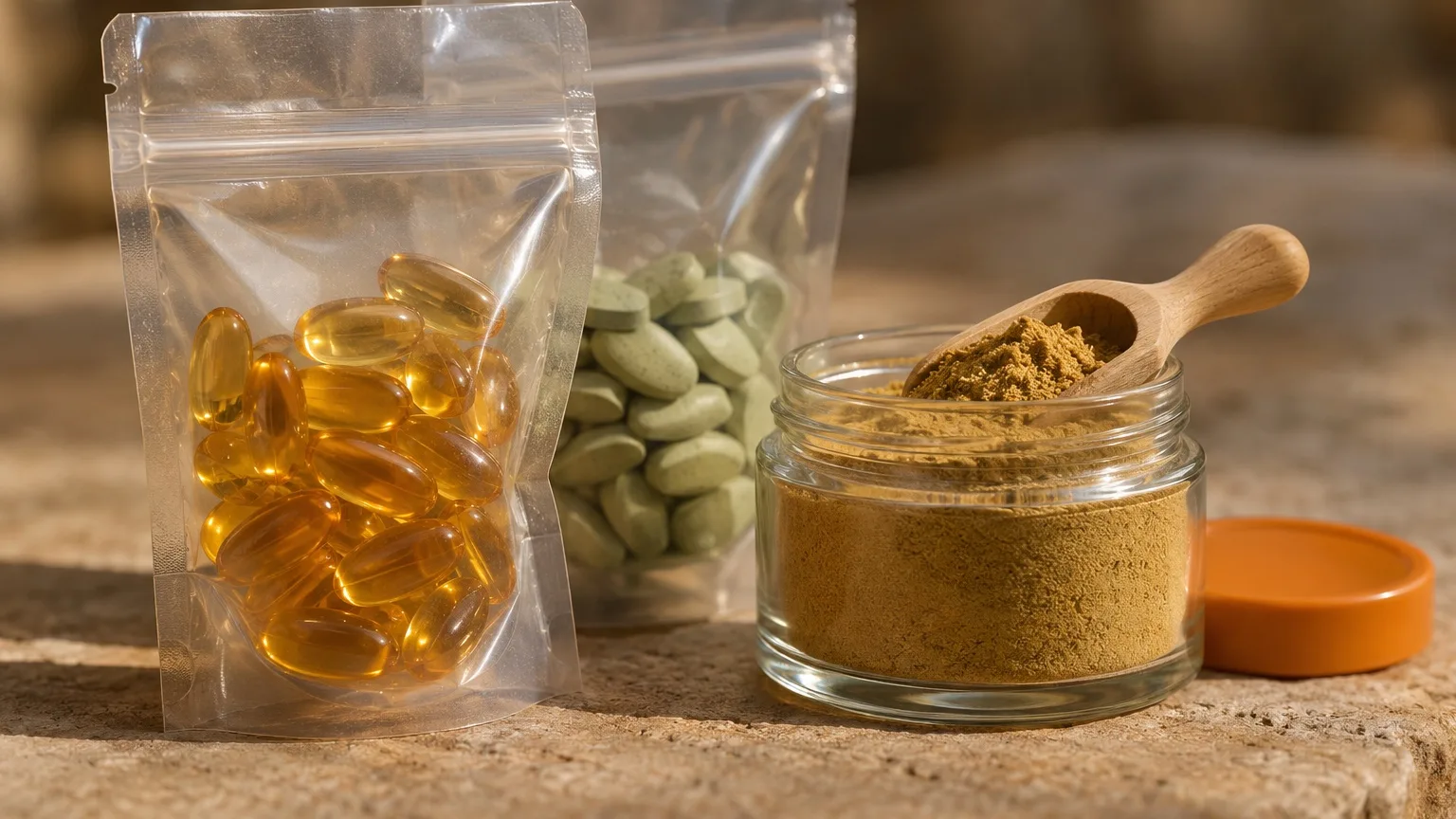
Dietary supplement lab testing Thailand-wide follows one pattern: you send samples of the finished supplement to a laboratory to show that it meets the quality standard set by law: micro-organisms, heavy metals and the amount of each vitamin or key ingredient declared in the formula. The result is an analysis report, a document that brand owners and factories need from the Thai FDA application through to the years after the product is on the shelf.
Manufacturers usually ask two questions: what must a supplement be tested for before it can be sold, and which lab tests does a supplement factory have to run. The short answer is that dietary supplements are a food with prescribed quality or standards, so the test list is written fairly clearly into the notifications. Many ordinary foods are different: the producer chooses tests by risk.
Three main test groups
- Micro-organisms: E. coli and three pathogens, under the Thai FDA Notification of 10 January 2006
- Contaminants, especially heavy metals, under Ministry of Public Health (MOPH) Notification No. 414 (2020) on food containing contaminants
- Key ingredient content: vitamins, minerals, amino acids or fatty acids that are key ingredients claimed on the label
The general rules for choosing a laboratory for any food are covered in which results the Thai FDA asks for and which labs qualify. This article stays with supplements.
Notification No. 293 and its amendments: the quality standard in law
The core rule is MOPH Notification No. 293 (B.E. 2548, 2005) on dietary supplements. It defines a dietary supplement as a product taken in addition to normal food, containing nutrients or other substances, in the form of tablets, capsules, powder, flakes, liquid or another form that is not a conventional food.
Clause 5: the quality the product must meet
Clause 5 of Notification No. 293 sets five quality requirements, which are the origin of almost every test on the list.
- The product has the characteristics of its type.
- Pathogenic micro-organisms are not above the levels set by the Thai FDA.
- E. coli is less than 3 per gram of food by the MPN (Most Probable Number) method.
- Microbial toxins, pesticide residues, other toxic substances, contaminants and veterinary drug residues are not above the levels in the MOPH notification on each subject.
- Vitamin or mineral content meets the criteria, for products intended to provide vitamins or minerals.
Clauses 6 to 8 of the same notification require compliance with the notifications on food additives, production methods (GMP) and containers.
Amendments to know
- No. 309 (2007) changed the advisory statement and warning on the label.
- No. 405 (2019) amended clause 4 so that dietary supplements are a food with prescribed quality or standards, and together with No. 411 (2019) revised label statements and warnings.
- No. 448 (2023) replaced clause 5(5), setting the kinds and maximum daily amounts of vitamins and minerals in an annexed list of 26 entries.
The Thai FDA notification that fills in clause 5
Notification No. 293 does not name the pathogens itself; it leaves that to the Thai FDA. The notification in use is the Thai FDA Notification on evidence and documents for applying to use a dietary supplement label, and quality standards for pathogenic micro-organisms, dated 10 January 2006. Clause 1 lists the documents and analysis results; clause 2 sets the pathogen criteria.
Applying for a Thai FDA number: which lab results go with the application
The full application procedure is in registering a dietary supplement in Thailand. This section looks only at the lab results.
Every application carries a product analysis report
The Thai FDA explanatory notice on Notifications No. 405 and No. 411 explains that the old split in filing routes under clause 4 has been removed. Supplements whose key ingredients are on the list and those that are not are filed with the same evidence: the formula, the quality or standard of the raw materials, and an analysis report on the product.
Results listed in the 2006 Thai FDA notification
Clause 1(5) of the notification of 10 January 2006 lists the product results to be shown:
- pathogenic micro-organisms under clause 2 of the same notification
- E. coli below 3 per gram of food by the MPN method
- contaminants: arsenic and lead
- vitamins, minerals, amino acids and fatty acids, where they are key ingredients claimed on the label or accompanying documents
- protein, and the kinds and amounts of amino acids, for products containing algae or using the word "protein" in the food name
- 10-hydroxy-2-decenoic acid (10-HDA) for products containing royal jelly
The same notification also asks for the raw material specification for key ingredients, the formula and the production process. For an extract, the solvent and the extract ratio must be stated.
The finished product specification in the 2026 Thai FDA guide
The Thai FDA Guide to applying for dietary supplements (revised 2026) brings the finished product specification together in chapter 8, split into physical, contaminant, microbiological and other quality items. In practice, use that list as the frame for your test order.
After the number is issued
The same guide says that when the product is first manufactured or imported for sale, the original set of the product analysis report must be sent to the Thai FDA, and a copy must be kept at the premises for officers to inspect during post-market surveillance.
Microbiological testing: the four organisms every report must cover
Microbiological testing of dietary supplements uses the criteria of the Thai FDA notification of 10 January 2006 together with clause 5(3) of Notification No. 293. It does not use MOPH Notification No. 416 (2020), which covers pathogens in ordinary foods. The Thai FDA explanatory notice on No. 416 states that it does not apply to dietary supplements, because pathogen requirements already exist under the 2006 notification.
The four criteria
- Escherichia coli: less than 3 per gram of food, by the MPN (Most Probable Number) method
- Staphylococcus aureus: not detected in 0.1 g of food
- Clostridium spp.: not detected in 0.1 g of food
- Salmonella spp.: not detected in 25 g of food
Read the units correctly
These criteria are not in colony-forming units per gram (cfu/g) from a plate count. E. coli uses MPN, a statistical estimate of the most probable number of organisms from tubes at several dilutions, so the report usually reads "less than 3 MPN/g". The three pathogens are presence or absence tests in a fixed sample amount, reported as "not detected" per weight tested.
The Food Division guide listing finished product tests under GMP 420, condition 6, says results must be reported in the same unit as the notification. In practice, if a Salmonella result reads "not detected in 1 g", ask the lab to test 25 g.
In practice, formulas built on plant or vegetable powders are more likely to carry micro-organisms than pure substances, so ask for a microbiological result on each raw material lot. Formulas with probiotics have their own rules, covered in probiotics in food.
Heavy metals and other contaminants in dietary supplements
Heavy metal testing of a dietary supplement uses List No. 1 of MOPH Notification No. 414 (2020) on food containing contaminants, which has rows written for dietary supplements. All values apply to the product as consumed, in milligrams per kilogram of food (mg/kg), which is the same as parts per million.
- Cadmium: not more than 0.3 mg/kg
- Lead: not more than 1 mg/kg
- Total mercury: not more than 0.5 mg/kg
- Total arsenic: not more than 2 mg/kg
The revised 2026 Thai FDA guide uses these four values as the contaminant specification for the finished product. The 2006 Thai FDA notification lists only arsenic and lead in its results, and says that products containing aquatic animals or seafood use inorganic arsenic, not more than 2 mg per kg of food. In practice, if the formula contains fish oil, fish collagen or seaweed, ask the lab whether it reports total or inorganic arsenic and pick the one that matches the specification you are filing.
Risk-based contaminants
The revised 2026 guide lists other quality items, such as tin not more than 250 mg/kg and total aflatoxin (B1+B2+G1+G2) not more than 20 micrograms per kg, with a note that both depend on the risk of contamination. In practice, formulas based on nuts, cereals or spices should include aflatoxin.
If the substance is not in the list
Clause 4 of Notification No. 414 uses List No. 1 first; if a substance is not there, the latest CODEX STAN 193-1995 applies; if it is not there either, the manufacturer or importer must prove that the level is acceptable.
Substances that should not be found
The GMP 420 test-list guide, condition 4, says other tests, including substances prohibited in food that the guide does not list, are decided by producers and inspectors according to local contamination risk or when there is reason for suspicion. In practice, weight-management or performance formulas should consider screening for modern drugs that do not belong in food, and brand owners should write into the manufacturing contract that no raw material outside the filed formula may be used.
The Thai FDA explanatory notice states that food not meeting the contaminant standard is substandard food under section 28, with a penalty under section 60 of the Food Act B.E. 2522 (1979).
Source: MOPH Notifications Nos. 293, 414 and 448 · Thai FDA notification of 10 January 2006 · Thai FDA Guide to applying for dietary supplements, revised 2026
Active ingredient content: vitamins, minerals, amino acids and extracts
Testing for content proves that what the formula and label declare is actually in the product, and that it does not exceed the legal ceiling.
Vitamins and minerals
Notification No. 448 (2023) sets the kinds and maximum daily amounts of vitamins and minerals in its annex, and a product intended to provide vitamins or minerals must contain at least 15 percent of the Thai Recommended Daily Intake (Thai RDI). The GMP 420 test-list guide shows these as ranges, for example vitamin C 15 to 1,000 mg. The full set is in Thai dietary supplement labels and vitamin limits and vitamin C supplement labels.
The same guide sets tolerances between the analysis and the label: for added vitamins and minerals, at least 100 percent of the label amount must be found, without exceeding the permitted maximum. In practice, some vitamins fall during storage, so formulas often include an overage, but it must not push the product over the ceiling. See food shelf life testing.
Amino acids
The Thai FDA Notification on requirements for amino acids as key ingredients of dietary supplements limits each amino acid to the maximum in its annexed table, and where several forms of the same amino acid are used, the total must not exceed the maximum for that amino acid. In practice, the report should show each claimed amino acid separately.
Plant extracts and other listed substances
The Thai FDA Notification giving advice on key ingredients in dietary supplements, dated 8 July 2024, lists plants, animal materials and other substances with the part used, active substance, process or extraction solvent, and conditions, mostly maximum daily amounts. If the source, part used or process falls under foods that need a safety assessment, that assessment must be filed first. The ingredient search tool shows the conditions for each entry.
The 2006 Thai FDA notification asks for the method of analysing the active substance or marker in the raw material when the amount of the active substance is claimed. In practice, ask the lab to use the same method on the finished product.
When to test: before filing, first lot, after changes and every year
Lab results are not used only once at filing. There are four points in time.
1. Before filing for the food serial number
The application carries the product analysis report, as the explanatory notice on Nos. 405 and 411 sets out. The revised 2026 Thai FDA guide says the report must be an original not older than 1 year, counted from the date the report was issued to the date of filing.
2. The first lot made or imported for sale
The original set of the analysis report goes to the Thai FDA, under chapter 12 of the guide. The GMP 420 test-list guide, condition 5, also says every product made for sale for the first time is to be sampled and tested.
3. Every year after that
MOPH Notification No. 420 (2020) on GMP, clause 3.9.1 of the basic requirements, says the finished product must meet the relevant notifications, with analysis results from a government laboratory or an accredited laboratory at least once a year. Producers with many products may sample by risk factors, as the test-list guide allows.
4. When the formula, raw material supplier or process changes
This is practice, not wording in a notification. In practice, when you change the supplier of a key raw material, the growing source, the extraction solvent or the production line, retest the first lot after the change for the items affected, such as heavy metals after changing a seaweed source. If the change affects the filed formula, check with the Thai FDA whether an amendment or a new application is needed, because the guide says the product must match the details filed.
Contract manufacturers should agree with the brand owner at contract stage who sends samples and who holds the reports. See hiring a supplement OEM factory.
- 1Trial batch and testingA lot made with the formula and process you will file
- 2File for the food serial numberAttach an original report not older than 1 year
- 3First lot made or importedSend the original set of results to the Thai FDA
- 4Test the finished product yearlyAt least once a year under GMP 420 clause 3.9.1
- 5Change of raw material or processPractice: retest the items affected
Source: Explanatory notice on Nos. 405 and 411 · Notification No. 420 · Thai FDA Guide to applying for dietary supplements, revised 2026 · last step is practice
COA versus a report from an ISO/IEC 17025 accredited laboratory
Producers receive two kinds of test document. Both get called a "COA", but they are not always interchangeable.
Certificate of Analysis (COA)
In practice, a COA is usually issued by the raw material maker or the factory itself, summarising that a lot meets the maker's specification. It may come from an in-house laboratory and may not name the method. A COA is therefore suited to controlling incoming raw materials.
The Thai FDA explanatory notice on contaminants gives an example of using a COA: where the finished product has no specific maximum but a raw material does, the producer must hold evidence such as an analysis report or COA showing raw material control under GMP.
A report from an accredited laboratory
Clause 1(5) of the 2006 Thai FDA notification says results used for filing must come from a Thai or foreign government agency, a body assigned or recognised by that country's government, or a body accredited by a laboratory accreditation body to international standards. The GMP 420 test-list guide gives ISO/IEC 17025 as an example, and says a COA from such a laboratory may be used.
How to read a report
In practice, check these seven points:
- Laboratory name, accreditation number, and whether each test is within the accredited scope
- Product name, brand, lot or batch number and production date match the filing
- Date samples were received and date the report was issued
- Method name, such as ISO, AOAC or FDA BAM
- Sample amount and unit match the criterion, such as Salmonella in 25 g
- Limit of detection or quantification (LOD/LOQ) below the criterion
- Signature of the authorised signatory
Point 6 matters for heavy metals. A lead result of "less than 2 mg/kg" does not prove compliance when the limit is 1.
Choosing a laboratory and preparing samples so the report can be filed
Choosing a laboratory
Chapter 11 of the revised 2026 Thai FDA guide names the bodies whose results are accepted: Thai and foreign government agencies, bodies assigned or recognised by government, and bodies accredited by a laboratory accreditation body to international standards. The guide points to the list of food laboratories accredited to ISO/IEC 17025 kept by the Bureau of Laboratory Quality Standards, Department of Medical Sciences.
In practice, ask for the laboratory's accredited scope and compare it line by line with your test order. A lab accredited for heavy metals may not be accredited for microbiology. Splitting samples across laboratories is allowed, with conditions covered in the next section.
Accepted methods
List No. 2 of Notification No. 414 says contaminant methods must be Codex methods, methods published by national or international standards bodies, or methods with validation documented and verifiable under the latest ISO/IEC 17025. The Thai FDA Notification on food analysis of 1 August 2024 applies a similar approach to chemical and physical tests.
Preparing samples
The following is practice that helps the report pass first time.
- Send the finished product in its retail pack, not the bulk blend, because limits apply to the product as consumed.
- Take all samples from one lot, and mark the lot number and production date on each.
- Ask the lab how many grams or capsules each test needs: Salmonella needs 25 g, and several vitamin tests need extra sample.
- Write the product name and brand on the sample form exactly as on the application.
- Give the lab the declared amount per serving so it can report in a unit that compares directly, such as mg per capsule or mg per day.
Why applications come back over lab results, and a pre-filing checklist
Chapter 11 of the revised 2026 Thai FDA guide describes the reports that can be filed. The list below comes from experience with real applications, not from the wording of a notification, roughly in order of frequency.
Common reasons
- The report is older than 1 year, or is a copy. The guide requires an original not older than 1 year from issue to filing.
- Tests missing from the product specification, such as no Clostridium, no mercury or cadmium, or no result for a vitamin claimed on the label. The guide says the report must be complete against the supplement quality specification.
- Several labs, different lots. The guide allows results from several bodies, but they must be from the same production lot, and each report must state the lot.
- Names on the report do not match the application. If the food name, brand or premises differ, a letter must certify that the sample has the same formula as filed, with the reason explained.
- Retests at a different laboratory. The guide says repeat or extra analyses go to the original body unless it cannot run that test, with an explanatory letter.
- Detection limit above the criterion, or the wrong unit, such as heavy metals in mg per capsule when the limit is in mg/kg.
- Using another product's results. A shared report is possible when the formula, process and premises match an approved product, and results belonging to someone else need the owner's written consent.
The guide also says products with certain ingredients need additional reports. If you are unsure which extra tests your formula needs, the Thai FDA advisor walks through it by product type. Once the number is issued, buyers can check it using the 13-digit Thai FDA number.
- ✓Accepted laboratoryGovernment body, or accredited to international standards such as ISO/IEC 17025
- ✓Complete against the product specificationFour micro tests, heavy metals and claimed substances
- ✓Original, not older than 1 yearFrom issue date to filing date
- ✓One production lotEvery report states the lot number
- ✓Product name matches the applicationIf not, prepare a letter certifying the same formula
- ✓Units and detection limitsDirectly comparable with the criteria
Source: Thai FDA notification of 10 January 2006 · Thai FDA Guide to applying for dietary supplements, revised 2026, chapter 11
Frequently asked questions
What must a dietary supplement be tested for before filing in Thailand?
Four microbiological results, heavy metals under Notification No. 414, and the vitamins, minerals, amino acids or fatty acids claimed on the label. Formulas with algae or royal jelly need extra tests.
Can a supplier COA replace testing of the finished product?
No. A raw material COA supports the raw material specification, but the application needs a report on the finished product from a government agency or an accredited laboratory.
Do supplements use the pathogen criteria of Notification No. 416?
No. The Thai FDA explanatory notice says No. 416 does not apply to dietary supplements, because criteria already exist in the Thai FDA notification of 10 January 2006.
How long is a lab report valid for filing?
The revised 2026 Thai FDA guide says it must be an original not older than 1 year, counted from the issue date to the filing date.
Is testing needed after the number is issued?
Yes. The original set of results goes to the Thai FDA for the first lot made or imported for sale, and under GMP Notification No. 420 clause 3.9.1 the finished product needs results from a government or accredited laboratory at least once a year.
Can tests be split across several laboratories?
Yes. The Thai FDA guide allows results from several bodies, but samples must come from the same production lot and each report must state the lot. Retests go back to the original laboratory.
Sources
- MOPH Notification No. 293 (B.E. 2548) on dietary supplements · Open source · Search our archive
- MOPH Notification No. 309 (B.E. 2550) on dietary supplements (No. 2) · Open source · Search our archive
- MOPH Notification No. 405 (B.E. 2562) on dietary supplements (No. 3) · Open source · Search our archive
- MOPH Notification No. 411 (B.E. 2562) on dietary supplements (No. 4) · Open source · Search our archive
- MOPH Notification No. 448 (B.E. 2566) on dietary supplements (No. 5) · Open source · Search our archive
- Thai FDA explanatory notice on MOPH Notifications on dietary supplements (No. 3) and (No. 4) · Open source · Search our archive
- Thai FDA Notification on evidence and documents for dietary supplement label applications and pathogenic micro-organism standards (10 January 2006) · Open source · Search our archive
- Thai FDA Notification on requirements for amino acids as key ingredients of dietary supplements · Open source · Search our archive
- Thai FDA Notification giving advice on key ingredients in dietary supplements (8 July 2024) · Open source · Search our archive
- MOPH Notification No. 414 (B.E. 2563) on standards for food containing contaminants · Open source · Search our archive
- Thai FDA explanatory notice on the MOPH Notifications on food containing contaminants · Open source · Search our archive
- Thai FDA explanatory notice on MOPH Notification No. 416 (B.E. 2563) on pathogenic micro-organisms · Open source · Search our archive
- MOPH Notification No. 420 (B.E. 2563) on production methods, equipment and storage of food (GMP) · Open source · Search our archive
- Food Division guide: finished product tests under GMP 420 · Open source · Search our archive
- Thai FDA Notification on food analysis (1 August 2024) · Open source · Search our archive
- Thai FDA Guide to applying for dietary supplements (revised 2026) · Open source · Search our archive
This article is for general information. It is not a Thai FDA ruling or legal advice, and rules change — check the latest notification or ask an expert before filing or producing. Spotted an error? Tell us and we will correct it
Related articles
 Factories / OEMFood Shelf Life Testing in Thailand: What the Law Requires and How to Set a Defensible DateFood shelf life in Thailand: who sets the date, expiry vs best before, real-time and accelerated testing, Q10, what to measure and records to keep.
 Factories / OEMFood Testing Lab in Thailand: Which Results the Thai FDA Asks For, When, and Which Labs QualifyFood testing lab in Thailand: which labs the Thai FDA accepts, when nutrition, contaminant and microbiology results are needed, and how to send samples.
 Brand ownersThailand probiotic food regulation: what the Thai FDA notice of 23 Nov 2026 changes, strain lists, 10⁶ CFU and evidenceThailand probiotic food regulation under the Thai FDA notice of 23 Nov 2026: species and strain lists, precautions, 10⁶ CFU per gram, evidence to keep.