 FDA Thailand
 Factories / OEM
Food Shelf Life Testing in Thailand: What the Law Requires and How to Set a Defensible Date

Food shelf life testing in Thailand: what the law actually requires
Food shelf life testing in Thailand answers one practical question: how long does your product stay safe and keep the quality you intend, when stored as the label says? The answer is the date printed after the Thai words for "expiry" or "best before" on every pack.
New producers often ask whether the Thai FDA sets a fixed number of days for each food. For most foods it does not. The labelling rules say which date must appear and how, but the number of days is for the producer or importer to establish, and they must be able to explain where it came from.
The rules that apply directly
- MOPH Notification No. 450 B.E. 2567 (2024) on labelling of food in containers, as amended by No. 474 B.E. 2569 (2026, in force 31 October 2026), requires an expiry or best-before date and storage instructions where relevant. Digital labels are allowed, but the expiry date must stay on the pack.
- MOPH Notification No. 174 B.E. 2539 (1996) prohibits importing or selling food past its labelled expiry or best-before date for six groups, including infant foods, fermented milk, pasteurised milk and foods for special dietary uses.
- MOPH Notification No. 420 B.E. 2563 (2020) on GMP requires records to be kept for at least one year after the labelled expiry date, and finished products to be tested at a government or accredited laboratory at least once a year.
- Product-specific standards for milk, drinking water and hermetically sealed food, covered in section 3.
How to print the date (day, month and year, or month and year only, and where on the pack) is covered in our guide to Thai food label requirements. This article covers the other half: how to arrive at a number you can defend.
Expiry date or best before: which to use and who sets the date
The labelling notification defines two terms.
- Expiry
(หมดอายุ) is the date marking the end of the food's quality under the storage conditions stated on the label. - Best before
(ควรบริโภคก่อน) is the date marking the end of the period in which the food keeps its good quality; after it, quality may change.
For sales purposes both work the same way, because both definitions say the food may not be sold after the date shown. The Thai FDA's explanatory notice therefore states that the date on the label must be the same as or later than the date of sale. Put simply, a product must not be sold past its label date, and this duty applies to producers, importers and sellers alike.
Choose the term that fits the product
Producers may use either term unless a product-specific notification says otherwise; for example, the novel food notification (No. 376) requires both a production date and an expiry or best-before date. In practice, if what limits the life is safety, such as microbial growth in a moist chilled food, "expiry" communicates better. If it is quality, such as a snack losing crispness or turning rancid, "best before" fits better.
The shelf life you establish also sets the date format: foods with a shelf life of 90 days or less must show day, month and year, while longer-life foods may show month and year only. Details are in our article on food label requirements.
Who sets the date
For food made in Thailand, the producer named on the label sets it. If you use a contract manufacturer, agree in writing who runs the study, who keeps the data and who signs off the final number.
For imported food, the foreign manufacturer's date is the starting point, but the importer should ask for the shelf-life data behind it and check whether the test conditions resemble Thai transport and retail. A product tested at room temperature in a temperate country may deteriorate faster in a Thai warehouse.
Foods whose own standards already fix storage or shelf life
Some foods have their own quality standards, and several of these say something specific about storage or shelf life. Producers in these categories have less freedom than producers of general foods.
| Food | What the notification sets |
|---|---|
| Pasteurised cow's milk, flavoured milk and milk products (Nos. 350, 351, 352) | Stored at no more than 8 °C; consumption period no more than 10 days from filling unless a longer period is approved under the Thai FDA criteria · total bacteria no more than 50,000 per millilitre up to the expiry date |
| Fermented milk, non-heated after fermentation or pasteurised (No. 353) | Stored at no more than 8 °C; no more than 30 days from filling unless the Thai FDA approves control measures |
| Sterilised and UHT milk | Held at ambient temperature for at least 5 days before release, for quality checks |
| Hermetically sealed food (No. 469) | No fixed number of days, but low-acid food (pH above 4.6 and water activity above 0.85) must contain no microorganisms able to grow during storage at ambient temperature |
| Drinking water in sealed containers (No. 462) | No fixed number of days; the explanatory notice allows the abbreviations MFD, BB or EXP with the dates |
| Foods containing probiotics (Nos. 339 and 346) | At least 106 CFU (colony-forming units) of live organisms per gram throughout the shelf life |
What evidence the Thai FDA accepts: the pasteurised milk extension criteria
The Food Committee's criteria for extending the consumption period of pasteurised milk show most clearly what kind of evidence the authority expects. The shelf-life study can be either the company's own study with references showing the method is internationally accepted, or data from textbooks or journals where the formula, heat process and storage temperature match the company's. Either way, there must be test results from a government or accredited laboratory on samples kept to the last day of the claimed life, and the highest-risk formula may represent the range, for example full-fat milk instead of low-fat, because fat drives rancidity.
These criteria apply only to pasteurised milk, but the logic is a good model for planning any food. See also hermetically sealed food under Notification 469 and bottled drinking water GMP.
What makes a food's shelf life short or long
Before designing a test, decide how your product is most likely to fail. The failure mode determines what you measure and whether accelerated testing is useful at all. Shelf life is usually limited by one of three kinds of change.
- Microbial: bacteria, yeasts and moulds grow until the food sours, turns slimy, grows mould or the pack swells. Sometimes pathogens increase with no visible sign.
- Chemical: fats oxidise and turn rancid, browning develops between sugars and proteins, vitamins decline and natural colours fade.
- Physical: crisp snacks absorb moisture and go soft, powders cake, bread stales, emulsions separate and drinks form sediment.
Factors inside the food
Water activity (aw) measures the free water available to microbes and chemical reactions, on a scale from 0 to 1. It differs from moisture content, because sugar and salt bind water. pH measures acidity. Notification 469 uses pH 4.6 and aw 0.85 as the boundaries for low-acid food. As general food science, most pathogenic bacteria struggle to grow below an aw of about 0.85, but some yeasts and moulds still can, so dry foods tend to be limited by mould or chemical change rather than bacteria. Fat type, sugar, salt and any permitted preservatives or antioxidants also matter.
External and process factors
Temperature has the strongest effect, followed by humidity, light and oxygen, all controlled through packaging and distribution. Thailand is hot and humid most of the year, so think about real trucks and warehouses, not an air-conditioned development lab. Heat process, filling temperature and line hygiene set the starting microbial load, so a shelf life established on one line holds only for that line under the same GMP system. See GMP 420 requirements for the basics.
Determining shelf life: start from the data you already have
Determining shelf life does not always start from zero. Existing information helps you set a target and shorten the test. Useful starting points include:
- Textbooks and journals covering the same food type under similar storage conditions.
- Your own existing products with a sales history, such as a new flavour on an established base recipe.
- Supplier data on raw materials, since a finished product should rarely outlast its fastest-deteriorating key ingredient.
- Packaging data, such as the oxygen and water vapour transmission rates of the film.
These are starting points, not final answers. If your formula, packaging or heat process differs from the reference, confirm with data on your own product.
Write a study plan before you start
A study protocol should state the product and pack, how it is stored from factory to consumer, the most likely failure mode, the target shelf life, whether you will use real-time testing, accelerated testing or both, what you will test and the end-point for each test, how many batches, when samples will be pulled, and how much safety margin you will subtract before printing a date.
For chilled foods with pathogen risk, some cases need specialist microbiological work, such as a challenge test in which organisms are deliberately added to the food. This must only be done in a laboratory equipped for biological safety.
- 1Define the product and real storageFormula, pack, and the route from factory to consumer
- 2Identify the likely first failureMicrobial, chemical or physical
- 3Gather existing dataLiterature, own products, raw material and packaging data
- 4Write the study planMethod, tests, end-points and time points
- 5Run real-time tests, plus accelerated if suitableProduction batches in the real sales pack
- 6Subtract a margin and set the label dateKeep the file ready for inspection
Source: Criteria for extending the consumption period of pasteurised milk (Food Committee meeting 7-2/2556) and general food science practice
Real-time shelf life testing
Real-time shelf life testing means storing the product under the same or similar conditions it will meet in practice, then pulling samples at intervals until past the target date. It takes time, but it is the most convincing evidence, because nothing has to be inferred from high-temperature results.
Storage conditions
- Ambient foods: many factories use 30 °C and 75% relative humidity, the long-term condition for hot, humid climates in the ASEAN stability guideline for drug products. It was written for medicines, but it reflects Thai conditions far better than an air-conditioned room.
- Chilled foods: store at the labelled temperature and run a second set slightly warmer, to mimic retail cabinets that do not hold temperature well.
- Frozen foods: store as labelled and consider simulating thaw and refreeze during transport.
Samples, batches and time points
Use the product in its real sales pack, from production-scale or near-production batches, typically two or three batches to see batch-to-batch variation. Small kitchen-scale trials help set a target but are not enough to set a label date. Each time point needs enough units for every test plus spares, so calculate quantities before production.
Sample more often early on and around the target, and continue beyond it. A 12-month target might be tested at months 0, 1, 3, 6, 9, 12 and 15; a chilled food with a 10-day target at days 0, 3, 5, 7, 10 and 12. For sensory tests, keep a reference sample that changes as little as possible for comparison.
Log the temperature and humidity of storage throughout, including any power cuts or cabinet failures.
Accelerated shelf life testing and Q10: how far can it go
Accelerated shelf life testing stores the product at higher temperature or humidity than in real life, so it deteriorates faster, and then back-calculates how long it would last under real conditions. It is most useful for comparing several formulas or packs quickly.
What Q10 means
Q10 is how many times faster deterioration runs when temperature rises by 10 °C. The conversion is: shelf life at the real temperature equals shelf life at the test temperature multiplied by Q10 raised to the power of (temperature difference divided by 10).
Example: a snack sold at 30 °C is tested at 45 °C and fails at week 8. With a Q10 of 2 the factor is about 2.8, giving roughly 22 weeks at 30 °C. With a real Q10 of 3 the factor is about 5.2 and the estimate becomes roughly 42 weeks. One assumption nearly doubles the answer, so Q10 should be measured on your own product at two or three temperatures, not assumed.
Limits you need to know
- Fats melt: chocolate, butter and cream fillings change state at high temperature in ways that never happen in use.
- Reactions accelerate unevenly: browning may speed up much more than rancidity, so the calculated life is limited by the wrong mechanism.
- Some changes slow down when warm: bread stales fastest in the fridge.
- Microbes do not follow a simple Q10: some die at high temperature and others take over, so this approach does not suit chilled foods or foods limited by microbial spoilage.
- Packaging changes: many films let through more moisture and oxygen when hot.
The sensible approach is to use accelerated tests to screen formulas and estimate a first shelf life, and to start real-time testing in parallel on day one. If you must launch first, print a short, cautious date and extend it once real-time data confirm. The ASEAN drug stability guideline offers a useful frame of reference: extrapolation beyond real-time data of no more than twice the period covered and no more than 12 months beyond it. Food has no such binding rule.
●Good for estimating shelf life
- Dry, low-aw foods limited by a single chemical reaction
- Comparing several formulas or packs at once
- Data at several temperatures to measure the real Q10
●Usable with care
- High-fat foods prone to rancidity
- Crisp snacks limited by moisture, as films pass more vapour when hot
- Foods prone to browning
●No substitute for real-time data
- Chilled or frozen foods
- Foods limited by microbial spoilage
- Chocolate, butter and cream fillings that melt
- Bread that stales fastest when cold
General technical practice, not a Thai FDA requirement.
Food analysis: what to measure and how to set end-point criteria
The core of the study is food analysis matched to the failure mode. You do not need to test everything, but you must test what fails first.
- Sensory: appearance, odour, taste and texture, by trained assessors or with a liking scale such as a 9-point scale, against a reference sample. Many foods reach the end of their life through changes people notice before any chemical value breaches a limit.
- Microbiological: total count, yeasts and moulds, coliforms, E. coli and relevant pathogens, preferably at a government or accredited laboratory.
- Chemical: peroxide value tracks early rancidity in nuts, fried snacks and oils. It can rise and then fall, so it is often paired with free fatty acids. Also vitamins or other substances claimed on the label, and instrumental colour.
- Physical: aw and moisture (critical for crisp snacks and powders), pH, viscosity, crispness or hardness, separation, and pack condition such as seal integrity and swelling.
Setting end-point criteria
End-points must be measurable and fixed before the study starts, not after you see the results. They come from three sources.
- Legal limits: values in product-specific notifications and the pathogen criteria in MOPH Notification No. 416 B.E. 2563 (2020), which in practice the product should be planned to meet up to the last day on the label.
- Label claims: the Food Division's guide to finished-product testing says added vitamins and minerals must be at least 100% of the labelled value, and naturally present ones at least 80%. Many producers therefore add an overage of unstable nutrients at the start, within permitted limits. See full versus short nutrition labels.
- Company quality limits: for example a sensory score, crispness, or an aw ceiling at which softening begins.
Once you know when the product first fails a criterion, subtract a safety margin before setting the label date, to cover batch variation and harsher distribution than in the lab. Foods limited by safety deserve a wider margin than foods limited by crispness.
Packaging, formula and process: when to test again
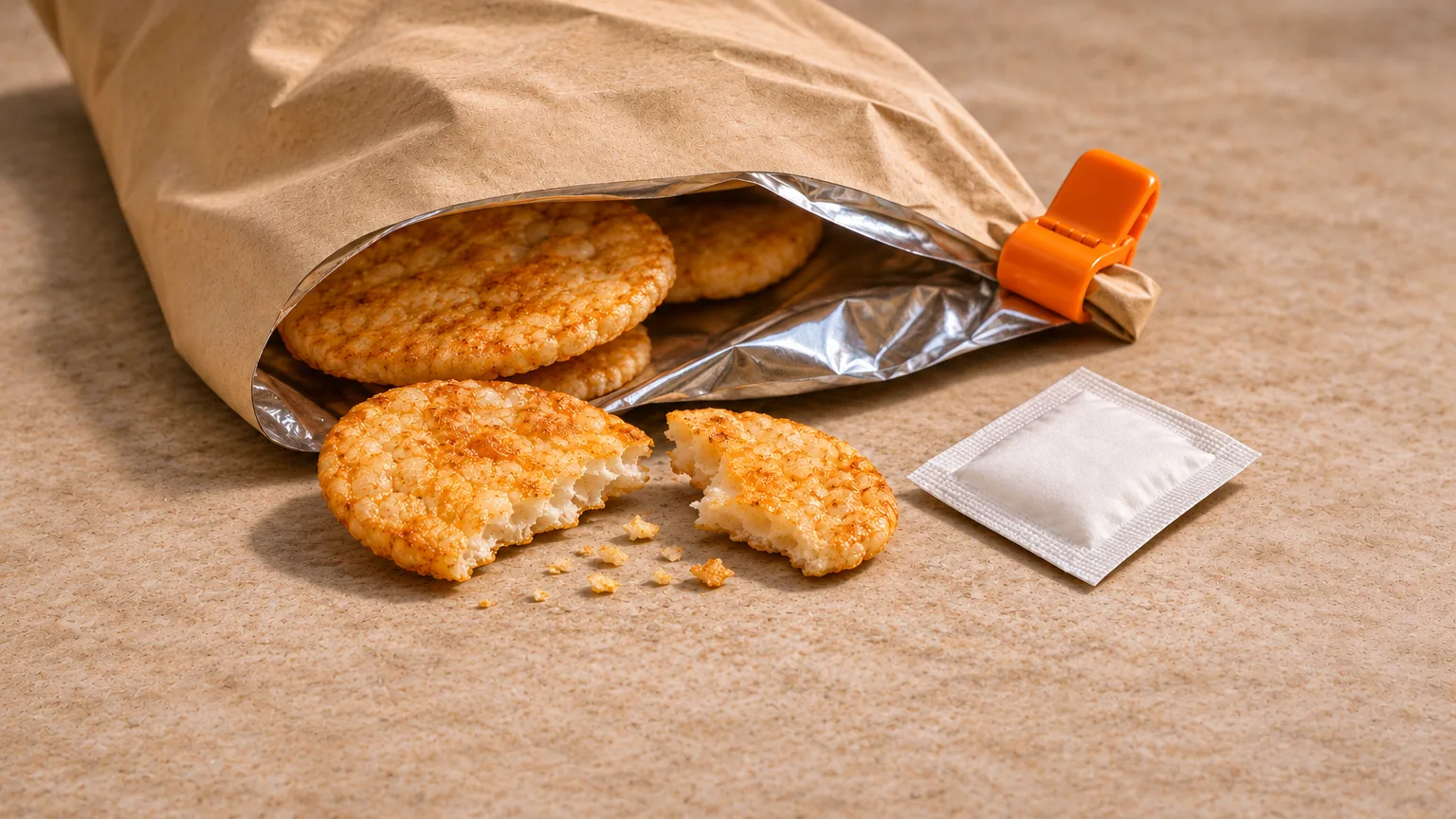
Packaging is part of the shelf life. The same snack in a single-layer plastic bag and in a multilayer film with an aluminium layer can differ several-fold in shelf life. Know your pack's moisture barrier (key for crisp snacks and powders), oxygen barrier (fatty foods and coffee), light barrier (oils and vitamin drinks), any support systems such as nitrogen flushing or desiccant sachets (which require a warning statement under the labelling notification's annex), and seal integrity.
Changes that call for a new assessment
- Formula, especially water, fat, sugar, salt, acid or preservatives
- Supplier or grade of a key raw material
- Heat process, filling temperature or production line
- Packaging material, thickness, supplier or pack size
- Sales route, for example from domestic sales to export by sea
If a change is small and there is a sound technical reason it has no effect, a documented assessment with limited confirmatory testing may be enough. For ranges with several flavours or sizes, use the same principle as the pasteurised milk criteria: test the highest-risk variant and write down why it is the highest risk. And if the change alters details declared to the Thai FDA, check whether the food serial number record needs amending.
Records to keep for inspection, and a pre-label checklist
When inspectors visit, or when a customer complains that a product spoiled before its date, the most useful thing you can have is a file explaining where the shelf life came from. GMP Notification No. 420 requires records to be kept for at least one year after the labelled expiry date, so a product with a two-year life needs batch records for at least three years from production. Keep the shelf-life study file at least as long, or for as long as the product is on sale.
What the file should contain
- The study plan and end-point criteria, approved before the start
- Batch, formula and packaging specification at the time of testing
- Storage temperature and humidity logs
- Results at every time point, laboratory reports and sensory score sheets
- Q10 calculations (if used), conclusions, the safety margin and who approved it
- References or foreign manufacturer data, and a change history
Before you print the date
Check that the term matches the failure mode, the date format matches the shelf life, the storage instructions on the label match the test conditions, and the date coder on the line calculates correctly. Use our free label checker for the other mandatory items, and find every notification cited here in our regulation archive. If you would like our consultants to help plan a study or review existing data, contact us; microbiological testing is sent to accredited partner laboratories.
- ✓Study plan and end-point criteria approved before the start
- ✓Batch, formula and packaging specification
- ✓Storage temperature and humidity logs
- ✓Results at every time point and laboratory reports
- ✓Q10 calculation and safety margin, with approver
- ✓Change history for formula or packaging, with assessments
Source: MOPH Notification No. 420 B.E. 2563 (2020) on record keeping, and general practice
Frequently asked questions
Who decides a food's shelf life in Thailand?
For locally made food, the producer named on the label. For imported food, the foreign manufacturer's date is the basis, but the importer should obtain supporting data. The exception is food whose own notification fixes the period, such as pasteurised milk at no more than 10 days from filling.
Do I have to submit a shelf-life study to the Thai FDA?
The general labelling rules require a date but do not require a study to be submitted in every case. Some cases clearly do, such as asking to show a longer consumption period for pasteurised milk than the notification allows. Otherwise, keep a file ready for inspectors.
Is accelerated testing alone enough?
It is useful for screening formulas and a first estimate, but for many foods it is not enough on its own, because fats melt, reactions speed up unevenly and microbes respond differently. Start real-time testing in parallel from day one.
How long does shelf life testing take?
Real-time testing must run at least as long as the shelf life you will print, and preferably longer, so a 12-month product needs more than a year. Accelerated tests usually take several weeks to a few months.
Do I need to retest if I change the pouch?
Assess every time. A better moisture and oxygen barrier backed by data may need only a documented assessment with limited testing; a weaker barrier or a new pack size should be retested.
Can I use the shelf life of a similar product or published research?
Yes, as a starting point, where formula, process, packaging and storage conditions match. You should still have results on your own product at the end of the claimed shelf life.
Sources
- MOPH Notification No. 450 B.E. 2567 (2024) on the labelling of food in containers · Open source · Search our archive
- MOPH Notification No. 474 B.E. 2569 (2026) on the labelling of food in containers (No. 2) · Open source · Search our archive
- Consolidated MOPH Notification No. 450 (2024) as amended by No. 474 (2026) · Open source · Search our archive
- Thai FDA explanatory notice on the MOPH notification on labelling of food in containers, 9 August 2024 · Open source · Search our archive
- MOPH Notification No. 174 B.E. 2539 (1996) on foods prohibited from import or sale (food past its expiry or best-before date) · Open source · Search our archive
- MOPH Notification No. 420 B.E. 2563 (2020) on production methods, equipment and food storage (GMP) · Open source · Search our archive
- Food Division list of finished-product quality tests under GMP 420 · Open source · Search our archive
- MOPH Notification No. 350 B.E. 2556 (2013) on cow's milk · Open source · Search our archive
- MOPH Notification No. 351 B.E. 2556 (2013) on flavoured milk · Open source · Search our archive
- MOPH Notification No. 352 B.E. 2556 (2013) on milk products · Open source · Search our archive
- MOPH Notification No. 353 B.E. 2556 (2013) on fermented milk · Open source · Search our archive
- Criteria for extending the consumption period of pasteurised milk (Food Committee meeting 7-2/2556) · Open source · Search our archive
- MOPH Notification No. 469 B.E. 2569 (2026) on food in hermetically sealed containers · Open source · Search our archive
- MOPH Notification No. 462 B.E. 2568 (2025) on drinking water in sealed containers · Open source · Search our archive
- Thai FDA explanatory notice on drinking water in sealed containers · Open source · Search our archive
- MOPH Notification on the use of probiotic microorganisms in food B.E. 2554 (2011) (No. 339) · Open source · Search our archive
- MOPH Notification No. 346 B.E. 2555 (2012) on the use of probiotic microorganisms in food (No. 2) · Open source · Search our archive
- MOPH Notification No. 376 B.E. 2559 (2016) on novel food · Open source · Search our archive
- MOPH Notification No. 416 B.E. 2563 (2020) on microbiological quality standards for pathogens in food · Open source · Search our archive
- ASEAN Guideline on Stability Study of Drug Product (R1), a drug guideline used here only as a frame of reference · Open source · Search our archive
This article is for general information. It is not a Thai FDA ruling or legal advice, and rules change — check the latest notification or ask an expert before filing or producing. Spotted an error? Tell us and we will correct it
Related articles
 Brand ownersThai Food Label Requirements: What Must Be on the Label, with an Example (2026)Thai food label requirements under Notifications 450 and 474: mandatory items, 10 allergen groups, expiry dates, letter heights and a mock label.
 Factories / OEMGMP for bottled drinking water plants in ThailandDrinking water GMP in Thailand: GMP 420 Specific Requirement 1, No. 462 water quality, raw water, filling, the production controller and labels.
 Factories / OEMGMP 420 explained: key requirements, the inspection forms and how audits are scoredThailand's GMP 420 for food plants: the five basic categories, specific requirements, the TS.1–TS.5 audit forms, scoring, pass criteria and major defects.