 FDA Thailand
 Brand owners
Wat Pho Medical Inscriptions: Thai Medicine Texts in Stone, the First National Text, and Lawful Use
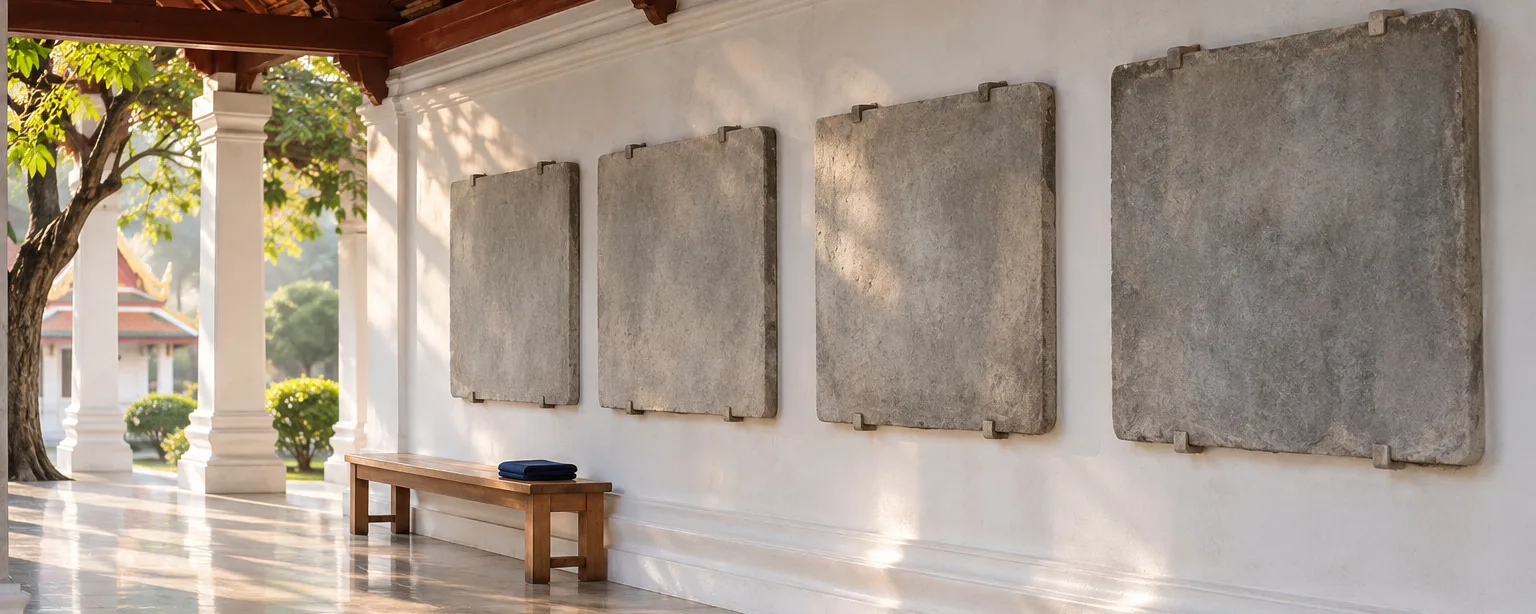
What the Wat Pho medical inscriptions are: Thai traditional medicine texts in stone, and the first national text
The Wat Pho medical inscriptions are stone slabs set into the pavilions and cloisters of Wat Phra Chetuphon Wimon Mangkhalaram. The 380 slabs that carry Thai traditional medicine knowledge were declared a national Thai traditional medicine text in the very first Ministry of Public Health notice, signed on 25 November 2015 (B.E. 2558), covering 1,061 formulas. Notice 28 (2020) later added "the Wat Phra Chetuphon medicine inscriptions (additional)": a further 73 slabs and 269 formulas. Every formula in these lists is therefore a national Thai traditional formula, and using one to make and sell a product, or to research and develop one for trade, needs permission first.
This article tells the story of the set, from the restoration of the temple under King Rama III, through what is on the stones and the UNESCO listing, to how you can read the originals today. It then explains how herbal, cosmetic and wellness brands can use a formula, or tell this story, the right way. For the wider picture of the three types of formula rights, see Thai traditional medicine formula rights.
Source: Ministry of Public Health notices, first notice (2015) and notice 28 (2020) · DTAM summary table · Manager Online (2011) · Princess Maha Chakri Sirindhorn Anthropology Centre
King Rama III and the restoration of Wat Pho: many fields of knowledge on the temple walls
The Wat Pho inscriptions are not only about medicine. The whole set runs to about 1,400 slabs across many fields of knowledge. The survey made for the UNESCO nomination photographed and registered 1,440 pieces, according to a 2011 report in Manager Online, while the Wat Pho epigraphic archive website says 1,431 slabs were inscribed by UNESCO. The small difference comes from how each source counts. The medical part chosen for the national text is 380 slabs.
The inscriptions were made during the restoration of the temple in the reign of King Rama III. An article by Watthana Chayathawat (2021) in the Journal of Thai Traditional Medicine Research states that the inscription on drug properties on the pavilion walls is dated B.E. 2375 (1832), and that the records of the restoration list Prince Wongsa Dhiraj Snid (then holding the rank of Krom Muen Wongsasanit) among the learned people involved.
Before Wat Pho came Wat Ratchaorot
Carving medicine texts in stone did not begin at Wat Pho. The same article states that King Rama III, while still Prince Krom Muen Chetsadabodin, had medicine texts carved on marble slabs for the cloister of Wat Ratchaorotsaram during its restoration in B.E. 2364 (1821), about ten years before the Wat Pho inscriptions. The Wat Ratchaorot inscriptions were declared a separate national text in notice 3.
Our own observation is that what makes the Wat Pho inscriptions stand out is scale. The medical part alone runs to hundreds of slabs, all on temple walls that anyone could walk up to, unlike Thai traditional medicine texts on palm leaf or folding paper that usually stayed with a few keepers.
Inside the Thai traditional medicine texts on the stones: mother and child, abscesses, massage and drug properties
Manager Online reported on the day the first notice came out (2015) that the 380 medical slabs cover three main groups:
- Phaen Mae Sue: knowledge on mother and child, pregnancy and childbirth
- Phaen Fi (abscesses): external abscesses, called "phaen ngai" (face up), and internal abscesses, called "phaen khwam" (face down)
- Phaen Nuat (massage): the lines and points of the body
Drug properties on the pavilion walls
Another part is a text on drug properties. Watthana Chayathawat (2021) explains that it opens with "the seven virtues of the myrobalan fruit" (samo) and the Benjakul formula, then lists herbs by name, part used, taste and the properties the text records. The author considers that the herbal properties text printed in Phaetthayasat Songkhro (1907) is probably a different wording from the Wat Phra Chetuphon version but comes from the same original.
What the notice's schedule shows
The schedule attached to the first notice is ordered by slab and pavilion, for example Sala Phongsachamnankit, Sala Wimangsa, the cloister around the great chedi, and the massage text pavilion (abscess plans). Each slab entry gives its content, the number of formulas and the formula names. The schedule totals 1,061 formulas: 744 are written as "drug name not stated" and 317 carry a name. Slabs that are massage charts or herb-property texts are counted as 0 formulas.
Ancient Thai medicine formula names in the schedule include Ya Kae Sannibat Achin, Ya Naowathawan, Ya Triphala, Ya Klom Nang Non, Ya Prasa Phlai, Ya Hom Nam Kaeo, Ya Prasa Kaphrao, Ya Khiao Khi Thong and Ya Namman Chaiyanuphap. The names show that the text holds oral remedies, medicated oils and remedies for external use, but the notice does not give ingredients or methods of preparation. Those have to be requested from the registrar, as set out in section 7 below.
The hermit statues, the Wat Pho school's printed books and the Memory of the World listing
The 80 hermit postures
Another body of knowledge people associate with Wat Pho is the hermit statues (ruesi dat ton). The Thai inscriptions database of the Princess Maha Chakri Sirindhorn Anthropology Centre states that King Rama I first had the hermit figures modelled in clay, which later decayed. In B.E. 2379 (1836) King Rama III had Prince Krom Muen Narongharirak oversee casting them anew in 80 postures, in "chin" (an alloy of zinc and tin), each with an inscribed verse in khlong si suphap form, 80 verses in all. The poets included royalty, nobles, monks and commoners, and 6 of the verses were composed by King Rama III. Copying the verses into a folding book was completed in B.E. 2381 (1838).
The same database records that many of the verse inscriptions are now lost and some statues have been stolen. Separately, a black folding book of the 80 hermit postures was declared a national text as a different item in notice 2, according to the summary table of the Department of Thai Traditional and Alternative Medicine.
A second life in the traditional medicine school
The knowledge of Wat Pho did not stay on the walls. The Wat Phra Chetuphon traditional medicine school later printed several Thai medicine texts, such as Phaetthayasat Songkhro volume 1 (1961) and Pramuan Sappakhun Ya Thai, as collected by Watthana Chayathawat (2021). An assistant abbot of Wat Pho told Manager Online (2015) that the school was "the first college of Thai traditional medicine", founded under King Rama III after the restoration. This is the temple's own statement.
Memory of the World
UNESCO entered the Wat Pho inscriptions on its Asia-Pacific regional register in 2008 and then on the Memory of the World International Register on 27 May 2011, at the 10th meeting of the International Advisory Committee at the University of Manchester, as reported by Manager Online. The examples named in the report include both the medicine inscriptions and the hermit inscriptions.
The point to get right: UNESCO listed the whole set of Wat Pho inscriptions, which covers many fields of knowledge. It did not list only the medicine texts, and it did not endorse any particular formula.
- Medicine inscriptions at Wat RatchaorotAbout ten years before Wat Pho
- Date on the drug-properties inscriptionOn the pavilion walls, during the restoration under King Rama III
- Hermit statues recast in 80 posturesCast in chin alloy, with 80 verses
- Hermit verses copied into a folding book
- UNESCO Asia-Pacific regional register
- Memory of the WorldThe whole set of Wat Pho inscriptions
- First national text notice380 slabs, 1,061 formulas
- Notice 28Additional 73 slabs, 269 formulas
Source: Watthana Chayathawat (2021) · Thai inscriptions database, Princess Maha Chakri Sirindhorn Anthropology Centre · Manager Online (2011, 2015) · DTAM summary table
Where the originals are, and how to read the Wat Pho inscriptions
The originals are still where they were made: stone slabs set into the walls of the gallery pavilions, pavilions and cloisters of Wat Phra Chetuphon Wimon Mangkhalaram (Wat Pho), Bangkok. Visitors can see them when the temple is open. But if you want to read the content slab by slab, or match it against the notice's schedule, reading from the walls may not be practical.
There are three easier routes:
- The Wat Pho epigraphic archive website of the Princess Maha Chakri Sirindhorn Anthropology Centre lets you search the inscriptions online and has a separate Medicine category. The Centre's Thai inscriptions database also records the history of the hermit inscriptions.
- The printed edition by the Wat Pho traditional medicine school, titled "Tamra Ya Sila Charuek nai Wat Phra Chetuphon Wimon Mangkhalaram" (2015), which collects the medicine texts.
- "Prachum Charuek Wat Phra Chetuphon", published by the monastic community of Wat Phra Chetuphon (2001), for readers who want the inscriptions across all fields.
In practice, if you plan to use the material for a product, note the slab number, pavilion and formula name exactly as in the notice's schedule, because the request form to the registrar must name the formula or text together with the notice number.
Declared national Thai traditional medicine texts: the first notice of 2015 and notice 28 of 2020
A national Thai traditional medicine text is a text the Minister of Public Health declares under section 17 of the Protection and Promotion of Traditional Thai Medicinal Intelligence Act B.E. 2542 (1999). Both notices that concern Wat Pho were issued under sections 4 and 17 and have the same effect: the listed text becomes a national Thai traditional medicine text, and the formulas in it become national Thai traditional formulas.
- The first notice (2015), clause 1, makes the inscriptions of Wat Phra Chetuphon Wimon Mangkhalaram (Wat Pho), 380 slabs, only the parts concerning Thai traditional medicine, a national Thai traditional medicine text. The schedule totals 1,061 formulas. It is the first notice in the series and carries no number.
- Notice 28 (2020) lists 16 texts with 1,404 formulas in total. One of them is the additional Wat Phra Chetuphon medicine inscriptions, 269 formulas. The Department's summary table gives 73 slabs for this additional part.
"National" here does not mean the state owns the stones, and it does not mean the formulas are certified to work. Its legal meaning is that the formulas in the text are protected by the state, and anyone who wants to use them commercially in the ways the law sets out must get permission first. The formula types and the full procedure are covered in Thai traditional medicine formula rights.
A common misunderstanding: the 744 formulas the schedule marks "drug name not stated" are still formulas in the declared text. In practice, regard every formula drawn from this set as a national formula, whether or not it has a name in the schedule.
Using an ancient Thai medicine formula from the Wat Pho inscriptions: preliminary information, then section 19 permission
If a brand wants to make a product from an ancient Thai medicine formula in the Wat Pho inscriptions, the formula-rights side has two main steps.
Step 1: ask the registrar for preliminary information
The Committee notice on disclosure of preliminary information (2017) lets a person who will apply for permission, and who wants preliminary information on a national formula or text, file the request form attached to the notice. The registrar discloses the herbal ingredients in their proportions and the properties of the formula, or a short summary of the essence of the text. The form must state the purpose, and name the formula or text together with the number of the Ministry of Public Health notice that declared it national.
For Wat Pho, state correctly whether the formula comes from the first notice (2015) or notice 28 (2020), because the two sets of slabs sit in different notices. You can search formula names in the schedules with the formula rights check tool.
Step 2: apply for permission to use under section 19
Under section 19 of the Protection and Promotion of Traditional Thai Medicinal Intelligence Act B.E. 2542, anyone who will use a national Thai traditional formula to register a drug formula and apply for a drug manufacturing licence, or to study, research and improve it into a new formula for trade, must apply for permission to use it and pay compensation for the use to the permitting authority under the ministerial regulation. The application, contract and duties after permission are explained in Thai traditional medicine formula rights.
The product is a separate gate
Permission to use a formula does not replace permission for the product. A herbal product still has to go through the steps under the Herbal Products Act B.E. 2562 (2019); see the overview in Thai traditional medicine and the Herbal Products Act. In practice, run both sides in parallel and complete both before ordering the first production lot.
How far a brand can tell the story: Thai traditional medicine texts and the herbal advertising rules
The story of the Wat Pho inscriptions is public history, so a brand can tell it. The line to draw is between telling the story of the text and using the text as evidence that the product works. In practice, the first is general content, while the second usually counts as advertising a herbal product.
Safe storytelling angles
- The history of the temple's restoration under King Rama III and the carving of many fields of knowledge on its walls
- The facts of the notices: the first notice of 2015 with 380 slabs and 1,061 formulas, and notice 28 of 2020
- The UNESCO listing, described as a listing of the whole set of Wat Pho inscriptions
- If the product really uses a formula from the inscriptions and permission has been granted, naming the source formula as it appears in the schedule, with the notice number
- General knowledge content, such as what "phaen ngai" and "phaen khwam" mean, kept separate from the brand's products
The advertising rules you need to know
Section 70 of the Herbal Products Act B.E. 2562 prohibits anyone from advertising a herbal product or its benefits unless a licence has first been obtained from the licensing authority. Section 74 prohibits advertising a herbal product in the following ways (summarised from the text):
- (1) boasting that its properties or ingredients can heal, relieve or prevent disease or illness "in a sacred way or according to personal belief", or claiming it can cure disease completely
- (2) showing properties that are false, exaggerated or misleading
- (3) giving the impression that an ingredient is present when it is not, or is present in a smaller amount than the advertisement suggests
- (4) certifying or praising the properties of the herbal product by any person, group of persons or institution
What to avoid when telling the Wat Pho story
- Words suggesting a sacred or miraculous formula, or one that works because it comes from a temple, which come close to the wording of section 74 (1)
- Anything that suggests the temple, the palace, UNESCO or any institution endorses the product, which comes close to section 74 (4)
- Writing "a formula from the Wat Pho inscriptions" when the product uses only some of the formula's herbs; in practice this risks a misleading impression about ingredients under section 74 (3)
- Turning properties recorded on the stones into product advertising; if you mention them, write them as history, "the text records its use for…", kept apart from the product, and advertising copy must be the approved copy
If the product is a cosmetic or a food rather than a herbal product, the advertising rules come from the law for that product group, but the same principle holds: tell the history, and do not use history as proof that the product works.
✘Avoid
- A sacred formula that works because it comes from a temple
- Suggesting the temple, the palace or UNESCO endorses the product
- Saying UNESCO listed the formulas
- Claiming a Wat Pho formula when only some of its herbs are used
- Turning properties on the stones into unapproved advertising copy
✔Fine to tell
- The history of the restoration under King Rama III
- UNESCO listed the whole set of Wat Pho inscriptions
- Notice numbers, slab counts and formula counts
- The source formula as named in the schedule, once permission is granted
- Properties in the text written as history: the text records its use for…
Summarised from the Herbal Products Act B.E. 2562, sections 70 and 74 · Protection and Promotion of Traditional Thai Medicinal Intelligence Act B.E. 2542, section 19
Images of the originals and copyright in printed editions: what to check first
Brands that want to use images of the inscriptions, or text from the books, on packaging and media should separate three things.
Photos of the actual slabs in the temple
The slabs are in a temple that is both a historic site and a place of worship. In practice, ask the temple for permission before photographing for commercial use, and avoid images that suggest the temple supports the product. For images from the Wat Pho epigraphic archive website, read that site's terms of use before reusing them.
Images of originals held by the National Library
If you want to use images of folding books or palm-leaf manuscripts from the National Library, its rules for the manuscript service require permission from the Director-General of the Fine Arts Department for commercial use, and any work that uses the material must credit the National Library.
Modern printed editions
The inscriptions were made almost 200 years ago, but modern printed editions, such as those of 2001 and 2015, contain their makers' own work: readings, explanations, photographs and layout. The Copyright Act B.E. 2537 (1994) protects literary works, which include books and printed matter, and gives the owner the exclusive right to reproduce, adapt and communicate them to the public. Section 6, paragraph two, states that protection does not extend to ideas, procedures, processes or systems.
In practice, you can retell historical facts in your brand's own words, but do not scan pages, copy images or copy long explanations from a printed edition without the publisher's permission. This is a caution, not a legal ruling; for a large project, consult a copyright specialist.
Historical references
The historical facts in this article come from the sources below. The laws and notices are listed under Sources at the end of the article.
- Watthana Chayathawat. (2021). The origin of herbal properties in Thai traditional medicine texts: a case study of cinnamon (Op Choei). Journal of Thai Traditional Medicine Research, 7(2), July–December 2021. Thai Traditional Medicine Program, Faculty of Allied Health Sciences, Pathumthani University. (Thai)
- Department of Thai Traditional and Alternative Medicine. (2023). Declarations protecting Thai traditional formulas in Thai traditional medicine texts (summary table of Ministry of Public Health notices). (Thai)
- Princess Maha Chakri Sirindhorn Anthropology Centre. Thai inscriptions database: record of the hermit inscriptions, Wat Phra Chetuphon Wimon Mangkhalaram. (Thai)
- Princess Maha Chakri Sirindhorn Anthropology Centre. Epigraphic Archives of Wat Pho: Memory of the World page.
- Manager Online. (2011). News report on UNESCO inscribing the Wat Pho inscriptions on the Memory of the World register. (Thai)
- Manager Online. (30 November 2015). News report on the declaration of the Wat Pho inscriptions as a national Thai traditional medicine text. (Thai)
- Wat Phra Chetuphon Traditional Medicine School. (2015). Tamra Ya Sila Charuek nai Wat Phra Chetuphon Wimon Mangkhalaram [Medicine texts of the stone inscriptions in Wat Phra Chetuphon]. (Thai)
- Monastic community of Wat Phra Chetuphon Wimon Mangkhalaram. (2001). Prachum Charuek Wat Phra Chetuphon [Collected inscriptions of Wat Phra Chetuphon]. (Thai)
- National Library of Thailand, Fine Arts Department. Rules and procedure for using the manuscript service. (Thai)
Frequently asked questions
When were the Wat Pho inscriptions declared a national text, and how many formulas do they contain?
The first Ministry of Public Health notice, signed on 25 November 2015, declared 380 slabs, only the parts concerning Thai traditional medicine, with 1,061 formulas. Notice 28 (2020) added 73 slabs and 269 formulas.
Did UNESCO list the Wat Pho medicine texts?
UNESCO inscribed the whole set of Wat Pho inscriptions on the Memory of the World register on 27 May 2011. The set covers many fields of knowledge, and medicine is one part. The listing does not endorse any formula.
Where can I read the Wat Pho inscriptions?
See the slabs at the temple, search them online on the Wat Pho epigraphic archive website of the Princess Maha Chakri Sirindhorn Anthropology Centre, or read the 2015 printed edition of the medicine texts by the Wat Pho traditional medicine school.
What do I need to do to make and sell a product from a Wat Pho formula?
Request preliminary information from the registrar to learn the ingredients in proportion and the properties, then apply for permission to use under section 19 of the Protection and Promotion of Traditional Thai Medicinal Intelligence Act. The product itself still goes through the Thai FDA steps. Search formula names with the formula rights check.
Is a formula marked 'drug name not stated' still a national formula?
The notice makes the formulas in the declared text national Thai traditional formulas, and the 744 unnamed formulas are in that text. In practice, regard them as national formulas and ask the registrar if unsure.
Can I write 'a formula from the Wat Pho inscriptions' in sales media?
Write it only when the product really uses that formula and permission to use it has been granted. Advertising a herbal product needs a licence under section 70, and must not suggest the product is sacred or that an institution endorses its properties, under section 74.
Sources
- Protection and Promotion of Traditional Thai Medicinal Intelligence Act B.E. 2542 (1999) · Open source · Search our archive
- Committee notice on disclosure of preliminary information on national Thai traditional formulas or texts B.E. 2560 (2017) · Open source · Search our archive
- Ministry of Public Health notice declaring national Thai traditional medicine texts and formulas B.E. 2558 (2015, first notice) · Open source · Search our archive
- Ministry of Public Health notice declaring national Thai traditional medicine texts and formulas (No. 28) B.E. 2563 (2020) · Open source · Search our archive
- Herbal Products Act B.E. 2562 (2019) · Open source · Search our archive
- Copyright Act B.E. 2537 (1994), consolidated to amendment No. 3 B.E. 2558 (2015) · Open source · Search our archive
This article is for general information. It is not a Thai FDA ruling or legal advice, and rules change — check the latest notification or ask an expert before filing or producing. Spotted an error? Tell us and we will correct it
Related articles
 Brand ownersThai Traditional Medicine Formula Rights: National, General and Personal Formulas Before the Thai FDA StepsThai traditional medicine formulas come in 3 types. National ones need permission to use, personal ones the right holder's consent, then Thai FDA steps.
 Brand ownersThai traditional medicine regulation: what a 'traditional drug' is and which law applies todayHow Thai traditional medicine moved from the Drug Act to the Herbal Products Act 2019: old registrations, licences, product categories, sales channels.
 Brand ownersAyurawet Sueksa Thai Medicine Text: A 1953 Textbook Declared National, With 2,773 FormulasKhun Nitthet Sukkit's Ayurawet Sueksa, first printed in 1953, became a national Thai medicine text in 2018. Two spellings, where to read it, lawful use.