 FDA Thailand
 Brand owners
Ayurawet Sueksa Thai Medicine Text: A 1953 Textbook Declared National, With 2,773 Formulas

What is the Ayurawet Sueksa Thai medicine text: a printed textbook that became a national text
The Ayurawet Sueksa Thai medicine text (
One detail trips up people who search for it: the Thai title is spelled two ways. Notice No. 18 writes
We tell the text's story in time order: the compiler, the setting of Thai medicine texts at the time, what the book contains, its reprint, and its declaration as a national text. We then sum up what a business should know before using a formula or the book's story in a product. For formula rights in general, read Thai traditional medicine formula rights.
Khun Nitthet Sukkit and the Thai traditional medicine text tradition of the 1950s
The compiler: Khun Nitthet Sukkit (Thomrat Phumchusri)
"Khun Nitthet Sukkit" is a conferred title; the name in brackets is his personal name and surname. The author record in the Thammasat University digital library reads
We have not found his working life, such as which office he served in or whether he taught at a particular school, so we do not tell more than the evidence shows. One practical point: academic works spell his title in several ways, including
Who it was written for
The annexed list of Notice No. 18 describes the book as covering traditional medicine for diagnosing diseases and their symptoms, and for understanding how to prevent illness. The notice adds that he compiled it so that Thai people interested in medicine could study it. On that description, this is a book for people who wanted to learn traditional medicine.
Thai medicine texts before 1953
To see why a book like this matters, look at what happened to Thai medicine texts earlier. The Thai Junior Encyclopedia, volume 33, says that King Rama V ordered the scattered medical texts to be revised in B.E. 2413 (1870), and that from B.E. 2440 (1897) the Royal Medical School (Ratchaphaetthayalai) taught both Thai and Western medicine. In B.E. 2458 (1915) the school stopped teaching Thai traditional medicine. An article by Naruedee Nanthawet and Chuleerat Charoenporn (2022) agrees on this point.
After that, Thai traditional medicine was no longer taught at the Royal Medical School, but it was still passed on through books that teachers and associations printed. Documented examples include:
- 1953 Ayurawet Sueksa by Khun Nitthet Sukkit is first printed.
- 1961 Volume 1 of Khun Sophit Bannalak's (Amphan Kittikhachon) traditional medicine text is first printed, and the traditional medicine school at Wat Phra Chetuphon (Wat Pho) reprints volume 1 of Phaetsat Songkhro, according to Wattana Chayatawat (2021).
- 1969–1971 Knowledge following Khun Sophit Bannalak's principles is used in lectures for sub-district health workers in training (Chayatawat 2021).
- 1977–1978 The Association of Traditional Medicine Schools at Wat Phra Chetuphon publishes Pramuan Sappakhun Ya Thai, parts 1–3, according to a Mahidol University bibliography.
In this list, Ayurawet Sueksa appeared about eight years before Khun Sophit Bannalak's text, so it is one of the earliest printed Thai medicine texts after the Second World War that we have evidence for. We have found no evidence, however, that it was used as an exam text or as the set text of any school. Chayatawat (2021) names five texts recognised by the Ministry of Public Health and used to compile the standard curriculum, and Ayurawet Sueksa is not among them.
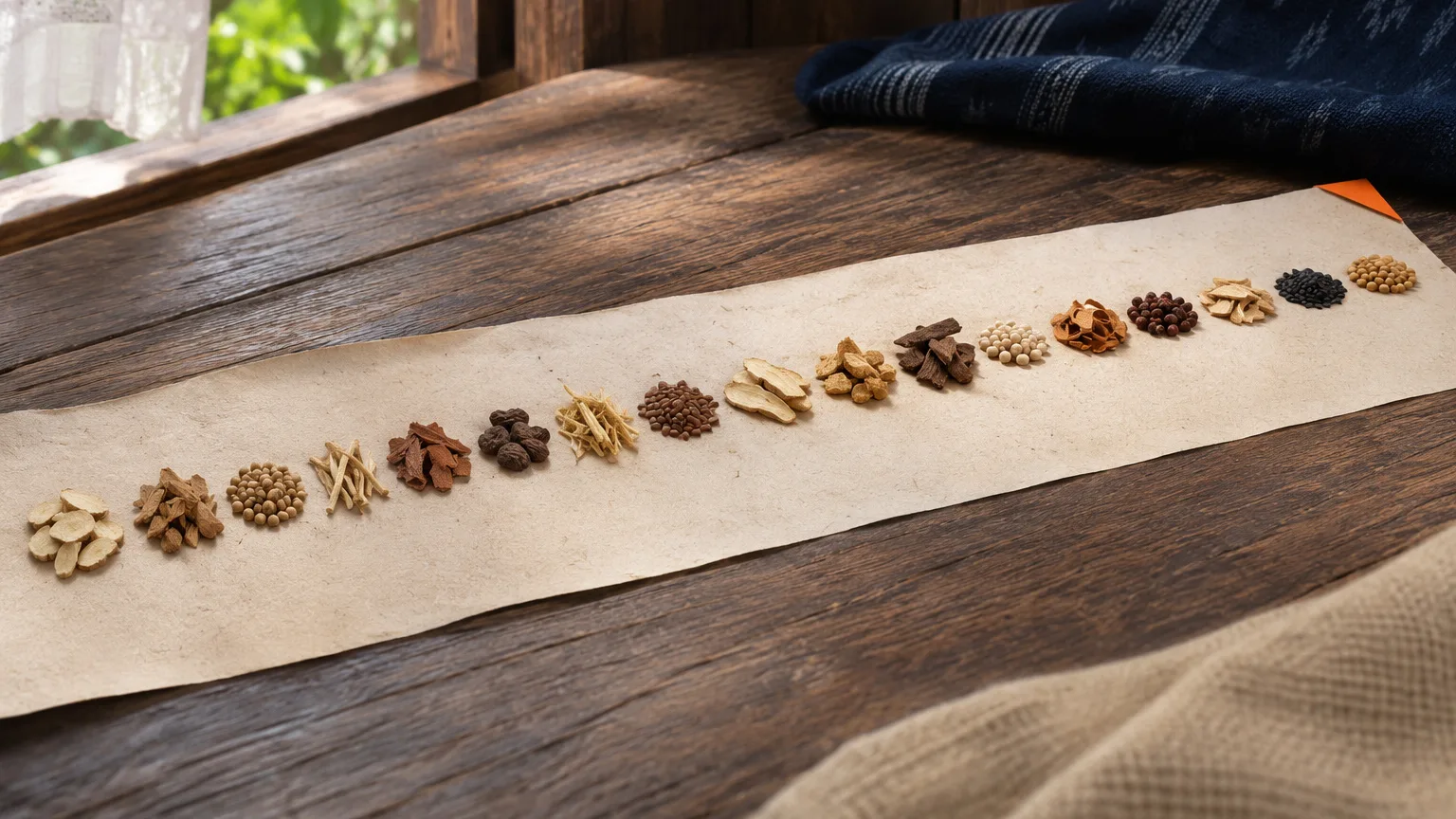
What is inside: old Thai medicine formulas in 17 symptom groups
The annexed list of Notice No. 18 says the book "consists of 17 symptom groups, 2,494 formulas" and gives the number of formulas in each group (see the table below). The notice does not list formulas by name. So we can see how the book sorts its old formulas into groups, but not what each formula is.
The 17 groups at a glance
- Fevers and acute illness remedies for "khai nuea, khai phit and khai kan" fevers (6) and for "puang" (74).
- Children and mothers remedies for children's diseases (57), for nursing mothers and children (21), and for children (511). Together these three groups hold 589 formulas.
- Elements, blood and wind "that wiphang" (113), blood (159), wind (59), "that banchop" (26) and stool-related elements (4).
- Urinary and menstrual groups impaired urination (4), "mutkhat" or difficult urination with blood or pus (4), "mutkit" or white discharge (10), and "mutkit ongkhasut" (53).
- Others "kasai" (98), general-purpose remedies, "ya bet set" (299), and "ya kae mareng, klak" (996).
The figure that stands out is the last group: 996 formulas, about 40% of the book in Notice No. 18. With the 277 formulas in Notice No. 19, this group has 1,273 formulas, and the general-purpose group has 301. We copy every group name as the notice writes it, including near-identical spellings such as
What the section title "ya kae mareng, klak" means
The text titles this section
A point for every reader: disease names in old texts are the terms Thai traditional doctors used in their time. They are not the same as a modern diagnosis. Words such as "mareng", "klak", "mutkit" or "kasai" in the text may not mean the condition that carries the same name today, and they must not become product claims. That the text lists a formula under a group is historical information, not evidence that the formula works.
Source: Ministry of Public Health Notice (No. 18) B.E. 2561, annexed list · Notice (No. 19) B.E. 2561, annexed list items 40–41 · Disease names in old texts are not modern diagnoses
The 1953 printing, the 1973 printing, and the two spellings
1953: the first printing
The Sripatum University library catalogue records a first printing in B.E. 2496 (1953), in Bangkok. We have only this one source, so we cite it as the catalogue states it.
1973: printed again after the compiler's death
The bibliography of Mahidol University's database of commonly used plants and indications for registering traditional medicines records a 1973 (B.E. 2516) printing by Phrom Chak Kan Phim press, Bangkok, 360 pages. This printing came about 18 years after the compiler's death as recorded by the library, which suggests people still wanted the book. Its place in the bibliography of a database built for registering traditional medicines also shows the book is still used as a reference in academic work.
2018: two notices in one year
In 2018 the Ministry of Public Health issued Notice No. 18, which declared the whole book with its 17 symptom groups. Later the same year it issued Notice No. 19, which lists two more entries from this book: "on general-purpose remedies, 2 formulas" and "on remedies for mareng and klak, 277 formulas". The notice does not explain why these two sections were added, so we can only say that formulas from these two sections were declared in Notice No. 19 in addition to those in Notice No. 18.
Ayurawet with "ch" or "t": two spellings, one book
Notice No. 18 spells the title
In Thai, the endings
This article uses "Ayurawet" for the book, follows
- Compiler bornPer the Thammasat University digital library author record
- Royal Medical School stops teaching Thai medicinePer the Thai Junior Encyclopedia, vol. 33
- First printingPer the Sripatum University library catalogue
- Compiler diesPer the Thammasat University digital library author record
- Printed againPhrom Chak Kan Phim press, 360 pages, per a Mahidol University bibliography
- Notice No. 182,494 formulas in 17 symptom groups (Royal Gazette, 29 Jun 2018)
- Notice No. 19279 more formulas (Royal Gazette, 6 Nov 2018)
Source: MOPH Notices No. 18 and 19 (2018) · Thammasat University digital library · Sripatum University library · Mahidol University bibliography · Thai Junior Encyclopedia, vol. 33
Where to find and read Ayurawet Sueksa
There is no manuscript of this text to visit. What you can look for is the printed book itself. These are the routes we found.
1. University libraries
- Thammasat University digital library has an author record and a book record for this text. During our research the pages would not open because of a security certificate problem, so we cannot confirm whether a full text is available online.
- Sripatum University library has a catalogue record for the first printing of 1953.
- The Mahidol University bibliography records the 1973 printing, which helps when you ask for an inter-library loan.
2. Second-hand bookshops
Copies of both the 1953 and 1973 printings still appear in second-hand bookshops. If you buy one, note the year, the press and the page count, because the content and layout of each printing may differ.
3. Ask the registrar for formula information
If you need the ingredients of a particular formula in order to use it, the official route is the preliminary information request to the registrar (see the section on using a formula below). It is a better route than comparing a recipe with a second-hand copy when you do not know which printing it is.
Search tips
- Search both
อายุรเวชศึกษา andอายุรเวทศึกษา . - Search the compiler as
นิทเทสสุขกิจ ,นิเทสสุขกิจ andนิสเทสสุขกิจ , or by his personal nameถมรัตน์ . - Do not confuse it with Vetchasueksa Phaetsat Sangkhep (
เวชศึกษา แพทย์ศาสตร์สังเขป ) by Phraya Phitsanu Prasat Vet, a different text listed in Notice No. 20.
Declared a national Thai traditional medicine text: Notices No. 18 and No. 19 of 2018
This text appears in two Ministry of Public Health Notices on the Declaration of National Thai Traditional Medicine Texts and National Thai Traditional Formulas. Both were issued under section 4 paragraph 1 and section 17 of the Protection and Promotion of Thai Traditional Medicinal Intelligence Act B.E. 2542 (1999), and both were signed by the Minister of Public Health.
- Notice No. 18 of B.E. 2561 (2018) was signed on 25 May 2018 and published in the Royal Gazette, vol. 135, special part 152
ง, p. 15, on 29 June 2018. Its annexed list has a single text: Ayurawet Sueksa, 17 symptom groups, 2,494 formulas. - Notice No. 19 of B.E. 2561 (2018) was signed on 5 October 2018 and published in the Royal Gazette, vol. 135, special part 280
ง, p. 7, on 6 November 2018. Its annexed list has 41 entries. Entries 1–39 are miscellaneous formula manuscripts ("tamra ya kret") held by the National Library, and entries 40–41 are from Ayurawet Sueksa: general-purpose remedies, 2 formulas, and remedies for mareng and klak, 277 formulas. The whole notice covers 2,971 formulas.
What "national" means
Both notices have the same two clauses. Clause 1 makes the texts in the annexed list national Thai traditional medicine texts, and clause 2 makes the Thai traditional formulas in those texts national Thai traditional formulas. As a result, the formulas in Ayurawet Sueksa are national formulas, even though the notices do not name them one by one. Anyone who wants to use them in the ways section 19 describes must get permission first. Reading, studying or telling the history of the text is not on the list in section 19. For formula rights of every kind, see Thai traditional medicine formula rights.
If you want to use an old formula from this text in a product
If you have a recipe that comes from Ayurawet Sueksa, or you think it might, there are two things to do before you invest in production.
1. Ask for preliminary information on the formula
The Notice of the Committee for the Protection and Promotion of Thai Traditional Medicinal Intelligence on Disclosure of Preliminary Information about National Thai Traditional Formulas or National Thai Traditional Medicine Texts B.E. 2560 (2017) lets an applicant for a use permit who wants preliminary information file the request form attached to the notice. The registrar discloses the herbal ingredients in proportion and the indications of the formula, or a short summary of a text. The form must state the purpose, the name of the formula or text, and the number of the notice that declared it national.
This text is covered by two notices, so give the right notice number. Most formulas are in Notice No. 18, but a formula in the general-purpose section or the "mareng, klak" section may be in Notice No. 18 or No. 19. If you are not sure which notice lists your formula, ask the registrar before you file.
2. Apply for a use permit under section 19
Section 19 of the Protection and Promotion of Thai Traditional Medicinal Intelligence Act says that anyone who wants to use a national Thai traditional formula to register a drug formula and apply for a production licence, or to research and improve it into a new formula for commercial purposes, must apply for a use permit and pay compensation for the use to the permit authority, as set out in a ministerial regulation. The steps, forms and contract are explained in full in Thai traditional medicine formula rights.
A permit on the traditional knowledge side does not replace the Thai FDA steps. The product itself still goes through the Thai FDA under the Herbal Products Act B.E. 2562 (2019) as usual. You can browse every notice and its formula counts in the Formula rights check.
Copyright in the book and rights in the formulas are separate
People often mix these up. Copyright in the book falls under the Copyright Act. National formula status falls under the Thai Traditional Medicinal Intelligence Act. Even if the book's text can one day be used free of copyright, the formulas in it remain national formulas under the notices, and using them in the ways section 19 describes still needs a permit.
How far a brand can tell the story of this Thai medicine text
The history of the text is a story you can tell, but once that story is part of product advertising, the Herbal Products Act B.E. 2562 (2019) applies. Section 70 says: "No person shall advertise a herbal product or the benefits of a herbal product unless licensed by the licensing authority."
Section 74 prohibits five kinds of advertising
- Boasting that the properties or ingredients of a herbal product can relieve, alleviate or prevent disease or illness in a sacred way or according to personal belief (the same item also bans advertising that it "can cure a disease completely, or using any other words with a similar meaning").
- Showing false or exaggerated properties, or properties that mislead about the herbal product.
- Implying that the product contains an ingredient it does not contain, or contains less of it than the advertising implies.
- Endorsing or praising the properties of the herbal product by any person, group of persons or institution.
- Breaching the rules, methods and conditions on advertising set by the Minister on the advice of the committee.
Angles that are safe to tell
- A traditional medicine book written for anyone who wanted to learn, as the annexed list of the notice describes it.
- A printed text from the 1950s, first printed in 1953 and printed again in 1973.
- The size of the text: 17 symptom groups and 2,773 formulas across two notices.
- One book, two spellings:
อายุรเวช andอายุรเวท , as each notice writes it. - Credit the compiler by his full name, Khun Nitthet Sukkit (Thomrat Phumchusri), and cite the notice numbers.
What to avoid
- Using a section title or disease name from the text, such as "mareng", "klak", "mutkit" or "kasai", to suggest the product is for those conditions.
- Lifting the notice's words praising traditional medicines into product advertising. Those words describe the text; they do not endorse any product.
- Saying the text is sacred, or that the product works because the text is old.
- Implying that the Ministry of Public Health, the Department of Thai Traditional and Alternative Medicine or any institution endorses the product because the text is national.
- Saying "a formula from Ayurawet Sueksa" when the product uses only part of a formula, or when you cannot show which formula it comes from and that you hold a permit.
If you state where a recipe comes from, describe what you actually did. Advertising a herbal product or its benefits needs a licence under section 70 before it is published.
✘Avoid
- Using a section title or disease name, such as mareng, klak or mutkit, to suggest the product is for that condition
- Lifting the notice's praise of traditional medicines into advertising
- Saying the text is sacred, or that the product works because the text is old
- Implying a government body endorses the product because the text is national
- Claiming a formula from the text when you use only part of it or have no permit
✔You can tell
- A traditional medicine book written for anyone who wanted to learn
- First printed in 1953 and printed again in 1973
- 17 symptom groups, 2,773 formulas across two notices
- One book, two Thai spellings of its title
- Credit the compiler by full name and cite the notice numbers
Advertising a herbal product or its benefits needs a licence under section 70 and must not fall under the prohibitions in section 74 of the Herbal Products Act B.E. 2562 (2019).
Images of the book, and copyright in a post-1947 printing
Pictures of the cover or pages
This text is a book printed in 1953 and 1973, so the images a brand wants are usually the cover or the inside pages. There are two layers to think about. First, the text shown in the image may still be under copyright (see below). Second, the photograph itself belongs to whoever took it. Photos from second-hand bookshops or other websites should not be used without permission.
If you want an old-manuscript mood image from the National Library of Thailand instead, the library's manuscript service page says that photographing or copying for trade or profit needs permission from the Director-General of the Fine Arts Department. The caption should say it is an illustration, not Ayurawet Sueksa.
Do not treat a post-1947 printing as public domain
The Copyright Act B.E. 2537 (1994) counts books, writings and printed matter as literary works, and the copyright owner has the exclusive right to reproduce, adapt and communicate the work to the public (sections 4, 6 and 15). As a general rule, copyright lasts for the author's life and 50 years after the author's death (section 19). On the other hand, section 6 paragraph 2 says protection does not extend to ideas, procedures, processes, systems or concepts.
For this text, we do not conclude that copyright has ended. The compiler's year of death comes from a single library record, a later printing may contain work by others such as a foreword, re-editing or new layout, and the status of a book printed before the current Act depends on several facts taken together. The safe approach is to retell the content in your own words and cite the source, rather than reprinting pages or long passages. If you want to reproduce pages or images for commercial use, check which printing you have and contact the rights holder first. This is a caution, not a legal opinion on any particular case.
Historical references
- Ministry of Public Health. Notice on the Declaration of National Thai Traditional Medicine Texts and National Thai Traditional Formulas (No. 18) B.E. 2561. Royal Gazette, vol. 135, special part 152
ง, p. 15, 29 June 2018. - Ministry of Public Health. Notice on the Declaration of National Thai Traditional Medicine Texts and National Thai Traditional Formulas (No. 19) B.E. 2561. Royal Gazette, vol. 135, special part 280
ง, p. 7, 6 November 2018. - Thammasat University Digital Library. Author record:
นิทเทสสุขกิจ (ถมรัตน์), ขุน, 2443-2498. Accessed 18 November 2026. - Sripatum University Library. Catalogue record of Khun Nitthet Sukkit's text, first printing, B.E. 2496 (1953).
- Mahidol University. Bibliography of the database of commonly used plants and indications for the registration of traditional medicines (entry S.6, Ayurawet Sueksa, 1973 printing; entries S.58–60, Pramuan Sappakhun Ya Thai).
- Wattana Chayatawat (
วัฒนา ชยธวัช ). (2021). The origins of herbal properties in Thai traditional medicine texts: a case study of cinnamon. Journal of Thai Traditional Medicine Research, 7(2), 137–160. - Naruedee Nanthawet and Chuleerat Charoenporn (
ณฤดี นันทเวชช์ และชุลีรัตน์ เจริญพร ). (2022). The establishment of Thai traditional medicine institutions. Journal of MCU Nakhondhat, 9(6), 51–67. - Thai Junior Encyclopedia Project. Thai Junior Encyclopedia, vol. 33: History of Thai traditional medicine.
- National Library of Thailand, Fine Arts Department. Manuscript services. Accessed 18 November 2026.
Frequently asked questions
How many formulas does Ayurawet Sueksa have?
Notice No. 18 of 2018 lists 17 symptom groups with 2,494 formulas, and Notice No. 19 of 2018 adds 279 more from the general-purpose section (2) and the "mareng, klak" section (277). Across both notices that is 2,773 formulas.
Why do the notices spell the title two different ways?
Notice No. 18 writes
Who compiled it, and when was it first printed?
Khun Nitthet Sukkit (Thomrat Phumchusri). The Thammasat University digital library author record gives B.E. 2443-2498 (about 1900-1955). The Sripatum University library catalogue records a first printing in 1953, and a Mahidol University bibliography records a 1973 printing.
Does the section "ya kae mareng, klak" mean remedies for cancer?
It should not be read that way. The text titles the section "ya kae mareng, klak". Disease names in old texts are the terms Thai traditional doctors used in their time, not modern diagnoses, and they must not become product claims.
Can I use a formula from Ayurawet Sueksa in a product?
Its formulas are national Thai traditional formulas under Notices No. 18 and 19. To register a drug formula and apply for a production licence, or to research and improve one into a new formula for commercial purposes, you need a use permit under section 19, and the product still goes through the Thai FDA. Browse the notices in the Formula rights check.
The book was printed in 1953. Can I copy its pages freely?
Do not treat it as public domain. The compiler's year of death comes from a single library record, and a later printing may contain work by others. Retell the content in your own words with a citation, and contact the rights holder before reproducing pages for commercial use. The formulas remain national formulas whatever the copyright status of the book.
Sources
- Protection and Promotion of Thai Traditional Medicinal Intelligence Act B.E. 2542 (1999) · Open source · Search our archive
- Ministry of Public Health Notice on the Declaration of National Thai Traditional Medicine Texts and National Thai Traditional Formulas (No. 18) B.E. 2561 (2018) · Open source · Search our archive
- Ministry of Public Health Notice on the Declaration of National Thai Traditional Medicine Texts and National Thai Traditional Formulas (No. 19) B.E. 2561 (2018) · Open source · Search our archive
- Committee Notice on Disclosure of Preliminary Information about National Thai Traditional Formulas or Texts B.E. 2560 (2017) · Open source · Search our archive
- Herbal Products Act B.E. 2562 (2019) · Open source · Search our archive
- Copyright Act B.E. 2537 (1994), consolidated to amendment No. 3 B.E. 2558 (2015) · Open source · Search our archive
This article is for general information. It is not a Thai FDA ruling or legal advice, and rules change — check the latest notification or ask an expert before filing or producing. Spotted an error? Tell us and we will correct it
Related articles
 Brand ownersThai Traditional Medicine Formula Rights: National, General and Personal Formulas Before the Thai FDA StepsThai traditional medicine formulas come in 3 types. National ones need permission to use, personal ones the right holder's consent, then Thai FDA steps.
 Brand ownersKhun Sophit Bannalak's Thai Traditional Medicine Text: a 1961 Teacher's Textbook Declared National Three TimesThe Khun Sophit Thai traditional medicine text: who wrote it, what is inside, why it was declared three times, formula permission and copyright caution.
 Brand ownersKing Narai Medical Text: An Ayutthaya Palm-Leaf Formula Book Declared a National Thai TextThe King Narai medical text: an Ayutthaya palm-leaf book of 79 formulas, declared national in 2015. Its story, the 1917 edition, and what brands must know.