 FDA Thailand
 Brand owners
King Narai Medical Text: An Ayutthaya Palm-Leaf Formula Book Declared a National Thai Text
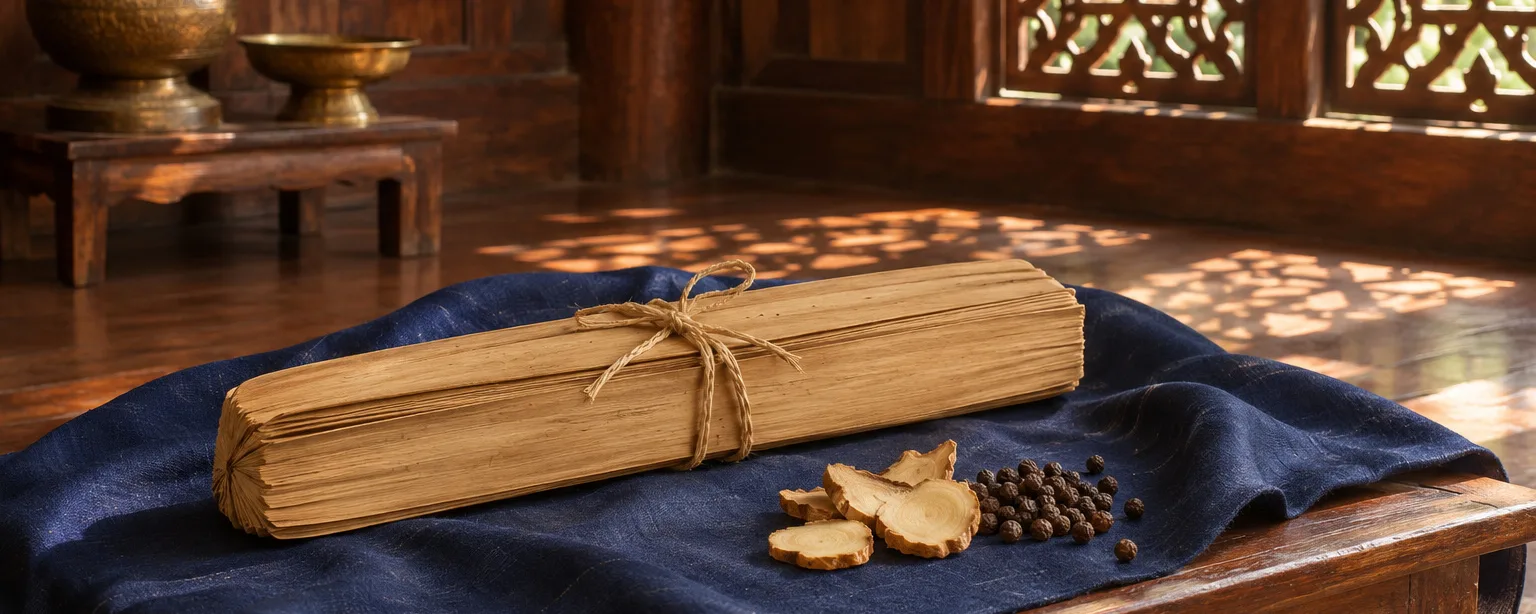
What is the King Narai medical text: a palm-leaf book of traditional Thai remedies that is now a national text
The King Narai medical text, known in Thai as
This article tells the story of the text in time order: the court of King Narai, what the manuscript contains, the 1917 printed edition, Thammasat University's revival work, and the day it was declared a national text. It then sets out what a brand owner should know before telling this story or using a formula. For an overview of rights in every kind of Thai traditional formula, read Thai traditional medicine formula rights.
79 or 81 formulas
Some sources say the text has 81 formulas, for example a Department news item published by Manager Online on 28 May 2012, and an academic article by Wattana Jayathavaj (2021), which also counts 385 ingredients. This article uses 79, the figure in the Department's summary table of notices, because that is the figure the Department uses for this notice and the one tied to legal protection. The list attached to the notice does not name the individual formulas of this text. We have not found a source that explains why the two figures differ.
Source: Ministry of Public Health Notice (No. 2) 2015 · Department of Thai Traditional and Alternative Medicine summary table · Manager Online, 28 May 2012 · Wattana Jayathavaj (2021) · Naewna
The court of King Narai: traditional Thai remedies prepared for the king
King Narai reigned from 1656 to 1688 (B.E. 2199–2231). In his reign the Ayutthaya court had royal physicians who looked after the king's health, and the medicines in this text come from that setting. A 2012 Department news item describes them as medicines prepared for the king. An account by Thammasat University's Thai Khadi Research Institute, published by the newspaper Naewna, says the text is more than 300 years old.
Siamese physicians through the eyes of a French envoy
King Narai's reign was a time when European embassies came to Ayutthaya. One envoy was La Loubère, ambassador of Louis XIV of France. Wattana Jayathavaj (2021) notes that in this same period La Loubère recorded that Siamese physicians prepared medicines from formulas handed down to them. This outsider's observation helps show that the court's knowledge of medicine was written down and passed on, not held only in one physician's memory.
What we still do not know
The sources we could access do not name the royal physician who compiled the text, and they do not give an exact year of writing. This article therefore says nothing about an author. A brand that wants to say who prepared or recorded the text should have verifiable evidence first, because an invented detail weakens the credibility of the whole story.
Inside this Thai traditional medicine text: elements, tastes and eight forms of medicine
In 2012 the Department called this text "the oldest Thai formula text found so far" and summarised its forms of medicine: medicines taken by mouth
| Form of medicine in the text | How it is used (plain explanation) |
|---|---|
| Taken by mouth | |
| Applied externally | |
| Smelled or inhaled | |
| Used through the nose | |
| Herbs wrapped in cloth and pressed on the body | |
| Dropped into the eye | |
| Dropped into the ear | |
| A wax-based ointment for external use |
This range is interesting for product makers today: more than 300 years ago the court already thought about many routes of use, not only medicines to swallow.
The ideas of elements and tastes
Wattana Jayathavaj (2021) summarises the theory in this text as follows. The body rests on the four elements. A physician must consider the season, the time, the patient's age and where the patient lives, and must know the nine tastes of medicine before compounding. The physician then matches the taste to the element that is out of balance. The article's examples: when the fire element is impaired, the text says to use bitter, hot and astringent medicines; when the water element is impaired, it says to use bitter and sweet ones. The name
These ideas are historical knowledge of Thai traditional medicine, not proof of effectiveness by modern scientific methods. When you retell them, always frame them as "the text says…".
From palm leaf to the 1917 printed edition, and the four old herbal formulas Thammasat revived
A palm-leaf text is hard to reach, because it has to be read from a hand-inscribed original. The content became more widely known once it was printed as a book. Wattana Jayathavaj (2021) cites a book titled
Thammasat's Thai Khadi Research Institute has studied it since 2009
According to Naewna, the Thai Khadi Research Institute at Thammasat University began studying this palm-leaf manuscript in 2009 (B.E. 2552) and revived four old herbal formulas from it:
ยาทาพระเส้น (a royal liniment for the sen lines). The institute's researchers explain that the text says it is used for disordered sen lines, cramp and aches.พระอังคบพระ เส้นตึงให้หย่อน น้ำมันมหาจักร (Maha Chak oil).ยาหอมดุม (Ya Hom Dum). The researchers explain that the text says it is used for fever with thirst and headache.
The institute also published a book,
From scholarship to legal protection
In 2012 the Department publicised the text as the oldest formula text found at that time. On 25 December 2015 the Minister of Public Health signed Notice No. 2, published in the Royal Gazette on 12 January 2016, which made the palm-leaf King Narai text a national Thai traditional medicine text.
- Reign of King NaraiMedicines in the text were prepared for the king; the envoy La Loubère recorded that Siamese physicians used formulas handed down to them
- Printed as a book
ตำราพระโอสถ พระนารายณ์, printed as a royal gift for the funeral of Phraya Phaetphongsa (Nak Rojanaphaet) - Thammasat begins its studyThe Thai Khadi Research Institute studies the palm-leaf manuscript and later revives four formulas
- The Department publicises the textCalled the oldest Thai formula text found at that time
- Declared a national textMinistry of Public Health Notice No. 2, published in the Royal Gazette on 12 Jan 2016
Source: Wattana Jayathavaj (2021) · Naewna · Manager Online, 28 May 2012 · Department summary table of notices
Where the original is and how to read this Thai traditional medicine text
The notice identifies the original by number 1143 in the register of the National Library of Thailand, Fine Arts Department, which looks after old palm-leaf and folding-book manuscripts through its manuscripts and inscriptions group. If you want to see this text, start from the text name and number given in the notice.
What a palm-leaf manuscript is
The National Library's manuscript database explains that a palm-leaf manuscript is a book whose letters are inscribed with a sharp metal stylus onto leaves of the lan palm. Most are Buddhist teachings, but some cover other subjects. The King Narai text is one example of a medical text recorded on palm leaves. TrueplookPanya, citing the Thai Junior Encyclopaedia, describes how the leaves were prepared: young, newly opened leaves were chosen, dried in sun and dew, soaked or boiled, dried again, pressed between boards and trimmed, smoked against mould, polished, then pierced and strung into bundles.
How to ask to see the original at the National Library
- Search the National Library's manuscript database, palm-leaf tab, by number or title.
- Register in the system and fill in the online request to study and use old manuscripts. When it is approved, the system notifies you by email.
- Prepare the evidence for your type of user. Members of the public use an ID card and a request letter; students and researchers use a letter from their institution.
- You may request up to five items at a time. If a printed edition, transliteration, microfilm or digital copy already exists, the service room shows you the copy instead of the original.
- In the service room you may not photograph the manuscripts yourself. Ask the staff for copies.
If you do not need the original, the easier route is a printed edition, such as the 1917 printing or the Thai Khadi Research Institute's book, in a university library. As of writing, we have not found a digital copy of this text from a government body that we can confirm is free to download.
Declared a national Thai traditional medicine text: Notice No. 2 of 25 December 2015
The Ministry of Public Health Notice on declaring national Thai traditional medicine texts and national Thai traditional formulas (No. 2) B.E. 2558 (2015) was issued under Sections 4 and 17 of the Act on Protection and Promotion of Thai Traditional Medicine Knowledge B.E. 2542 (1999). It makes the texts in its attached list national Thai traditional medicine texts, and the formulas in those texts national Thai traditional formulas. The list has eight texts. The palm-leaf King Narai text is first, alongside the royal medical texts of King Rama V, the royal medicine text of King Rama II and five others.
What "national" means
Section 17 lets the Minister declare a formula or text that has special benefit or value for medicine or public health as national. Once declared, the formulas in the text are protected as a set, even though the notice does not list them one by one. The key effect for a business is Section 19: anyone who will use a national formula to register a drug formula and obtain a production licence, or research and adapt it into a new formula for trade, must apply for permission to use it and pay compensation for that use under the ministerial regulation. For use for one's own benefit, the Department explained in 2012 that no permission is needed.
In practice, if your formula comes from the King Narai text or from a printed edition of it, regard it as a national formula, even if you cannot find the formula name in the notice. The three kinds of rights and the steps under the ministerial regulations are covered in Thai traditional medicine formula rights, and you can search the list of notices with the formula rights check tool.
Using a traditional Thai remedy from this text in a product: preliminary information, then Section 19 permission
Before you invest in a product built on a formula from the King Narai text, there are two steps to know. The first tells you what the declared formula actually contains. The second is the permission to use it.
Step 1: ask the registrar for preliminary information
The B.E. 2560 (2017) notice of the Committee for the Protection and Promotion of Thai Traditional Medicine Knowledge on disclosure of preliminary information about national formulas or texts lets an applicant who wants preliminary information file the form attached to the notice. The form asks for the purpose, such as registering a drug formula and obtaining a production licence, or researching and developing a new formula for trade, and for the name of the formula or text with the number of the notice. For this text that is Notice No. 2 of 2015. The registrar discloses the herbal ingredients in their proportions and the properties of the formula, or a short summary of the essence of the text. Attachments include an ID card, company documents, the business establishment licence, and a power of attorney if someone files for you.
This step is very useful, because a formula taken from a printed edition or from word of mouth may not match the declared formula. Comparing your formula with the registrar's information first tells you whether you are using a national formula in full, in part, or in an already adapted form.
Step 2: apply for permission under Section 19
If you will register and produce the formula, or research and develop it into a new formula for trade, you must apply for permission under Section 19 of the Act on Protection and Promotion of Thai Traditional Medicine Knowledge B.E. 2542. This permission is separate from the Thai FDA steps under the herbal products law, which still apply as usual. The detailed order of work is in Thai traditional medicine formula rights.
How far a brand can tell the story: traditional Thai remedies and the herbal advertising rules
The story of this text is very appealing: the Ayutthaya court, a French envoy, palm leaves more than 300 years old, and a university revival. We observe that formula numbers from this text are already cited in patent documents; one Thai patent, for example, refers to
Safe storytelling angles
- Verifiable facts, such as the period, the form of the original, its National Library number and Notice No. 2 of 2015.
- Historical knowledge, such as the four elements, the nine tastes and the eight forms of medicine, written as "the text says…".
- Once you hold Section 19 permission, which formula your product uses, within the scope of that permission.
- If the text is only an inspiration, say plainly that it is an inspiration, not the original formula.
What to avoid
Section 70 of the Herbal Products Act B.E. 2562 (2019) prohibits advertising a herbal product or its benefits without a licence. Section 74 prohibits several kinds of advertising, including claims that a product heals, relieves or prevents disease in a sacred or belief-based way or for good, false or exaggerated claims, giving the impression that a product contains an ingredient it does not have or has less of than stated, and using a person, group or institution to endorse or praise its properties. Applied to this story, be careful not to:
- use the court origin or the age of the text as evidence that a product works;
- use words suggesting sacredness, or a secret formula for every complaint;
- imply that the palace, a government body or a university endorses the product;
- claim the full formula when you use only some of its herbs or have changed the proportions.
We have not yet researched the rules on commercial use of royal names or symbols. A brand that wants to use this text's name as a product name or on packaging should check that point separately.
✘Avoid
- Using the court origin as evidence that the product works
- Words suggesting sacredness, or a secret formula for every complaint
- Implying that the palace, a government body or a university endorses the product
- Claiming the full formula when you use only part of it
- Images of the original without Fine Arts Department permission
✔Fine to tell
- The period, the form of the original and its National Library number
- Notice No. 2 of 2015 and what national means
- The ideas of elements and tastes, framed as the text says…
- The name of the formula you use, once you hold Section 19 permission
- Saying plainly when the text is only an inspiration
Advertising a herbal product needs a licence first (Section 70)
Source: Herbal Products Act 2019, Sections 70 and 74 · Act on Protection and Promotion of Thai Traditional Medicine Knowledge 1999, Section 19 · National Library manuscript services
Images of the original and copyright in printed editions of the Thai traditional medicine text
Images are often overlooked, but they involve the rights of several parties. The points below are cautions, not a legal ruling.
Images of the original from the National Library
The National Library's manuscript service page says that photographing or copying an original requires a request, and that use for trade or profit requires permission from the Director-General of the Fine Arts Department. Its service rules also ask for a letter to the Director-General before publishing images of old manuscripts in a book, research or article, and work that uses the information must credit the National Library. Palm-leaf images found online should therefore not go on labels or sales material if you do not know their origin and have no permission.
Printed editions and modern books
The Copyright Act B.E. 2537 (1994) provides that copyright lasts for the author's life and 50 years after the author's death. Books published more recently, such as the Thai Khadi Research Institute's revival book, with their explanations, illustrations and layout, may still be protected. Texts printed after 1947 (B.E. 2490) should in general not be assumed to be in the public domain. We have not checked the copyright status of the 1917 printing or of modern editions of this text, so do not conclude on your own that they are free to use.
The safe route is to use images you take or create yourself, such as herbal raw materials or blank palm leaves, or images under a clear licence with credit as required, and to cite your information sources in text.
Historical references
The list below gives the sources used for the historical story in this article. The laws cited are in the source list at the end of the article.
- Department of Thai Traditional and Alternative Medicine. Summary table
"การประกาศ คุ้มครอง รายการ ตำรับยาแผนไทย ในตำรา การแพทย์ แผนไทย" (document 5.1). - Department of Thai Traditional and Alternative Medicine. Open dataset of formulas in the national Thai traditional medicine texts (dtam-acad-002), updated 2026.
- Manager Online (Quality of Life section). Department of Thai Traditional and Alternative Medicine news item on national texts, 28 May 2012.
- Wattana Jayathavaj.
"ที่มาสรรพคุณ ตัวยาในตำรา การแพทย์ แผนไทย: กรณีศึกษาสมุนไพรอบเชย" (Origins of herbal properties in Thai traditional medicine texts: a case study of cinnamon). Journal of Thai Traditional Medicine Research 7, no. 2 (July–December 2021): 137–160. ตำราพระโอสถ พระนารายณ์. Printed as a royal gift for the funeral of Phraya Phaetphongsa (Nak Rojanaphaet). Bangkok: Sophon Phiphatthanakon press, 1917. (Cited from Wattana Jayathavaj 2021.)- Naewna newspaper ("Like Sara" section). Report on the Thai Khadi Research Institute, Thammasat University, studying and reviving formulas from the
โอสถพระนารายณ์ text. - Thai Khadi Research Institute, Thammasat University.
สืบสานภูมิปัญญา ตำราโอสถพระนารายณ์. (Cited from the Naewna report.) - National Library of Thailand, Fine Arts Department. "Manuscript services" page. Accessed 18 November 2026.
- National Library of Thailand, Fine Arts Department. Database of old manuscripts, inscriptions, folding books, scripture cabinets and palm-leaf manuscripts: home, search and service rules pages. Accessed 18 November 2026.
- TrueplookPanya.
"การเต รียมใบลานจาร หนังสือ" (Preparing palm leaves for inscribing), 10 May 2017, citing the Thai Junior Encyclopaedia, vol. 32.
Frequently asked questions
What is the King Narai medical text?
A medicine text from the Ayutthaya court in the reign of King Narai. The original is a palm-leaf manuscript, number 1143 in the National Library register, and it was declared a national Thai traditional medicine text in Ministry of Public Health Notice No. 2 of 2015.
How many formulas does it contain, 79 or 81?
The Department of Thai Traditional and Alternative Medicine's summary table of notices counts 79, the figure tied to legal protection. A 2012 Department news item and a 2021 academic article say 81. This article uses 79.
What forms of medicine are in the text?
According to the Department's 2012 summary: medicines taken by mouth, applied to the skin, inhaled, used through the nose, compresses, eye drops, ear drops and wax-based ointments. The text also records diagnosis, symptoms and prognosis from the Ayutthaya period.
Which formulas did Thammasat revive?
According to Naewna, Thammasat University's Thai Khadi Research Institute has studied the palm-leaf manuscript since 2009 and revived four formulas:
What must I do to produce and sell a formula from this text?
The formulas in this text are national Thai traditional formulas. To register and produce one, or research and develop it into a new formula for trade, you must first obtain permission under Section 19. You can ask the registrar for preliminary information under the 2017 committee notice. The Thai FDA steps still apply as usual.
Can I use the text's name or palm-leaf images in advertising?
You can tell the historical facts, but advertising a herbal product needs a licence under Section 70, and Section 74 rules out using the story as evidence of effect, claiming sacredness, or having an institution endorse the product. Commercial use of the National Library's images of the original needs permission from the Director-General of the Fine Arts Department.
Sources
- Act on Protection and Promotion of Thai Traditional Medicine Knowledge B.E. 2542 (1999) · Open source · Search our archive
- Ministry of Public Health Notice on declaring national Thai traditional medicine texts and national Thai traditional formulas (No. 2) B.E. 2558 (2015) · Open source · Search our archive
- Notice of the Committee for the Protection and Promotion of Thai Traditional Medicine Knowledge on disclosure of preliminary information about national formulas or texts B.E. 2560 (2017) · Open source · Search our archive
- Herbal Products Act B.E. 2562 (2019) · Open source · Search our archive
- Copyright Act B.E. 2537 (1994), consolidated to amendment No. 3 B.E. 2558 (2015) · Open source · Search our archive
This article is for general information. It is not a Thai FDA ruling or legal advice, and rules change — check the latest notification or ask an expert before filing or producing. Spotted an error? Tell us and we will correct it
Related articles
 Brand ownersThai Traditional Medicine Formula Rights: National, General and Personal Formulas Before the Thai FDA StepsThai traditional medicine formulas come in 3 types. National ones need permission to use, personal ones the right holder's consent, then Thai FDA steps.
 Brand ownersAyurawet Sueksa Thai Medicine Text: A 1953 Textbook Declared National, With 2,773 FormulasKhun Nitthet Sukkit's Ayurawet Sueksa, first printed in 1953, became a national Thai medicine text in 2018. Two spellings, where to read it, lawful use.
 Brand ownersKhun Sophit Bannalak's Thai Traditional Medicine Text: a 1961 Teacher's Textbook Declared National Three TimesThe Khun Sophit Thai traditional medicine text: who wrote it, what is inside, why it was declared three times, formula permission and copyright caution.