 FDA Thailand
 Brand owners
Cosmetic manufacturing premises in Thailand: site requirements, inspection and registration
Cosmetic manufacturing premises in Thailand: why the site is inspected before notification
Anyone planning to make their own creams, soaps or shampoos for sale soon asks whether cosmetic manufacturing premises in Thailand need a licence. Under the Cosmetic Act B.E. 2558 (2015), anyone who manufactures for sale, imports for sale or manufactures under contract must notify each cosmetic product first, and may produce or import only after receiving a notification receipt. The premises themselves must meet the criteria the Minister announces for the site, equipment and manufacturing methods.
What people call "licensing the premises" is, in practice, applying for a premises inspection result from the Thai FDA (Food and Drug Administration). If officers find no defects, you receive a premises code to use when filing notifications. Without that code you cannot notify. The notification rules also require the applicant to have manufacturing or import premises that meet the criteria. An individual applicant must be a Thai national aged at least 20, and a juristic person must be registered in Thailand.
There are three kinds of premises:
- Manufacturing premises: where products are made and filled, for both manufacturers for sale and contract manufacturers.
- Import premises: the office of an importer for sale.
- Storage premises: where raw materials or goods are kept, which may be at a different address from the import premises.
Passing the inspection is not the end. The notifier must keep meeting the criteria for as long as it holds the notification receipt. If it does not, the authority may order it to stop or correct, and may revoke the notification. Refill stations, where cosmetics are dispensed at a service point, follow their own notification and premises code and sit outside this article.
Premises standards: who follows Annex A and who follows Annex B
The core rule is the Ministry of Public Health notification on criteria, methods and conditions for manufacturing or importing cosmetics B.E. 2561 (2018). It has two annexes, split by type of business rather than by size:
- Annex A
(ภาคผนวก ก) applies to manufacturers for sale and contract manufacturers, whether a small workroom or a large factory. It covers the site, equipment, containers, manufacturing methods and storage. - Annex B
(ภาคผนวก ข) applies to importers for sale. It covers import premises, storage premises and documents about the source factory.
The premises inspection manual from the Cosmetics and Hazardous Substances Control Division, revised edition 2 (September 2025, replacing the 2020 edition), breaks Annex A into ten chapters: general information, personnel, manufacturing site, equipment, hygiene and sanitation, production, quality control, production documents, storage, and complaints.
The point newcomers should know is that the pre-notification inspection covers only chapters 1 to 4 for manufacturing premises: general information, personnel, the site itself and equipment, because nothing has been produced yet. Import premises are checked against chapters 1 to 3. When you later apply for a premises certificate or receive a surveillance inspection, manufacturing premises are checked against all ten chapters and import premises against all six.
There are only two outcomes. No defects means a pass. Any defect means a fail that must be fixed, so it pays to prepare fully for the first visit. For the wider idea of GMP (good manufacturing practice), see what is GMP.
Source: MOPH notification on criteria, methods and conditions for manufacturing or importing cosmetics B.E. 2561 and the premises inspection manual, revised edition 2
Building, rooms, production water and the sign you must display
Annex A item 3 and the inspection manual set out the physical requirements clearly. The points applicants most often miss are:
- Building: sound, with floors, walls and ceilings that are easy to clean.
- At least two separate rooms: a production or filling room, and a storage room for raw materials, packaging and cosmetics, divided by floor-to-ceiling walls on all four sides with a door.
- Doors: the production room may have only one door apart from a fire exit, and a curtain alone cannot serve as the door.
- Working space: at least 3 square metres per worker.
- Not allowed in the rooms: a hand-washing sink in the production or storage room, curtains or blinds. If sunlight reaches the work area through glass walls, use sun-control film instead.
- Not required: an air lock. Ventilation fans are acceptable.
- Hazardous substances: surfactants or disinfectants classed as hazardous substances may share the store if kept on separate shelves at least 1 metre apart.
Production water must be at least as good as the standard for drinking water in sealed containers. If your formulas use water as an ingredient, plan the water source and how you will test it when you design the rooms.
Sign: display a permanent sign reading
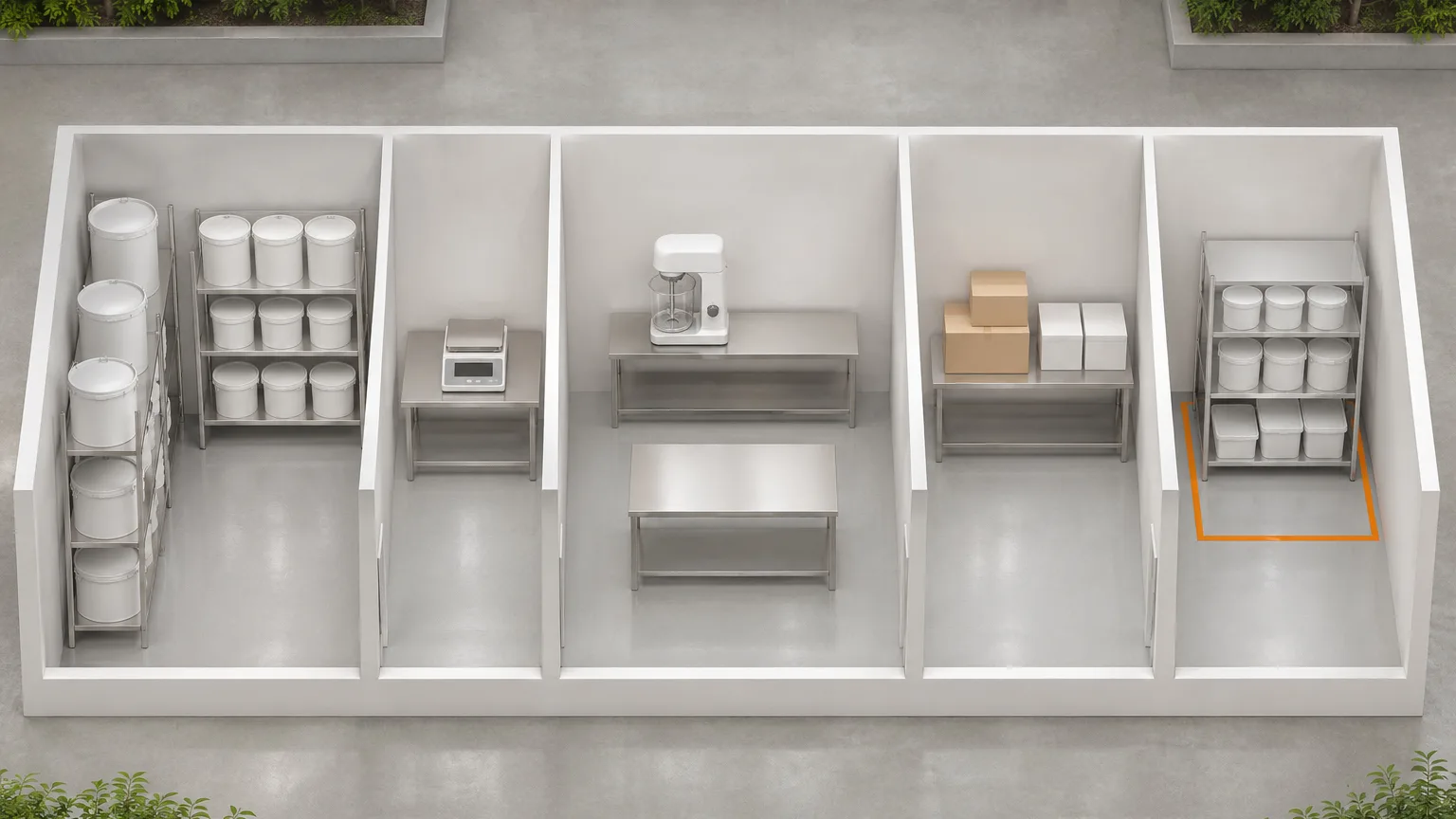
The Thai FDA also publishes model layouts for shampoo, conditioner and liquid soap production, showing weighing, mixing, filling and changing rooms, a warehouse, and the routes of people and goods. Its notes say, for example, that toilets should sit outside the production building, used water must be cleaned before it goes into public drains, and room sizes depend on production volume. The layouts illustrate the idea; they do not fix one size for every site.
Registering cosmetic manufacturing premises through e-Submission
Registering cosmetic manufacturing premises happens in the Thai FDA e-Submission system. According to the operator manual for premises inspection requests, revised edition 2 (foreword dated September 2026), a new operator completes three steps before filing:
- Verify identity through the ThaiD app.
- Request access to the system: premises in Bangkok apply at the Thai FDA One Stop Service Center (OSSC), premises elsewhere at the Provincial Public Health Office, or by granting authority online.
- Log in and file the request under the
"จัดการสถานที่" (manage premises) menu.
The address must match your registration: manufacturing and import premises must be the head office or a branch listed on the company certificate. To produce at another address, add it as a branch first. Storage premises need not appear on the certificate. If one address has several activities, such as manufacturing and storage, request all of them.
Attachments in three groups, as PDF files:
- Identity documents, such as a power of attorney, an individual's commercial registration or a community enterprise registration. For companies, officers check the Department of Business Development database themselves.
- Premises documents, such as proof of ownership, or a consent letter or lease that states the site may be used as cosmetic manufacturing premises, plus evidence of staff training.
- A location map, floor plans, and photos of the outside, inside and signs.
Permits from other agencies: the document list attached to the notification rules includes a licence for a business hazardous to health or a factory licence among the premises documents, and the premises inspection manual lists a factory operating licence or an industrial estate permit "if any". Check early which ones apply to you.
If documents are incomplete, the request is not approved and must be filed again, referring to the earlier request through the
- 1Verify identityThrough the ThaiD app
- 2Request system accessBangkok at OSSC, provinces at the provincial health office, or online authority
- 3Prepare the site and three document groupsIdentity, premises, maps, plans and photos
- 4File under manage premisesCover every activity at the address
- 5On-site inspectionManufacturing premises checked on chapters 1–4
- 6Premises code issuedUsed when filing notification form Jor.Khor.1
Source: Operator manual for premises inspection requests, revised edition 2
Can you make cosmetics at home?
Yes, if the space meets the same criteria as any other manufacturing site. Annex A applies to every manufacturer for sale, and there is no separate set of rules for small producers. The Thai FDA premises unit's Q&A and the operator manual address home production as follows:
- A house extension or a shipping container may be used, but it must be separate from living quarters and must not be a passage to other parts of the house.
- Condominium units, flats and apartments may not be used as a manufacturer's production or storage premises.
- One house number may hold only one manufacturing site.
- Walls must enclose all four sides up to the ceiling, and a garden fence does not count as a wall.
- Production and storage rooms must still be at least two separate rooms.
On paperwork, an applicant who is not the householder needs a consent letter or lease stating that the site may be used as cosmetic manufacturing premises. If the house registration copy lacks the householder page, other proof of rights is accepted, such as a lease, a land title deed copy or a sale contract. A Thai individual may apply in their own name with a commercial registration, and community enterprises may apply with their community enterprise registration documents.
Think before you invest: later surveillance visits also check production, quality control and production documents. If your formulas need machines or controlled rooms beyond what a home can offer, hiring a factory may suit you better.
People, documents and records the inspector will ask for
Personnel and general information are two of the four chapters checked before notification, so prepare your people and documents along with the rooms.
Personnel
- Production staff must be trained or self-study, with records as evidence.
- Minimum topics are the 2018 manufacturing or import criteria notification, the 2018 notification rules, the labelling notification dated 14 June 2019, and preparing the product information file (PIF).
- Staff who joined within the past year need a medical certificate before starting work. Staff employed longer need evidence of a health check at least once a year.
General information about the site: the name and address of the manufacturing and storage premises, company history, organisation chart, building description, list of machines, and plans of every floor if the building has more than one.
Once production starts, Annex A adds that you need a master formula matching the notification, a production record for every batch, a batch numbering system, quality checks and retained samples of finished products, and systems for complaints, adverse event reporting and recalls. The officers' manual says retained samples should be kept until expiry, or for three years from manufacture if no expiry date is set.
The 2017 notification on keeping cosmetic information requires product information to be kept at the manufacturing or import premises, on paper or electronically, in Thai or English. Manufacturers need specifications for every raw material including water, safety data sheets (SDS), the master formula, product specifications and test methods.
If a surveillance inspection finds the site does not comply with the notification, the manual says officers will take legal action and order improvements. Your document system must work every day, not be written up just before a visit.
- ✓General information, organisation chart and plans of every floor
- ✓Staff training records on the four topics
- ✓Medical certificates and annual health checks
- ✓List of equipment and machines
- ✓Raw material specifications including water, and SDS
- ✓Master formula, batch records and retained samples
Cosmetic import premises and storage premises
An importer for sale needs no production room, but it does need cosmetic import premises and storage premises that pass Annex B before notification. The pre-notification inspection covers chapters 1 to 3: general information, personnel and the premises.
- Import and storage premises must be separate from living quarters, with permanent signs reading
"สถาน ที่นำเข้าเครื่อง สำอาง" (cosmetic import premises) and"สถาน ที่เก็บรักษา เครื่อง สำอาง" (cosmetic storage premises), following the same sign rules as manufacturing premises. - Import and storage premises may be at different addresses, and the storage area may be divided off with partitions.
- Goods must sit on shelves or pallets, not directly on the floor.
- In a condominium building, an importer may use only a ground-floor commercial unit that outsiders can reach and that is separate from residential rooms.
- Staff involved in importing and storage need a health check at least once a year, and you should have stock cards and procedures from import through post-market follow-up.
For importer duties on source-factory documents, letters of authorisation, customs declarations and retained samples, read importing cosmetics to sell in Thailand. The overseas factory standards that Annex B accepts are explained in what is ISO 22716.
Hiring a factory or running your own production site
Most brand owners start by hiring a factory. Annex A applies to contract manufacturers just as it does to manufacturers for sale, so it is the contract manufacturer's premises that must meet the criteria, and the contract manufacturer attaches the hiring contract when it files the notification. For who holds the notification, see who owns the notification when a factory makes your cream, and for choosing a factory, see cosmetic manufacturer in Thailand.
Your own production site lets you control formulas, batches and costs, but you carry all ten chapters of Annex A, from personnel and hygiene to recalls. If you need evidence beyond a premises code, there are two further options:
- Certificate of manufacturing or import premises: the notifier files form Sor.Khor.1
(ส.ค.1). Officers inspect against the full manufacturing or import criteria and issue a certificate on form Sor.Khor.2 Kor for manufacturing premises or Sor.Khor.2 Khor for import premises. It is valid for three years, and moving premises requires a fresh application. - ASEAN Cosmetic GMP certificate: regulation RL-CH4-1, amendment 2 in force from 9 December 2025, applies to manufacturers or contract manufacturers that request certification. Before inspection you must run the full GMP system, have made at least three batches of notified cosmetics within three years, carry out internal audits and management review, and be producing on the inspection day. A critical defect means a fail, and you must fix everything and apply again. The certificate is valid for three years and lapses if the manufacturing site moves or the business is transferred.
The same regulation forbids presenting a GMP certificate as certification of a product, so choose your wording carefully on labels and in advertising.
Moving, changing or cancelling premises
A premises code is tied to the address and rooms that were inspected, so each change has its own route:
- Company renamed, same registration number: no new premises request. File form Jor.Khor.4
(จ.ค.4) to amend the notification receipts. - Moving address: apply for a new premises inspection. Once the new site is approved you may produce under the existing notification numbers, but you must still file Jor.Khor.4.
- Moving rooms or changing the room number you registered: apply for new premises.
- Changing details without moving, such as plans or English contact details: file through the premises management system with a Digital ID, attaching a director's letter and evidence. Plan changes need photos, and you must press the final confirmation for the request to count as filed.
- Data pulled from the Department of Business Development: operators cannot edit it in the system and must contact officers or send a letter.
A common mistake is assuming that once premises details are updated, every notification receipt changes too. The manual is clear that after the address details are approved, you must still file Jor.Khor.4 for each notification receipt.
To stop using a site, file a premises cancellation or business closure request in e-Submission under the
Checklist before you apply for a premises inspection
Use this list before applying for an inspection.
- You have decided whether to manufacture, import or hire a factory, and know which annex applies.
- The address is the head office or a branch on the company certificate, or you hold a commercial registration as an individual.
- You hold proof of ownership, or a consent letter or lease stating the site may be used as cosmetic manufacturing premises.
- The site is not in a condominium or apartment, is separate from living quarters and is not a passage.
- Production and storage are separate rooms with floor-to-ceiling walls, one production-room door, and no sinks, curtains or blinds inside.
- The permanent sign is up, meets the size and lettering rules, and is separate from the company sign.
- Training records on the four topics, medical certificates and staff health checks are ready.
- Maps, plans, and outside, inside and sign photos match the real site.
- You have checked whether your location needs permits from other agencies.
Search the full notifications in the Thai FDA law library and ask case-specific questions with the Thai FDA question assistant. If you want our team to plan the room layout and get the site ready for inspection, see production site setup, or for help with documents and notification, see document preparation and registration and notification. Once you have a premises code, the next step is Thai cosmetic notification, using the notification documents checklist.
Frequently asked questions
Do cosmetic manufacturing premises in Thailand need a licence?
What you need is a premises inspection result from the Thai FDA, requested through e-Submission. If officers find no defects you receive a premises code to use when notifying cosmetics, and you must keep meeting the 2018 manufacturing or import criteria for as long as you hold the notification receipt.
Can I make cosmetics at home or in a condominium?
At home, yes, if you use an extension or a container that is separate from living quarters, is not a passage, and has separate production and storage rooms. Condominium units, flats and apartments may not be used as a manufacturer's production or storage premises.
How many rooms does a cosmetic production site need?
At least two separate rooms: one for production or filling and one for storing raw materials, packaging and cosmetics, divided by floor-to-ceiling walls with a door. Allow at least 3 square metres of working space per worker.
What must the premises sign look like?
A permanent sign reading cosmetic manufacturing premises in Thai on one line, separate from the company sign, with a dark background, at least 15 x 45 centimetres, letters at least 5 centimetres high, and clearly visible from outside.
What do I do if I move my production site?
Apply for a new premises inspection. Once approved you may produce under existing notification numbers, but you must file form Jor.Khor.4 to amend the receipts. A premises certificate needs a fresh application, and an ASEAN Cosmetic GMP certificate lapses when the site moves.
Do I need GMP before notifying cosmetics?
The minimum before notification is Annex A of the 2018 notification, with chapters 1 to 4 checked before notification. An ASEAN Cosmetic GMP certificate is something a manufacturer applies for when ready, and it requires at least three batches of notified cosmetics within three years before inspection.
Sources
- Cosmetic Act B.E. 2558 (2015) · Open source · Search our archive
- MOPH notification on notification, issuing, renewing, amending and replacing cosmetic notification receipts (22 August 2018) · Open source · Search our archive
- MOPH notification on criteria, methods and conditions for manufacturing or importing cosmetics B.E. 2561 (2018) · Open source · Search our archive
- Premises inspection manual under the 2018 manufacturing or import criteria, revised edition 2 (September 2025) · Open source · Search our archive
- Officers' manual on premises inspection under the 2018 manufacturing or import criteria (revised edition 2) · Open source · Search our archive
- MOPH notification on keeping cosmetic information for inspection B.E. 2560 (2017) · Open source · Search our archive
- MOPH notification on applying for and issuing certificates of cosmetic manufacturing or import premises · Open source · Search our archive
- Q&A on inspection of cosmetic manufacturing and import premises (Thai FDA premises unit) · Open source · Search our archive
- Q&A on the cosmetic manufacturing and import premises system (Thai FDA premises unit) · Open source · Search our archive
- Public manual on requesting a manufacturing or import premises inspection for new or relocated premises · Open source · Search our archive
- Operator manual on requesting a premises inspection result, revised edition 2 · Open source · Search our archive
- Model layout of cosmetic manufacturing premises under cosmetic GMP · Open source · Search our archive
- Operator manual on amending manufacturing, import or storage premises details without relocation · Open source · Search our archive
- Operator manual on amending premises details without relocation in the Thai FDA system · Open source · Search our archive
- Operator manual on cancelling notifications, cancelling premises and closing a business · Open source · Search our archive
- Letter requesting cancellation of cosmetic premises · Open source · Search our archive
- Regulation RL-CH4-1 on ASEAN Cosmetic GMP certification, amendment 2 (9 December 2025) · Open source · Search our archive
- Public manual on requesting a premises code for cosmetic refill stations · Open source · Search our archive
This article is for general information. It is not a Thai FDA ruling or legal advice, and rules change — check the latest notification or ask an expert before filing or producing. Spotted an error? Tell us and we will correct it
Related articles
 Brand ownersHow to notify cosmetics with the Thai FDA: a step-by-step guide from formula to notification numberThai cosmetic notification step by step: the cosmetic test, formula screening, applicant and premises rules, documents, JK.1 filing, labels and renewal.
 Brand ownersDocuments needed for Thai cosmetic notification (checklist)A brand owner's checklist for Thai cosmetic notification: applicant and premises papers, product data, case-specific attachments and the file to keep.
 Brand ownersFiling cosmetic notification online (e-submission), step by stepHow to file Thai cosmetic notification online in e-Submission: identity, access rights, premises, the J.K.1 request, payment and the notification number.