 FDA Thailand
 Brand owners
Thai Smallpox Medical Manuscripts: 24 Samut Thai Books at the National Library and How Brands Can Use Their Story

What the Thai smallpox medical manuscripts are: 24 samut thai books at the National Library
In this article, the Thai smallpox medical manuscripts are the group of samut thai (folding books) at the National Library of Thailand that record medicine formulas for fi dat, or smallpox. The Ministry of Public Health declared them national Thai traditional medicine texts in notices No. 4 and No. 5 of B.E. 2559 (2016), and added one more book in notice No. 35 of B.E. 2566 (2023). Counting from the lists attached to the notices, 24 books carry the word
Smallpox was an epidemic that people in Siam knew well. Foreigners who came to the country from the Ayutthaya period to the early Rattanakosin period wrote about it many times. Thai healers recorded their knowledge of the disease in dozens of samut thai. The disease is gone today, but the books are still in the National Library and are now protected by the state as national knowledge.
This article tells the story of the group in order: what the word fi dat means, the history of the disease in Siam, what the notice lists show, how to view an original, and what businesses should know before using a formula or telling this story in a brand.
A note before reading: we refer to the texts by their titles in the notices, and we do not equate the disease groups in the texts with any modern disease, because we have not found academic work that studies the content of this set directly.
Source: Counted from the lists attached to Ministry of Public Health notices declaring national Thai traditional medicine texts and formulas, No. 4 and No. 5 (2016) and No. 35 (2023)
Fi dat, its two spellings and khai hua: a disease name in Thai traditional medicine texts
The Royal Institute dictionary defines
Why the notices spell it "ฝีดาด"
Thai traditional medicine texts and old disease names
Thai traditional medicine texts name diseases as healers of the time saw and understood them, not by the pathogen as modern medicine does. We have not found academic work that explains whether
Smallpox texts held outside the National Library help show how this kind of text organised its knowledge. The Anthropology Centre article quotes an old manuscript that groups medicines by the number of days since the pustules "show their heads", with named preparations such as
Smallpox in Siam: from foreign accounts to the inoculation drive under King Rama III
According to Terwiel's article in the Journal of the Siam Society (1988), Simon de La Loubère, who came to Ayutthaya in B.E. 2230–2231 (1687–1688), recorded smallpox as the most dangerous contagious disease in Siam. In B.E. 2368 (1825) Henry Burney called smallpox "the real plague of Siam", and in December B.E. 2381 (1838) Dr Dan Beach Bradley wrote that almost every family had lost someone to it, and that it came almost every year at the end of the rainy season and into the dry season.
Before that, communities in Bangkok had their own ways of coping. Terwiel says the Indian community already inoculated people with matter from smallpox patients, the Chinese blew powdered smallpox scabs into the nose, and the Thai had their own forms of care, such as bathing in cold water.
The great inoculation of B.E. 2381–2382: Thai physicians did most of the work
Terwiel explains that the great inoculation drive of B.E. 2381–2382 (1838–1839) was a royal initiative of King Rama III. The King had royal physicians learn the method from Bradley, granted money for the smallpox matter used, and helped poor people with their costs. Royal physicians inoculated more than a thousand members of the royal family and nobility, while ordinary healers inoculated commoners in numbers too large to count. In early B.E. 2382 King Rama III granted a reward to Bradley, and a similar amount to the Thai physicians. In the same period Bradley printed 500 copies of an inoculation guide, and Thai physicians asked for them "in great numbers".
So this was not work done by Western doctors alone. In the records Terwiel studied, the people who inoculated most of the population were Thai healers.
From inoculation to cowpox vaccine
Cowpox vaccine failed many times because the material spoiled during sea voyages. Terwiel says it first succeeded around February B.E. 2383 (1840), but people were slow to accept it, until a Thai assistant named Nak began to do the vaccinating in B.E. 2387 (1844), after which more people agreed.
According to Pearson's introduction in the Journal of the Siam Society (2016), Bradley's eight-month-old daughter died of smallpox in December B.E. 2385 (1842). He then printed a Thai cowpox vaccination manual in B.E. 2387 (1844), 500 copies. Interestingly, the manual advises avoiding "khong salaeng" (foods and things considered aggravating in Thai medicine) for 8–9 days after vaccination and taking a purgative, which Pearson notes in his footnotes was borrowed from Thai medical practice.
Real progress came after the Pasteur Institute in Saigon opened in 1890 and supplied smallpox vaccine to the region. In the end, the World Health Organization declared smallpox eradicated worldwide in 1980.
- La Loubère in AyutthayaRecords smallpox as the most dangerous contagious disease in Siam
- Henry BurneyCalls smallpox the real plague of Siam
- The great inoculationA royal initiative of King Rama III, carried out mainly by Thai royal physicians
- First successful cowpox vaccineAfter many failures as the material spoiled at sea
- Bradley's cowpox vaccination manual500 copies, advising avoidance of khong salaeng after vaccination
- WHO declarationSmallpox eradicated worldwide
- Notices No. 4 and No. 523 smallpox samut thai declared national texts
- Notice No. 35Adds
ตำราแผนที่ฝีดาษ, no. 177
Source: Terwiel (1988) · Pearson (2016) · World Health Organization · Ministry of Public Health notices No. 4, 5 (2016) and 35 (2023)
What the Thai traditional medicine texts on smallpox contain: titles, a picture book and formula counts
The Ministry of Public Health notices do not publish the content of the formulas, but the attached lists give each book's title, its National Library number, the type of samut thai and the number of formulas. That is enough to build a fair picture of the group.
Titles in the lists
คัมภีร์แผนฝีดาด (Khamphi Phaen Fi Dat), nos. 143, 144, 145 (volume 2), 146 and 151 in notice No. 4, and nos. 152, 155 and 156 in notice No. 5ตำราฝีดาด (Tamra Fi Dat), nos. 153, 154, 159, 160 and 161, andตำรายาฝีดาด (Tamra Ya Fi Dat), nos. 157, 158, 162, 164, 166, 167 and 168 in notice No. 5 (the list has no no. 165)ต้นสมุทตำราฝีดาษ ทำพิศมต่างๆ , no. 163, with 208 formulasตำราแผนภาพฝีดาด (Tamra Phaen Phap Fi Dat, "the picture text on fi dat"), no. 169, with 25 formulasยาฝีดาด ประสาด , no. 170, with 39 formulasตำราแผนที่ฝีดาษ (Tamra Phaen Thi Fi Dat, "the map text on fi dat"), no. 177, a black samut thai with 139 formulas, declared in notice No. 35, whose history is given as an original holding of the National Library
From 7 formulas to 308
Counting from the lists attached to the notices, the books vary greatly in size. The smallest is
"Picture" and "map" in the titles
The titles
Related books we did not count
The same lists also include
What is still unknown
Notices No. 4 and No. 5 do not give the year of writing, the author or the provenance of each book, and we have not found a study that dates this set. So we cannot say whether any book was written before or after the inoculation of 1838. We have also not found a printed edition or transcription of these texts.
What a samut thai is, and how to view a manuscript by its number
What a samut thai is
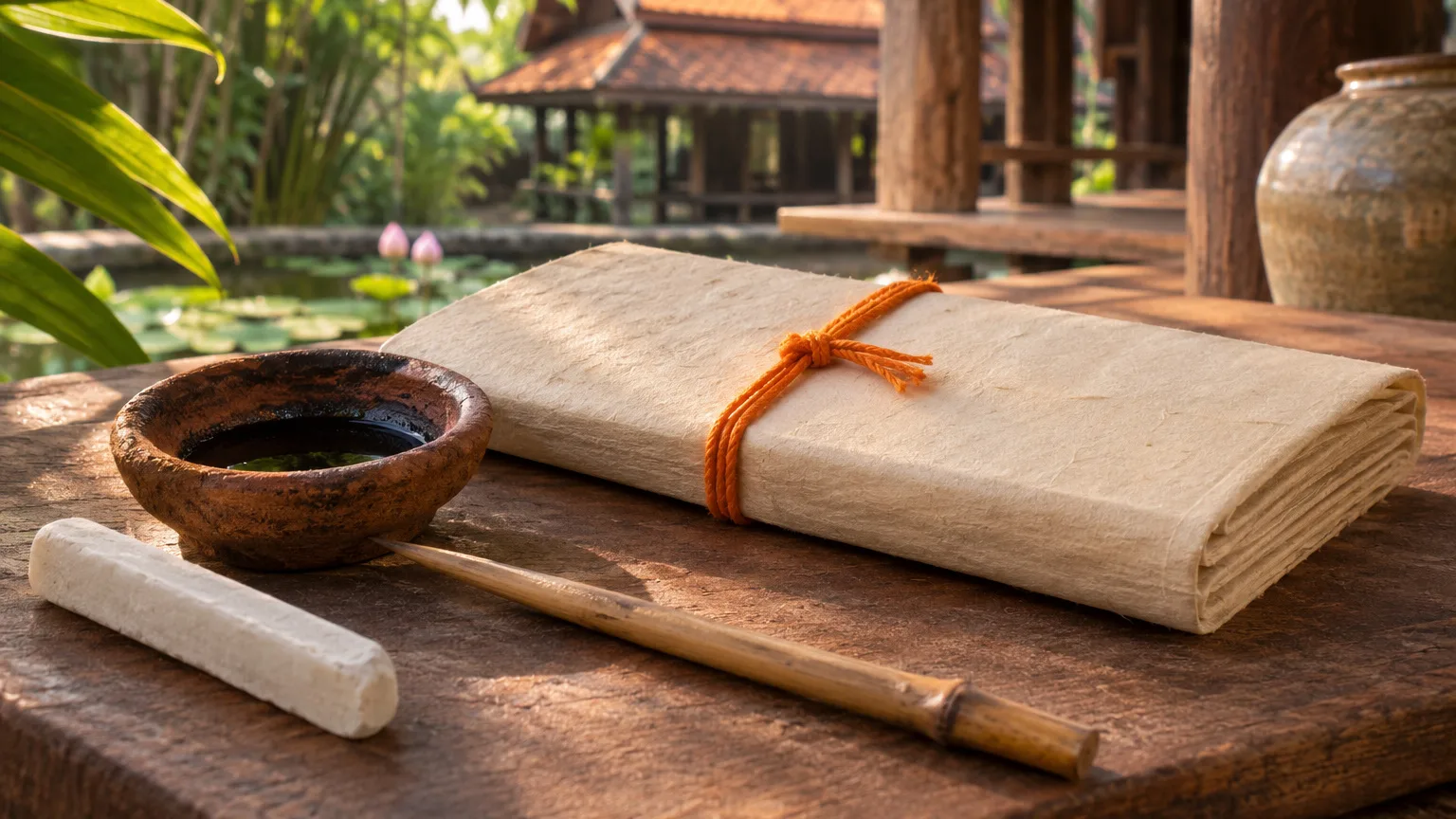
The Royal Institute dictionary defines a samut thai as a book made of long, narrow sheets of khoi paper folded back and forth like a pleated cloth, in both white and black paper, also called samut khoi. The National Library's manuscript database adds that samut thai are made from bark that can be turned into paper, such as po, khoi, sa and pineapple fibre, and are used for writing text, pictures and line drawings.
The Thai Junior Encyclopedia, volume 32, explains that white and black books differ from the stage where a rice paste is spread on the paper: white books mix lime water into the paste, while black books mix in soot or finely ground charcoal. Black books are written with white chalk or white ink, and white books with black ink. This smallpox set has both: 15 white and 9 black samut thai (counted from the lists attached to the notices).
As of 18 November 2026, the National Library's search system showed 14,688 samut thai records. That is the number the system displays, not an official holdings count.
The "number" in a notice is the National Library register number
The number after each title in the notices, such as no. 169 or no. 177, is the National Library's register number for that manuscript. You can use it to search for and request the original.
Steps to view an original
- Search the register on the manuscript database at manuscript.nlt.go.th. Choose the
"หนังสือสมุดไทย" (samut thai) tab and search by register number or title. Note the category, group, title and number in full. - Register and apply online. Fill in the online request form to study and use old manuscripts. When the Director of the National Library approves it, the system notifies you by email, and you can then go to the Manuscripts and Inscriptions Group.
- Prepare evidence for your user type. Members of the public need an ID card and a request letter; students and officials need a letter from their institution; foreign researchers need a letter from the National Research Council of Thailand.
- Expect a copy in some cases. If a book already has a printed edition, transcription, microfilm or digital copy, the reading room will show you the copy instead of the original.
- Follow the reading room rules. Wear gloves, place the original on the cloth provided, do not trace or touch the script, and do not photograph old manuscripts yourself. Copies must be requested through staff, with one form per manuscript number.
Work that uses information from old manuscripts must credit the National Library and send one copy of the work to the Manuscripts and Inscriptions Group. For commercial use of images, see the section on images and copyright below.
Declared national Thai traditional medicine texts: notices 4, 5 and 35
The Ministry of Public Health notices on declaring national Thai traditional medicine texts and national Thai traditional formulas are issued under sections 4 and 17 of the Protection and Promotion of Thai Traditional Medicine Knowledge Act, B.E. 2542 (1999). They declare the texts in the attached list to be national Thai traditional medicine texts, and the formulas in those texts to be national Thai traditional formulas.
| Notice | Dates | Whole notice | Smallpox texts |
|---|---|---|---|
| No. 4, B.E. 2559 | Signed 1 April 2016 · Royal Gazette 11 May 2016 | 35 items, 2,369 formulas | 5 books, 489 formulas |
| No. 5, B.E. 2559 | Signed 11 July 2016 · Royal Gazette 11 August 2016 | 19 items, 2,372 formulas | 18 books, 2,355 formulas |
| No. 35, B.E. 2566 | Royal Gazette 1 November 2023 | 26 National Library texts, 2,578 formulas (3,861 formulas in the whole notice) | 1 book, 139 formulas |
The figure of 24 books and 2,983 formulas in this article is our own count from the lists attached to the three notices. The whole-notice totals are the figures stated in the notices.
What "national" means
A national Thai traditional medicine text is a text the state has declared protected as shared national knowledge. Once a text is on the list, every formula in it is a national Thai traditional formula, even though the notice gives only the book title and the number of formulas, not each formula's name. As a result, using a formula for trade, or researching it into a new formula for trade, requires permission under section 19. For an overview of the three types of formula, read Thai traditional medicine formula rights.
Using a formula from the smallpox texts: the preliminary information request and section 19 permission
If a brand is interested in a formula from the smallpox texts, the formula-rights side involves two main steps: requesting preliminary information, and applying for permission to use the formula.
1. Request preliminary information from the registrar
The notice of the Committee for the Protection and Promotion of Thai Traditional Medicine Knowledge on disclosing preliminary information about national Thai traditional formulas or texts, B.E. 2560 (2017), lets an applicant for permission who wants preliminary information file the request form attached to the notice. The registrar discloses the herbal ingredients in proportion and the stated properties of the formula, or a short summary of the text. The form must name the formula or text and the number of the notice that declared it. For this group, give the book title, the manuscript number and notice No. 4, 5 or 35 exactly as in the list.
2. Apply for permission under section 19
Section 19 of the Protection and Promotion of Thai Traditional Medicine Knowledge Act, B.E. 2542, provides that anyone who will use a national Thai traditional formula to register a drug formula and obtain a drug production licence, or research and adapt it into a new formula for trade, must apply for permission to use it and pay compensation for that use to the licensor. The steps, forms and contract are explained in Thai traditional medicine formula rights.
Points specific to this group
- The formulas in the smallpox texts were written in an age of epidemics, so the stated properties the registrar discloses may concern illnesses that do not suit an ordinary product. Reading the preliminary information first helps you decide whether a formula fits the product you plan.
- Rights in a formula and product approval are separate matters. The product itself still has to go through the steps of the Herbal Products Act, B.E. 2562 (2019).
- You can look up book titles and numbers in our formula rights check.
How far a brand can tell the story of the smallpox texts
The story of the smallpox texts can be told from many angles, but once it appears in advertising for a herbal product it must stay within the Herbal Products Act, B.E. 2562 (2019). Section 70 provides that no one may advertise a herbal product or the benefits of a herbal product unless they have first obtained a licence from the licensing authority, and section 74 lists five kinds of prohibited advertising.
Angles you can use (as history, not tied to product benefits)
- Knowledge born in an age of epidemics. People in Siam faced smallpox almost every year, and Thai healers recorded what they knew in dozens of books.
- Thai and Western physicians working side by side. The inoculation of 1838–1839 was a royal initiative of King Rama III, and Thai royal physicians did most of the work, according to Terwiel (1988).
- Open-minded learning. Bradley included the Thai practice of avoiding khong salaeng in his own vaccination manual, according to Pearson's introduction (2016).
- The craft of the samut thai. Khoi paper, white and black books, and traditional inks.
- Verifiable provenance. Once you have permission to use a formula, state the book title, manuscript number and notice number as given in the list.
What to avoid
- Do not link a product to preventing infectious or epidemic disease, and do not use words like "antiviral" or "builds immunity". Section 74 (2) prohibits advertising that shows false or exaggerated properties or misleads about the properties of the herbal product.
- Do not describe a formula as "sacred" or magical. Section 74 (1) prohibits boasting that a product relieves or prevents disease "in a sacred way or according to personal belief".
- Do not imply that the National Library, the Fine Arts Department, the Department of Thai Traditional and Alternative Medicine or the palace endorses the product. Section 74 (4) prohibits advertising that certifies or praises a herbal product's properties by any person, group of persons or institution.
- Do not imply that you use a complete formula if you use only part of it. Section 74 (3) prohibits advertising that suggests a product contains an ingredient that it does not actually contain.
- Do not use images of the National Library originals without permission (see the next section).
Wording on labels and in advertising should come from approved information. If you are unsure whether a sentence counts as advertising, have an RA team read it before you publish.
✘Avoid
- Linking the product to preventing infectious or epidemic disease
- Words like antiviral or builds immunity
- Calling a formula sacred or magical
- Implying the Library, a department or the palace endorses the product
- Implying a complete formula when you use only part of it
- Using images of the originals without permission
✔You can tell
- The history of smallpox in Siam, from citable sources
- Thai physicians and Bradley in the inoculation of 1838–1839
- The craft of samut thai: khoi paper, white and black books
- Book title, number and notice, once you have permission to use the formula
- Plainly, that the age and authors of the originals are unknown
Advertising a herbal product needs a licence first under section 70 and must stay within section 74
Source: Herbal Products Act B.E. 2562 (2019), sections 70 and 74
Images of the samut thai originals and copyright: points of caution
Images of National Library originals
The National Library's manuscript services page states that photographing or copying for trade or profit requires permission from the Director-General of the Fine Arts Department, and the service rules state that anyone publishing images of old manuscripts in a book, research or article must write to the Director-General of the Fine Arts Department. Images of pages from the smallpox samut thai on packaging, websites or advertising should therefore be cleared before use. We have not found images of the originals in this set released under an open licence.
If you need an illustration without using the originals, choose photographs of generic samut khoi with a clear licence, or take new photographs, and write captions that are accurate, without calling them the National Library smallpox texts.
Copyright: a caution, not a ruling
- Section 7 of the Copyright Act, B.E. 2537 (1994), provides that regulations, notices and orders of state agencies are not copyright works. You can therefore cite titles, manuscript numbers and formula counts from the notice lists.
- Section 19 provides that copyright lasts for the creator's life plus 50 years after the creator's death. Printed editions, transcriptions or photographs made later, especially works printed after B.E. 2490 (1947), may still have a copyright owner, so do not assume they are in the public domain before checking.
- The National Library's rules on images of originals apply separately from copyright. Even though the manuscripts are very old, using their images still follows the Library's rules.
Historical references
The list below gives the historical and service sources used in this article. Laws and notices are listed in the sources at the end of the article.
- Terwiel, B.J. (1988). Acceptance and Rejection: The First Inoculation and Vaccination Campaigns in Thailand. Journal of the Siam Society 76: 183–201.
- Bradley, Dan Beach. Treatise on Smallpox Vaccination. Translated with an introduction by Quentin (Trais) Pearson. Journal of the Siam Society 104 (2016): 147–168. (Thai original printed in Bangkok by the A.B.C.F.M. Press, 1844.)
- Dokrak Phayaksri (2022). Boils in Thai medicine texts (in Thai). Database of Manuscripts in Thailand, Princess Maha Chakri Sirindhorn Anthropology Centre (Public Organization).
- Office of the Royal Society. Royal Institute Dictionary (online edition), entries
"ฝีดาษ", "ดาษ", "ปลูกฝี", "สมุดไทย" and"สมุดข่อย". Accessed 18 November 2026. - World Health Organization. Smallpox (health topic). Accessed 18 November 2026.
- National Library of Thailand, Fine Arts Department. Old manuscript services. Accessed 18 November 2026.
- National Library of Thailand. Database of old manuscripts, inscriptions, samut thai, scripture cabinets and palm-leaf manuscripts: search page, service rules and guide to requesting old manuscripts. Accessed 18 November 2026.
- Thai Junior Encyclopedia, volume 32, on samut thai (read through the TruePlookpanya online edition, 2017).
Frequently asked questions
What are the Thai smallpox medical manuscripts?
They are the samut thai at the National Library of Thailand that record formulas for fi dat (smallpox), declared national Thai traditional medicine texts in notices No. 4 and No. 5 of 2016 and No. 35 of 2023. Counting from the notice lists, there are 24 books with 2,983 formulas.
Is there a difference between ฝีดาด and ฝีดาษ?
How many formulas does each book contain?
Counting from the notice lists, the smallest book has 7 formulas
Where can I view the originals?
At the Manuscripts and Inscriptions Group of the National Library. Find the number on manuscript.nlt.go.th, register, and submit the online request form. You may not photograph old manuscripts yourself in the reading room; copies are requested through staff.
Can I use a formula from these texts in a product?
The formulas in this group are national Thai traditional formulas. To register and produce one, or research it into a new formula for trade, you need permission under section 19, and the product still has to go through the Herbal Products Act steps. Search in our formula rights check.
Can I put a photo of an original page on my packaging?
The National Library states that photographing or copying for trade requires permission from the Director-General of the Fine Arts Department, so get permission first and caption the image accurately.
Sources
- Protection and Promotion of Thai Traditional Medicine Knowledge Act B.E. 2542 (1999) · Open source · Search our archive
- Committee notice on disclosing preliminary information about national Thai traditional formulas or texts B.E. 2560 (2017) · Open source · Search our archive
- Ministry of Public Health notice declaring national Thai traditional medicine texts and formulas (No. 4) B.E. 2559 (2016) · Open source · Search our archive
- Ministry of Public Health notice declaring national Thai traditional medicine texts and formulas (No. 5) B.E. 2559 (2016) · Open source · Search our archive
- Ministry of Public Health notice declaring national Thai traditional medicine texts and formulas (No. 35) B.E. 2566 (2023) · Open source · Search our archive
- Ministry of Public Health notice declaring national Thai traditional medicine texts and formulas (No. 2) B.E. 2558 (2015) · Open source · Search our archive
- Herbal Products Act B.E. 2562 (2019) · Open source · Search our archive
- Copyright Act B.E. 2537 (1994) · Open source · Search our archive
This article is for general information. It is not a Thai FDA ruling or legal advice, and rules change — check the latest notification or ask an expert before filing or producing. Spotted an error? Tell us and we will correct it
Related articles
 Brand ownersThai Traditional Medicine Formula Rights: National, General and Personal Formulas Before the Thai FDA StepsThai traditional medicine formulas come in 3 types. National ones need permission to use, personal ones the right holder's consent, then Thai FDA steps.
 Brand ownersAyurawet Sueksa Thai Medicine Text: A 1953 Textbook Declared National, With 2,773 FormulasKhun Nitthet Sukkit's Ayurawet Sueksa, first printed in 1953, became a national Thai medicine text in 2018. Two spellings, where to read it, lawful use.
 Brand ownersKhun Sophit Bannalak's Thai Traditional Medicine Text: a 1961 Teacher's Textbook Declared National Three TimesThe Khun Sophit Thai traditional medicine text: who wrote it, what is inside, why it was declared three times, formula permission and copyright caution.