 FDA Thailand
 Brand owners
Khamphi That Winitchai: A Three-Volume Thai Medicine Element Theory Text Declared National
What is Khamphi That Winitchai: a three-volume Thai medicine element theory text laid out like a course
Khamphi That Winitchai (
What makes this set interesting is that its content is ordered like a course. A 2017 (B.E. 2560) Silpakorn University thesis by Kamphon Malaphim (
This article tells the text's story in time order, explains where the originals are and how to read them, then sums up what a business should know before using a formula or the text's story in a product. For formula rights in general, read Thai traditional medicine formula rights.
Source: Ministry of Public Health Notice (No. 20) B.E. 2561, annexed list item 1 · Kamphon Malaphim (2017), thesis, Silpakorn University
Elements in Thai traditional medicine, as volume 1 explains them
The title, "That Winitchai" (diagnosis of the elements), describes the first volume well. Volume 1 has no formula count in the notice because it is the volume of principles. Notice No. 20 says only that it deals with "the diagnosis of the elements". The detail available today comes from the conservation edition and from the thesis that studied the manuscript.
The elements are the basis for explaining the body
Put simply, the text sees the body as made of elements. When the elements are in their normal state, the body is normal. When an element departs from its normal state, illness follows. The doctor's task is therefore to diagnose which element is out of balance and in what way, before choosing a medicine. According to the summary in Kamphon Malaphim's 2017 thesis, the text classifies abnormal elements during illness into five types:
- kamroep (aggravated)
- yon (weakened)
- phikan (impaired)
- taek (broken)
- ok chak rang kai (leaving the body)
Volume 1 starts from Buddhist teaching, then moves to the fire element, the planets and the seasons
According to the conservation edition, volume 1 opens with the five aggregates (khandha), the six sense bases (ayatana) and the 18 kinds of material form, which are Buddhist teachings on body and mind. It then turns to the four great elements (mahabhuta rupa) and to the causes pitta, vata and semha, which together are called sannipata. The volume also explains four kinds of digestive fire (samathat, wisamathat, tikkhathat and manthathat), pairs the planets with the elements, describes three orbital paths (atchawithi, nakhawithi and khowithi), and discusses the three seasons and the six seasons.
The column "Na Ban Phra Athit" by Panthep Puapongpan (Manager Online, 2023) suggests that the text links Thai medicine with Buddhist ideas of body and mind and draws on astronomy as well. That is the columnist's view, but it helps explain why one text talks about the body, the seasons and the stars together.
Note that the text records how Thai traditional doctors thought in the past. We describe its content as the text and the studies state it. We do not vouch for the medical effect of any idea or formula in it.
Volumes 2 and 3: from knowledge of medicinal materials to formulas grouped by disease
If volume 1 is the theory, volumes 2 and 3 are where the theory is put to use. Notice No. 20 describes them like this:
- Volume 2 (no. 95): the notice says "79 formulas, presented by disease group".
- Volume 3 (no. 99): the notice says "presented by disease group, concerning the four elements, 103 formulas".
Kamphon Malaphim's 2017 thesis describes them from a scholar's angle: volume 2 covers basic knowledge of medicinal herbs, and volume 3 covers formulas by disease and symptom, with the three volumes ordered for study. The notice and the thesis therefore stress different things. The notice gives formula counts and the grouping by disease, while the thesis explains each volume's role in learning.
What the manuscripts look like
The thesis says the text has three parts: a homage to the teachers and the Triple Gem, the content, and a closing note that records when the copying was finished. The content is divided into medical principles and materia medica. The notice itself classes all three volumes as "texts of the medicine category".
The foreword to the conservation edition says the original is a black samut thai, written in an old hand, with content more than 100 years old. It found several hands, including formal scribe, clerk and cursive styles, and spelling that is not consistent. For example, the word for element, "that", is sometimes spelled differently. These details suggest that more than one copyist worked on the text.
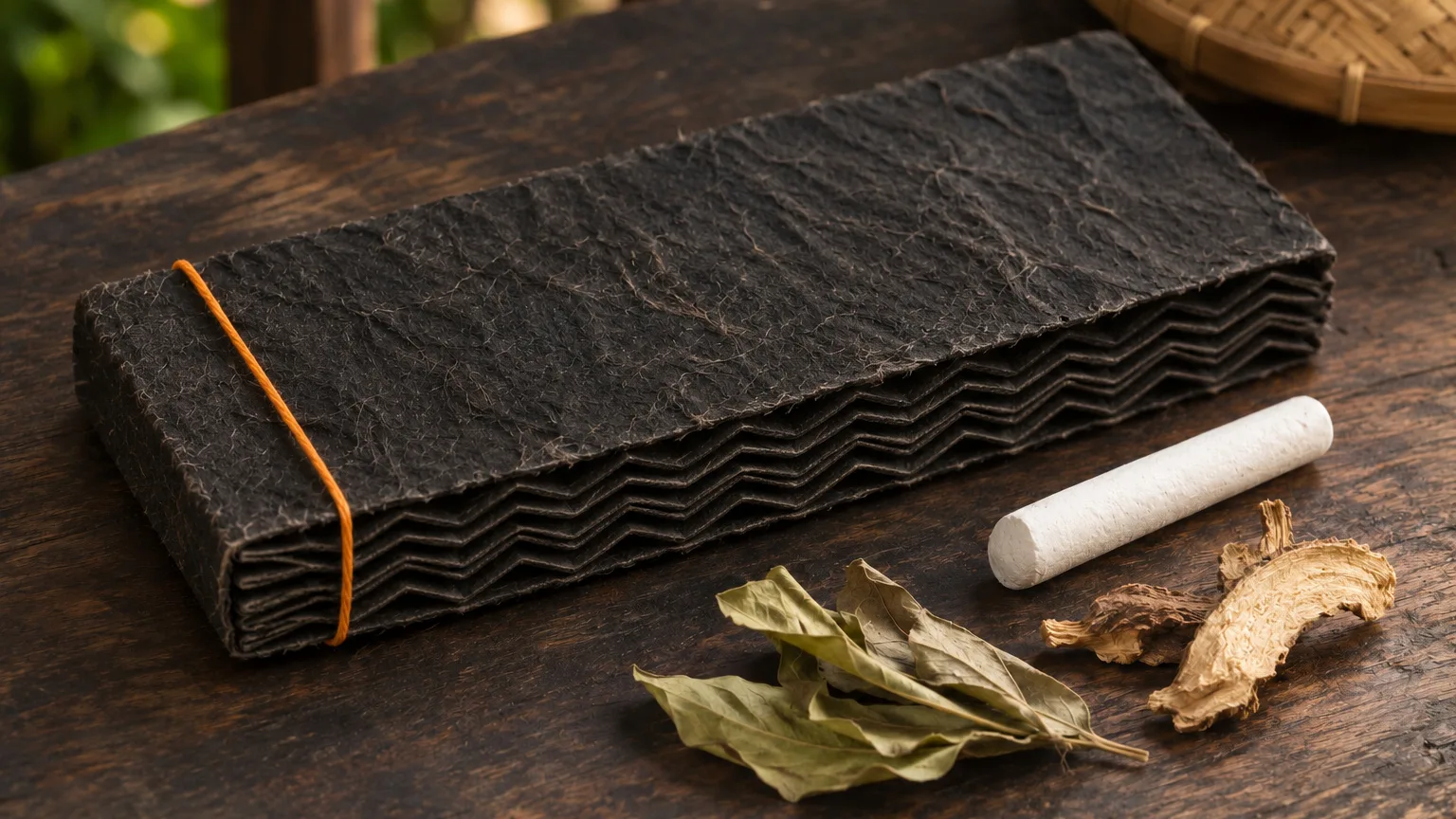
A black samut thai is made of khoi paper blackened with soot or finely ground charcoal, and is written on with a white chalk pencil or white ink, as the Thai Junior Encyclopedia, volume 32, explains. Picture white letters on black pages folded back and forth into a book.
The notice does not list the formulas by name. To find out which formulas the text contains, read the conservation edition or ask the registrar for preliminary information (see the section on using a formula below).
How this Thai medicine text travelled: from a black samut thai to the National Library and a conservation edition
Nobody knows who wrote Khamphi That Winitchai, and the copying date of the manuscript has not been found. There is still enough evidence to tell its story in stages.
Late 24th Buddhist century: when it was probably recorded
Kamphon Malaphim's 2017 thesis suggests that the text was recorded in the Rattanakosin period, in the late 24th Buddhist century. This is the researcher's estimate, not a year written in the manuscript.
6 February B.E. 2458: volume 3 enters the library
Notice No. 20 records the history of volume 3 as given
More than one medical text entered the library that day. Notice No. 35 (2023) records the history of Khamphi That Wiphang, no. 100, in the same words and with the same date of 6 February B.E. 2458.
2017: academic study
Kamphon Malaphim studied the text for a master's thesis in Epigraphy at Silpakorn University, titled "An Analytical Study of the Dhatuvinicchaya, a Thai Traditional Medical Text". It is the source of the account of the three-volume structure, the text's age and the five types of abnormal elements.
2018: declared a national text
The Minister of Public Health signed Notice No. 20 on 7 December 2018 (B.E. 2561), and it was published in the Royal Gazette on 22 January 2019 (B.E. 2562).
September 2019: the conservation edition
The Division for the Protection and Promotion of Thai Traditional Medicine Wisdom and Thai Folk Medicine, Department of Thai Traditional and Alternative Medicine, published "Tamra That Winitchai (conservation edition)" in its series of conservation editions of Thai traditional medicine texts. The first printing in September 2019 (B.E. 2562) ran to 1,000 copies, ISBN 978-616-11-4053-3, 353 pages, with a glossary and a bibliography, funded by the Thai Traditional Medical Knowledge Fund. The transcriber was Kamphon Malaphim, the same person who wrote the thesis, and the compilers were Dr. Nanthasak Chotchanadechawong and team.
So the story has a thread worth telling: one researcher carried the work forward, from studying the manuscript at university to transcribing it for a state edition. Manager Online (2023) commented that the text is knowledge that was nearly lost, that some parts have been lost over time, and that it is not yet part of the professional licensing curriculum.
- Probably recordedEstimate in Kamphon Malaphim's 2017 thesis
- Volume 3 enters the libraryGiven to the library, as the notice records
- ThesisEpigraphy, Silpakorn University
- Notice No. 20Declared a national text (Royal Gazette, 22 Jan 2019)
- Conservation editionDepartment of Thai Traditional and Alternative Medicine, ISBN 978-616-11-4053-3
Source: MOPH Notice No. 20 (2018) · Kamphon Malaphim (2017) · Tamra That Winitchai, conservation edition (2019)
Where the originals are, and how to read Khamphi That Winitchai
All three originals are at the National Library of Thailand, Fine Arts Department. The easiest way to read the content is the conservation edition from the Department of Thai Traditional and Alternative Medicine, which has already transcribed the manuscript into modern script. To see the originals or the library's copies, follow the library's steps.
1. Search the register in the ancient documents database
The National Library's site manuscript.nlt.go.th has a search page with four tabs: inscriptions, palm-leaf manuscripts, samut thai books, and scripture cabinets. You can search by register number, or by register title, cover title or subject. The samut thai tab shows the columns register, subject, category, group, sub-group and library. Try the samut thai tab and search for no. 113, 95 or 99, or for the Thai name
2. Register and apply online
The library's guide asks you to register as a member of the ancient documents database, then fill in the online form to request permission to study and use ancient documents. When the Director of the National Library approves, the system notifies you by email, and you then use the service at the Manuscripts and Inscriptions Group. The documents needed depend on the type of user. For example, members of the public use their ID card and a request letter, and students and civil servants use a letter from their institution.
3. Note the details before you apply
The service rules advise noting the category, group, title and number in full before you apply.
4. In the reading room
- If a printed, transliterated, microfilm or digital copy already exists, the library shows you the copy instead of the original.
- Users must wear gloves, lay the original on a cloth, rest it on a triangular wooden support, and must not trace over it or touch the writing.
- You may not photograph ancient documents yourself. Request copies through the staff, with one form per manuscript number.
Any work that uses information from the documents must credit the National Library and send one copy of the work to the Manuscripts and Inscriptions Group.
Declared a national Thai traditional medicine text: Notice No. 20 of 2018
The Notice of the Ministry of Public Health on the Declaration of National Thai Traditional Medicine Texts and National Thai Traditional Formulas (No. 20) B.E. 2561 was issued under section 4, paragraph one, and section 17 of the Protection and Promotion of Thai Traditional Medicinal Intelligence Act B.E. 2542 (1999). It was signed on 7 December 2018 and published in the Royal Gazette, volume 136, special part 20 Ng, page 6, on 22 January 2019.
Its annexed list has two texts: Khamphi That Winitchai in three volumes, with 182 formulas, and Wetchasueksa Phaetsat Sangkhep by Phraya Phitsanuprasatwet, which has its own article. The notice as a whole covers 451 formulas.
What "national" means
The notice has two clauses. Clause 1 makes the texts in the annexed list national Thai traditional medicine texts, and clause 2 makes the Thai traditional formulas in those texts national Thai traditional formulas. The result is that the formulas in Khamphi That Winitchai are national formulas, even though the notice does not name them one by one. Anyone who wants to use a formula in the ways section 19 describes must get permission first. Reading, studying or telling the history of the text is not on the list in section 19. Formula rights of every kind are explained in Thai traditional medicine formula rights.
If you want to use a formula from Khamphi That Winitchai in a product
If you have a formula that comes from Khamphi That Winitchai, or may come from it, there are two things to do before you invest in production.
1. Ask for preliminary information about the formula
The Notice of the Committee for the Protection and Promotion of Thai Traditional Medicinal Intelligence on Disclosure of Preliminary Information about National Thai Traditional Formulas or National Thai Traditional Medicine Texts B.E. 2560 (2017) lets an applicant for a use permit who wants preliminary information file the request form attached to the notice. The registrar discloses the herbal ingredients in proportion and the indications of the formula, or a short summary of the text. The form must state the purpose, the name of the formula or text, and the number of the notice that declared it national, which for this text is Notice No. 20.
This route is especially useful for this text, because the notice does not name the formulas. Comparing your formula with the registrar's information shows whether it matches a national formula.
2. Apply for a use permit under section 19
Section 19 of the Protection and Promotion of Thai Traditional Medicinal Intelligence Act says that anyone who will take a national Thai traditional formula to register a drug formula and apply for a licence to produce the drug, or to study, research and improve it into a new formula for commercial purposes, must apply for permission to use it and pay compensation for the use to the permitting authority, as set by ministerial regulation. The steps, forms and contract are explained in full in Thai traditional medicine formula rights.
Permission on the traditional knowledge side does not replace the Thai FDA steps. The product still has to go through the Thai FDA under the Herbal Products Act B.E. 2562 (2019) as usual. You can browse the texts and formula counts in every notice in the Formula rights check tool.
How far a brand can tell the story of the element theory
The history of the text can be told, but once the story appears in product advertising, the Herbal Products Act B.E. 2562 (2019) applies too. Section 70 says that no one may advertise a herbal product or the benefits of a herbal product unless they have a licence from the licensing authority.
Section 74 prohibits five kinds of advertising
- Boasting about the properties or ingredients of a herbal product by claiming they can treat, relieve or prevent disease or illness in a sacred way or according to personal belief (the same clause also prohibits claims that it "can cure a disease completely", or other words with a similar meaning).
- Stating properties that are false, exaggerated or misleading.
- Implying that the product contains an ingredient that it does not contain, or contains in a smaller amount than the ad implies.
- Endorsing or praising the product's properties through any person, group of persons or institution.
- Breaching the advertising criteria, methods and conditions set by the Minister on the Committee's advice.
Safe storytelling angles
- A text laid out like a course: elements, then materials, then formulas, showing how systematically Thai traditional doctors thought.
- Thai medicine, Buddhism and astronomy: one text covers the five aggregates, the seasons and the planets.
- From the library to a state printing: give the date in the notice and the year of the conservation edition as recorded.
- One researcher carried it forward: from the 2017 thesis to transcriber of the 2019 conservation edition.
What to avoid
- The phrases "balances the elements" (
ปรับธาตุ ) or "fixes impaired elements" (แก้ธาตุพิการ ) as product advertising, because they state a property. - Wording that makes the text sound sacred, or says the product works because it comes from an old text.
- Wording that implies the palace, the library, the Department of Thai Traditional and Alternative Medicine or any institution endorses the product.
- "Formula from Khamphi That Winitchai" if the product uses only part of a formula, or if you cannot show which volume and number the formula comes from and that permission has been granted.
If you state where a formula comes from, keep it true to what you actually did. Advertising a herbal product or its benefits needs a licence under section 70 before publication.
✘Avoid
- Using "balances the elements" or "fixes impaired elements" as product advertising
- Saying the text is sacred, or that the product works because the text is old
- Implying the palace, the library or a government body endorses the product
- Claiming a formula from the text when you use only part of it or have no permit
✔You can tell
- Three volumes laid out like a course: elements, materials, formulas
- The text links Thai medicine with Buddhist teaching, the seasons and the planets
- The date in the notice and the year of the conservation edition, as recorded
- Credit the text, the notice and the studies by name
Advertising a herbal product or its benefits needs a licence under section 70 and must not fall under the prohibitions in section 74 of the Herbal Products Act B.E. 2562 (2019).
Images of the originals, and copyright in the printed edition
Images of the National Library originals
The National Library's ancient documents service page says that photographing or copying for trade or profit needs permission from the Director-General of the Fine Arts Department. The service rules also ask you to write to the Director-General before publishing images of ancient documents in a book, research, thesis or article. If a brand wants to use a real page of the text on packaging or in media, ask for permission first and credit the National Library.
Without permission, use a samut thai image with a clear licence, and caption it accurately as an example of a samut thai, not as the original of Khamphi That Winitchai.
A modern printed edition may be under copyright
The 2019 conservation edition is a new book, with the transcription, editing, glossary and layout of its makers. The Copyright Act B.E. 2537 (1994) counts books and printed matter as literary works, and gives the copyright owner the exclusive right to reproduce, adapt and communicate the work to the public (sections 4, 6 and 15). On the other hand, section 6, paragraph two, says protection does not extend to ideas, procedures, processes, systems or concepts.
In practice, retelling the content in your own words with a credit is different from reprinting pages or long passages. If you want to reproduce pages or images from the conservation edition for commercial use, ask its makers first. This section is a caution, not a legal opinion on any particular case.
Historical references
- Notice of the Ministry of Public Health on the Declaration of National Thai Traditional Medicine Texts and National Thai Traditional Formulas (No. 20) B.E. 2561. Royal Gazette, vol. 136, special part 20 Ng, p. 6, 22 January 2019.
- Notice of the Ministry of Public Health on the Declaration of National Thai Traditional Medicine Texts and National Thai Traditional Formulas (No. 35) B.E. 2566. Royal Gazette, vol. 140, special part 273 Ng, p. 124, 1 November 2023.
- Kamphon Malaphim. (2017). An Analytical Study of the Dhatuvinicchaya, a Thai Traditional Medical Text. Master's thesis, Epigraphy, Silpakorn University.
- Division for the Protection and Promotion of Thai Traditional Medicine Wisdom and Thai Folk Medicine, Department of Thai Traditional and Alternative Medicine. (2019). Tamra That Winitchai (conservation edition). Transcribed by Kamphon Malaphim; compiled by Nanthasak Chotchanadechawong et al. Bangkok: Samcharoen Panich. ISBN 978-616-11-4053-3.
- Panthep Puapongpan. (2023, 4 August). "Khamphi That Winitchai": Thai traditional medicine knowledge that was nearly lost. Column Na Ban Phra Athit, Manager Online.
- National Library of Thailand, Fine Arts Department. Ancient documents service. Accessed 18 November 2026.
- National Library of Thailand. Database of ancient documents, inscriptions, samut thai, scripture cabinets and palm-leaf manuscripts (manuscript.nlt.go.th): search page, service rules, and guide to requesting ancient documents. Accessed 18 November 2026.
- Thai Junior Encyclopedia, volume 32, on samut thai books (preparing and writing samut thai).
Frequently asked questions
How many volumes and formulas does Khamphi That Winitchai have?
Three volumes, National Library manuscripts nos. 113, 95 and 99. Notice No. 20 of 2018 says volume 1 deals with the diagnosis of the elements and gives no formula count, volume 2 has 79 formulas and volume 3 has 103, for 182 in all.
In this Thai medicine element theory text, how many kinds of abnormal element are there?
Kamphon Malaphim's 2017 thesis says the text classifies abnormal elements during illness into five types: aggravated, weakened, impaired, broken, and leaving the body.
When was Khamphi That Winitchai written?
The notice gives no date of writing. Kamphon Malaphim's 2017 thesis suggests it was recorded in the Rattanakosin period, in the late 24th Buddhist century. The notice records that volume 3 was given to the library on 6 February B.E. 2458.
Where can I read it in modern Thai script?
The Department of Thai Traditional and Alternative Medicine published Tamra That Winitchai (conservation edition) in September 2019, ISBN 978-616-11-4053-3. To see the National Library originals or copies, search the register at manuscript.nlt.go.th and apply online.
Can I use a formula from Khamphi That Winitchai in a product?
Its formulas are national Thai traditional formulas under Notice No. 20. To register a drug formula and apply for a production licence, or to research and improve one into a new formula for commercial purposes, you need a use permit under section 19, and the product still goes through the Thai FDA. Browse the notices in the Formula rights check tool.
Can I say a product "balances the elements" based on this text?
Avoid it, because it states a property. Advertising a herbal product or its benefits needs a licence under section 70, and section 74 prohibits exaggerated claims and claims of sacred effect. You can tell the text's history, but do not use the text as evidence that the product works.
Sources
- Protection and Promotion of Thai Traditional Medicinal Intelligence Act B.E. 2542 (1999) · Open source · Search our archive
- Ministry of Public Health Notice on the Declaration of National Thai Traditional Medicine Texts and National Thai Traditional Formulas (No. 20) B.E. 2561 (2018) · Open source · Search our archive
- Committee Notice on Disclosure of Preliminary Information about National Thai Traditional Formulas or Texts B.E. 2560 (2017) · Open source · Search our archive
- Herbal Products Act B.E. 2562 (2019) · Open source · Search our archive
- Copyright Act B.E. 2537 (1994), consolidated to amendment No. 3 B.E. 2558 (2015) · Open source · Search our archive
This article is for general information. It is not a Thai FDA ruling or legal advice, and rules change — check the latest notification or ask an expert before filing or producing. Spotted an error? Tell us and we will correct it
Related articles
 Brand ownersThai Traditional Medicine Formula Rights: National, General and Personal Formulas Before the Thai FDA StepsThai traditional medicine formulas come in 3 types. National ones need permission to use, personal ones the right holder's consent, then Thai FDA steps.
 Brand ownersAyurawet Sueksa Thai Medicine Text: A 1953 Textbook Declared National, With 2,773 FormulasKhun Nitthet Sukkit's Ayurawet Sueksa, first printed in 1953, became a national Thai medicine text in 2018. Two spellings, where to read it, lawful use.
 Brand ownersKhun Sophit Bannalak's Thai Traditional Medicine Text: a 1961 Teacher's Textbook Declared National Three TimesThe Khun Sophit Thai traditional medicine text: who wrote it, what is inside, why it was declared three times, formula permission and copyright caution.