 FDA Thailand
 Brand owners
Wat Ratchaorot Medicine Inscriptions: 50 Marble Slabs, 186 Thai Formulas and What Brands Should Know
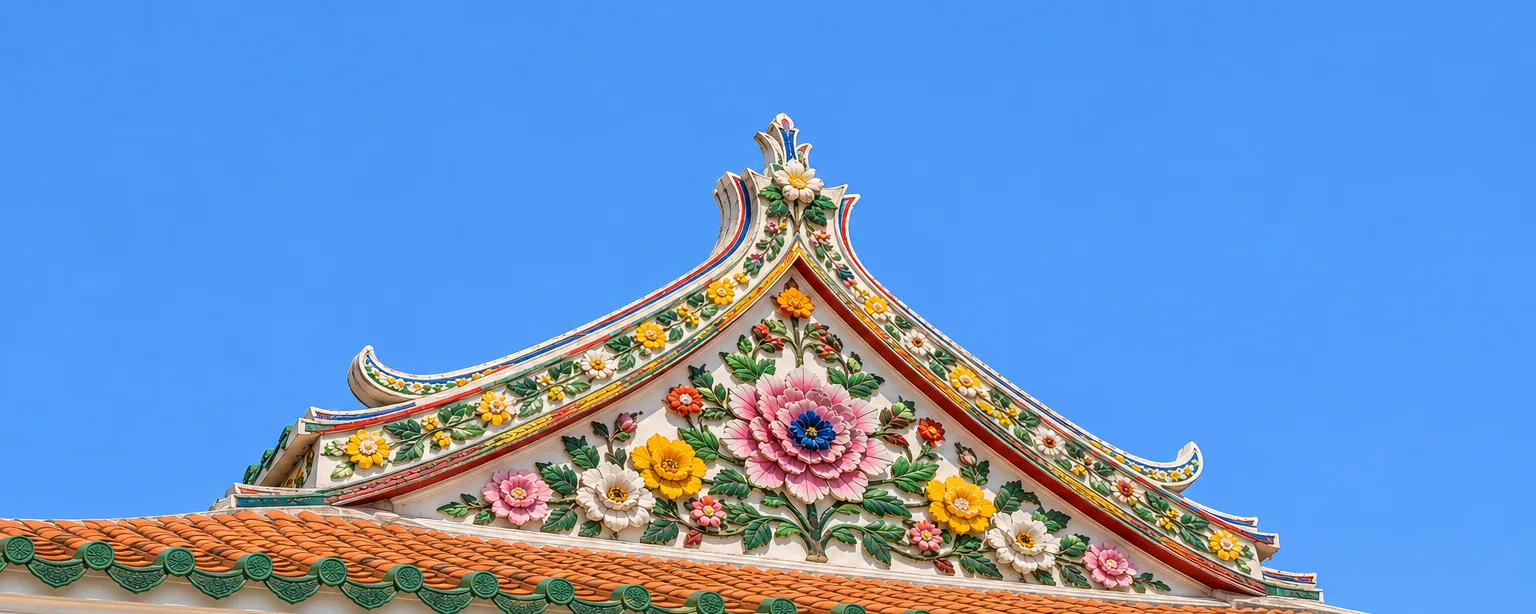
What are the Wat Ratchaorot medicine inscriptions? A Thai traditional medicine text on 50 marble slabs
The Wat Ratchaorot medicine inscriptions are a Thai traditional medicine text carved on marble slabs set into the cloister gallery of Wat Ratchaorotsaram Ratchaworawihan. King Rama III had them carved in 2364 BE (1821) while he was still Prince Chetsadabodin (Krom Muen Chetsadabodin), a son of the reigning king. Fifty slabs remain today, and the Ministry of Public Health declared all 50 a national Thai traditional medicine text in Notice No. 3, dated 30 March 2559 BE (2016), covering 186 formulas.
The set is about 10 years older than the medicine inscriptions at Wat Pho. The text on each stone gives everything from the name of the disease and the name of the medicine to the ingredients, how to prepare it and how to use it, so these old formulas give a clear picture of how a medicine maker worked two hundred years ago.
This article tells the story of the Wat Ratchaorot inscriptions specifically: where they came from, what the slabs look like, what is carved on them, and what Thai medicine students, product R&D teams and herbal brand owners should know before using a formula from them or telling their story on a product. For the whole system of rights in Thai traditional formulas, see Thai traditional medicine formula rights.
1821: Prince Chetsadabodin restores the temple and has Thai medicine recipes carved in stone
An academic article by Wattana Chayathawat (2021) in the Journal of Thai Traditional Medicine Research, citing a Fine Arts Department book (2002), explains that Rama III had this set of medicine inscriptions made while he was still Prince Chetsadabodin, during the restoration of Wat Ratchaorot in 2364 BE (1821). The inscriptions are therefore more than 200 years old.
This was a period when the royal court cared about collecting medical texts. One example is the preface to the first printing (1916) of the Royal Pharmacopoeia of King Rama II, which says that in 2355 BE (1812) King Rama II found the texts in the royal pharmacy incomplete and had formulas collected from monks, officials and ordinary people. The Wat Ratchaorot inscriptions came about nine years later, with one difference: they were not kept in a library or pharmacy but carved on stone in a temple.
The sources we found do not say directly why medicine was carved at this temple, so we do not guess on the builder's behalf. What the sources do say is that the Wat Ratchaorot inscriptions predate the medicine inscriptions at Wat Phra Chetuphon Wimon Mangkhalaram (Wat Pho), made under Rama III around 2375 BE (1832), by about 10 years. Both sets are linked to Rama III, made at different times. The story of the much larger Wat Pho set is told separately in the Wat Pho medical inscriptions.
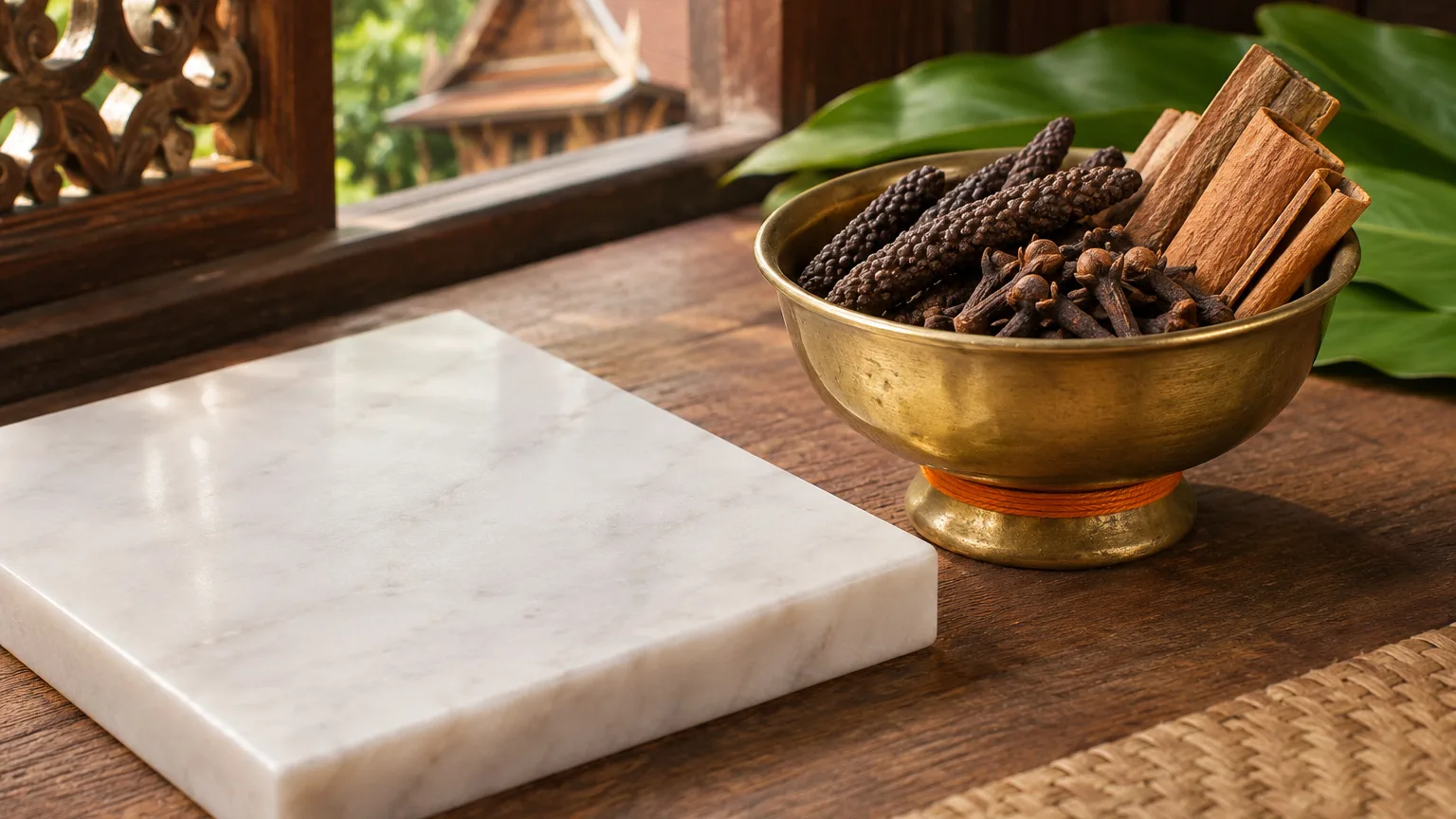
Old Thai medicine formulas on 33 cm marble squares, each opening with sitthikariya
According to Wattana Chayathawat (2021), the Wat Ratchaorot inscriptions are carved on square marble slabs 33 centimetres wide (a little longer than a 30 cm ruler), set in a row along the cloister gallery. The size is small enough for someone walking past to stop and read one slab at a time.
One slab, one topic
The same article explains that each slab opens with the word "sitthikariya"
- The name or signs of the disease, in the text's own terms
- The name of the medicine (some formulas have none)
- The ingredients: the herbs and other materials used
- How to prepare it
- How to use it
The annex to Notice No. 3 quotes the opening text of every slab, and "sitthikariya" leads the quoted text for 30 of the 50 slabs. For many of the others the annex quotes only the disease name, such as "the seven kinds of sannibat" or "asthma". Anyone who wants the full wording of a slab should read the Fine Arts Department book or look at the slab itself at the temple.
Researchers should also know that, according to Wattana Chayathawat, the Wat Ratchaorot inscriptions do not give the properties of each herb on its own. They give properties at the level of the formula: this formula is used for this disease. An R&D team that needs herb-by-herb information has to find it in other texts, such as texts on the properties of medicines, not in this set.
What is in this Thai traditional medicine text: 186 formulas, disease groups and formula names
The annex to Notice No. 3 is arranged by slab, from slab 1 to slab 50. For each slab it gives the disease described, the number of formulas and the formula names: 186 formulas in total. Of these, 37 have names. For the other 149, the annex says "medicine name not stated", because the slab gives the formula no name.
Disease groups in the text's own terms
Reading the annex for all 50 slabs shows that the inscriptions cover many groups of conditions in the Thai traditional medicine system, using old names that should not be translated into modern diagnoses on your own. For example:
- Lom (wind) conditions of several kinds, such as lom chatubat wayo, lom bat thayak, lom ba mu and lom chuk siat
- Kalon conditions, such as kalon en, kalon hin, kalon nam and kalon lom
- Fevers, such as the seven kinds of sannibat and khai chaliang
- Children's conditions, which the text calls kuman kumari, on at least 5 slabs
- Other conditions, such as atisan, thurawasa, rit siduang, asthma, fi dat, mutakit, klak and kluean, rattapitta and thong man
Besides formulas, some slabs are charts or manual-therapy texts: slab 16, the face-down leech chart (phaen pling khwam); slab 19, the face-up leech chart (phaen pling ngai); and slab 45, the face-down massage chart (phaen nuat khwam).
Formula names that appear in the notice
Named formulas in the annex include Ya Phrom Phak, Ya Samut Kluean and Ya Rattana That (slab 5), Ya Suriyawutthi, Ya Ratcha Wirechana Osot, Ya Lueang Horakhun, Ya Khiao Khi Thong, Ya Sangkha Ratsami, Namman Sanan Traiphop, Ya Nawa Hoi, Ya Narai Phang Khai, and Ya Borom Sukhi Wirechana and Ya Maha Anantakhun on the last slab. Many names show the form of the medicine, such as a wash (ya cha), a powder sprinkled on wounds (ya roi pak phlae) and a wax ointment (sie phueng) on slab 2, or decoctions and oils on other slabs.
These formula names were published in the Royal Gazette and anyone can read them, but the annex does not give the ingredients or their proportions. That information is on the slabs and in the book, and an applicant for permission to use a formula can ask the registrar for it, as explained in section 7.
Where the original is and how to read these old Thai medicine formulas
Unlike many other national texts, which are folding books or palm-leaf manuscripts kept in a library, the original of this text is still set into the cloister gallery of Wat Ratchaorotsaram Ratchaworawihan. There are three ways to read it:
- See the slabs at the temple. The slabs are within the temple grounds. Visitors should dress modestly and respect the place. If you want to photograph them for business use, ask the temple for permission first.
- The Fine Arts Department book titled "Charuek Tamra Ya Wat Ratchaorotsaram Worawihan" (Medicine Inscriptions of Wat Ratchaorotsaram Worawihan), published in 2545 BE (2002) by Arthit Products Group, as cited in Wattana Chayathawat (2021). This is the edition to use when you need the full wording of a formula. Search for it in library catalogues.
- The annex to Notice No. 3 in the Royal Gazette, volume 133, special part 93 Ngo, dated 22 April 2559 BE (2016), gives a slab-by-slab overview: the disease, the number of formulas and the formula names. You can open it in our law archive.
A note on the temple's name when searching: the notice itself uses "Wat Ratchaorotsaram Ratchaworawihan", but the heading of the annex and the title of the Fine Arts Department book use "Wat Ratchaorotsaram Worawihan". Try both in library catalogues.
In our searches we did not find an official digital edition of the book that an agency offers for download, and we found no record that this set has been nominated to UNESCO. If you come across a copy of the book uploaded by a user to a general website, be careful about copyright, as described in section 9.
Declared a national Thai traditional medicine text: Notice No. 3 of 2016, and the leech charts in Notice No. 2
Section 17 of the Protection and Promotion of Traditional Thai Medicinal Intelligence Act B.E. 2542 (1999) empowers the Minister to declare Thai traditional formulas or texts that are of special benefit or value to medicine or public health as national Thai traditional formulas or national Thai traditional medicine texts. "National" is therefore not a word of praise but a legal status, under which commercial use needs permission first.
Notice No. 3 of 2016
Ministry of Public Health Notice No. 3 was issued under sections 4 and 17, dated 30 March 2559 BE (2016), and published in the Royal Gazette on 22 April 2559 BE (2016). It has two operative clauses:
- Clause 1 makes the stone inscriptions of Wat Ratchaorotsaram Ratchaworawihan listed in the annex a national Thai traditional medicine text.
- Clause 2 makes the Thai traditional formulas in that text national Thai traditional formulas.
Clause 2 matters a great deal for businesses, because protection covers every formula in the text, including the 149 formulas the annex lists as "medicine name not stated". A formula having no name does not mean it is free to use.
The leech charts in Notice No. 2
A few months before Notice No. 3, Notice No. 2, dated 25 December 2558 BE (2015), had already declared "the Thai leech chart texts" (tamra phaen pling khong thai) a national text. That text is made up of 7 folding books held by the National Library and 2 stone slabs from Wat Ratchaorotsaram Ratchaworawihan on the face-down and face-up leech charts, which match slabs 16 and 19 in the annex to Notice No. 3. These two slabs therefore appear in two notices.
An overview of all the national text notices, and how to read them, is in Thai traditional medicine formula rights.
- Medicine carved on marbleDuring the temple's restoration, under Prince Chetsadabodin
- Wat Pho medicine inscriptionsMade under Rama III about 10 years later
- Fine Arts Department bookMedicine Inscriptions of Wat Ratchaorotsaram Worawihan
- Notice No. 2Thai leech chart texts, including 2 slabs from the temple
- Notice No. 350 slabs, 186 formulas declared a national text; Royal Gazette 22 April 2016
Using an old formula from the inscriptions in a product: preliminary information and permission under section 19
If your team is interested in a formula from the Wat Ratchaorot inscriptions for a product, there are two steps on the formula-rights side to understand before you invest.
Step 1: ask for preliminary information on the formula
The Committee's notice on disclosing preliminary information about national Thai traditional formulas or national Thai traditional medicine texts, B.E. 2560 (2017), lets an applicant for permission to use a formula who wants preliminary information file the request form attached to the notice (form Por.Tor. 17). The information the registrar discloses is the herbal ingredients in proportion and the properties of the formula, or a short summary of the essence of the text.
The form asks for your purpose, for example registering the formula and applying for a manufacturing licence, or research to develop a new formula for commercial use, and for the name of the formula or text with the number of the Ministry of Public Health notice that declared it. For this text that is Notice No. 3 of 2559 BE (2016). Because most formulas have no name, we suggest also giving the slab number and the formula's position in the annex, so that officials can identify the formula exactly.
Step 2: apply for permission to use it under section 19
Section 19 provides that anyone who wishes to take a national Thai traditional formula to register a medicine formula and apply for a manufacturing licence under the drug law, or to research it in order to improve or develop a new formula for commercial benefit, must file an application for permission to use it and pay compensation for that use to the licensing authority, under the rules in the ministerial regulation. The procedure, the contract and the duties after permission are covered in the main article of this series.
Rights in the formula are a separate matter from approval of the product. Once the rights side is settled, the product still has to follow the Thai FDA route for its product type. You can start with the formula check tool, which walks through the questions one step at a time.
How far can a brand tell this story? Keeping a Thai traditional medicine story within advertising law
The story of 200-year-old inscriptions is a good story for a brand, but once it appears in material that sells a product, it becomes advertising. If the product is a herbal product, the law that applies is the Herbal Products Act B.E. 2562 (2019).
- Section 70 prohibits anyone from advertising a herbal product or its benefits unless they have first obtained a licence from the licensing authority.
- Section 74 prohibits advertising a herbal product in the following ways: (1) boasting that the properties or ingredients of the herbal product can remedy, relieve or prevent a disease or illness in a sacred way or according to personal belief, or claiming that it can cure a disease completely; (2) showing properties that are false, exaggerated or misleading as to the properties of that herbal product; (3) suggesting that it contains an ingredient that it does not in fact contain, or contains less of it than the advertisement suggests; (4) endorsing or praising the properties of the herbal product by any person, group of persons or institution.
If the product is a cosmetic or a food, it falls outside the definition of a herbal product in section 4, and the law for that product type applies instead. The principle of not overclaiming still holds.
Safe ways to tell the story
- Tell historical facts and say where they come from, for example that the inscriptions were carved in 1821 on marble, that 50 slabs remain, and that they were declared a national text in Notice No. 3 of 2016.
- Describe how a slab is laid out: the word "sitthikariya" and the order of disease, medicine name, ingredients, preparation and use, as part of a heritage of knowledge.
- Explain how your team studied the inscriptions, which book you used, and which formula you have permission to use, once you actually have it.
- Say honestly that the product uses some of the herbs found in a formula, if it does not use the whole formula.
What to avoid
- Words suggesting sacredness or special power, such as "a sacred temple formula"
- Suggesting that the temple, the palace or any institution endorses the product
- Turning a disease name or text from a slab into a product claim. The text says which formula was used for which disease, but that is not a claim the product has been allowed to make.
- Saying that the product uses a formula from the inscriptions when it uses only part of it or has changed the proportions
- Calling it "the oldest" or "the model for Wat Pho", which we found no source to support
✘Don't
- Claim the formula is sacred or has special power
- Suggest the temple, the palace or an agency endorses the product
- Turn disease names on the slabs into product claims
- Say you use a formula from the inscriptions when you use only part of it
- Call it the oldest without a source
✔Do
- Tell the 1821 date and the 50 marble slabs, with sources
- Describe the word sitthikariya and how a slab is laid out
- Cite Notice No. 3 of 2016 correctly
- Say which formula you have permission to use, once you have it
- Use illustrations you made or images you have permission for
Source: Herbal Products Act B.E. 2562, sections 70 and 74
Images of the original and copyright in the printed edition
This section is a caution, not a legal ruling. Before real use, ask the rights holder or an expert.
Photographs of the slabs at the temple
The slabs are at a temple. If you want to photograph them for packaging, advertising or brand material, ask the temple for permission first, and do not use the images in a way that suggests the temple endorses the product, which links to the prohibition in section 74 (4) described above.
The leech-chart folding books at the National Library
The folding-book part of the leech-chart text is held by the National Library. According to the National Library's manuscript service page, photographing or copying for trade or profit requires permission from the Director-General of the Fine Arts Department, and the service rules say that publishing images of manuscripts in a book, research work or article requires a letter to the Director-General. Users do not photograph manuscripts themselves; copies are requested through staff.
The printed edition of 2002
The formulas on the stones are more than 200 years old, but the Fine Arts Department book printed in 2545 BE (2002) is a recent publication that may contain transcriptions, photographs, commentary and layout that are the creative work of its makers. The Copyright Act B.E. 2537 (1994) gives the copyright owner the exclusive right to reproduce, adapt and communicate a work to the public, and copyright generally lasts for the life of the author plus 50 years. So do not photograph pages or copy long passages into brand material without permission. The National Library's rules also advise that anyone who wants to publish a book whose copyright belongs to the Fine Arts Department should ask its Office of Literature and History.
A simpler route is to use illustrations you create yourself, such as images of herbs and medicine-making tools, and to tell the facts about the inscriptions in words, with their sources.
Historical references
The historical facts in this article come from the following sources (legal sources are in the source list at the end of the article).
- Wattana Chayathawat. (2021). The origin of herbal properties in Thai traditional medicine texts: a case study of cinnamon [in Thai]. Journal of Thai Traditional Medicine Research, 7(2) (July–December 2021), p. 137 onwards. Thai Traditional Medicine Program, Faculty of Allied Health Sciences, Pathumthani University.
- Fine Arts Department. (2002). Charuek Tamra Ya Wat Ratchaorotsaram Worawihan [Medicine inscriptions of Wat Ratchaorotsaram Worawihan, in Thai]. Bangkok: Arthit Products Group. (Cited from Wattana Chayathawat, 2021)
- Royal Pharmacopoeia of King Rama II [in Thai]. (1916). Preface to the first printing. (On the 1812 collection of formulas)
- Department of Thai Traditional and Alternative Medicine. Summary table of national protection of formulas in Thai traditional medicine texts [in Thai] (file 5.1).
- Royal Gazette, volume 133, special part 93 Ngo (22 April 2016). Ministry of Public Health Notice No. 3 of 2016, with annex.
- Royal Gazette, volume 133, special part 7 Ngo. Ministry of Public Health Notice No. 2 of 2015 (Thai leech chart texts).
- National Library of Thailand, Fine Arts Department. Manuscript service, and rules for using the manuscript database [in Thai]. Accessed 18 November 2026.
Frequently asked questions
How many slabs and formulas do the Wat Ratchaorot medicine inscriptions have?
Fifty slabs remain. Ministry of Public Health Notice No. 3 of 2016 declared all 50 a national Thai traditional medicine text covering 186 formulas: 37 named, and 149 listed as medicine name not stated.
When were they carved, and by whose command?
In 2364 BE (1821). Rama III had them carved while he was still Prince Chetsadabodin, during the restoration of Wat Ratchaorot, according to Wattana Chayathawat (2021), citing the Fine Arts Department book (2002).
How do they differ from the Wat Pho inscriptions?
The Wat Ratchaorot set was made about 10 years earlier, on 33 cm square marble slabs in the cloister gallery, and was declared a national text in Notice No. 3 of 2016. The Wat Pho set is much larger and is in the first notice of 2015.
Are the unnamed formulas protected too?
Yes. Clause 2 of Notice No. 3 makes the Thai traditional formulas in this text national Thai traditional formulas, so all 186 formulas are covered, including those listed as medicine name not stated.
What do I need to do to use a formula from these inscriptions in a product?
File form Por.Tor. 17 for preliminary information on the formula under the Committee's notice of 2017, then apply for permission to use it under section 19 of the Protection and Promotion of Traditional Thai Medicinal Intelligence Act B.E. 2542. The product itself must then go through the Thai FDA steps for its product type.
Can I use photos of the slabs or pages of the Fine Arts Department book in brand material?
Ask for permission first. Photos taken at the temple need the temple's permission and should not suggest that the temple endorses the product. The 2002 printed book may carry copyright in its transcriptions, photos and layout, so do not reproduce it without permission.
Sources
- Protection and Promotion of Traditional Thai Medicinal Intelligence Act B.E. 2542 (1999) · Open source · Search our archive
- Ministry of Public Health Notice on national Thai traditional medicine texts and formulas (No. 3) B.E. 2559 (2016) · Open source · Search our archive
- Ministry of Public Health Notice on national Thai traditional medicine texts and formulas (No. 2) B.E. 2558 (2015) · Open source · Search our archive
- Committee Notice on disclosing preliminary information about national Thai traditional formulas or texts B.E. 2560 (2017) · Open source · Search our archive
- Herbal Products Act B.E. 2562 (2019) · Open source · Search our archive
- Copyright Act B.E. 2537 (1994), consolidated to amendment No. 3 B.E. 2558 (2015) · Open source · Search our archive
This article is for general information. It is not a Thai FDA ruling or legal advice, and rules change — check the latest notification or ask an expert before filing or producing. Spotted an error? Tell us and we will correct it
Related articles
 Brand ownersThai Traditional Medicine Formula Rights: National, General and Personal Formulas Before the Thai FDA StepsThai traditional medicine formulas come in 3 types. National ones need permission to use, personal ones the right holder's consent, then Thai FDA steps.
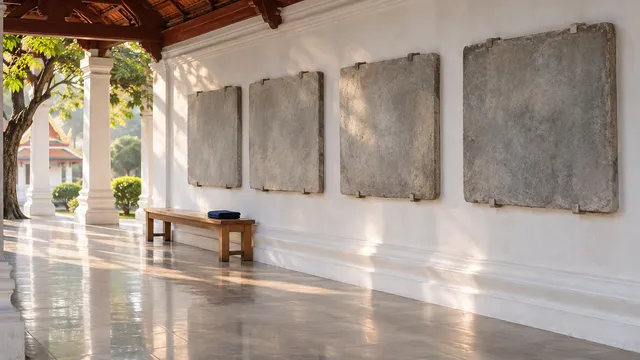 Brand ownersWat Pho Medical Inscriptions: Thai Medicine Texts in Stone, the First National Text, and Lawful UseWat Pho medical inscriptions: 380 slabs and 1,061 formulas, the first national Thai medicine text. History, UNESCO, how to read them and lawful brand use.
 Brand ownersAyurawet Sueksa Thai Medicine Text: A 1953 Textbook Declared National, With 2,773 FormulasKhun Nitthet Sukkit's Ayurawet Sueksa, first printed in 1953, became a national Thai medicine text in 2018. Two spellings, where to read it, lawful use.