 FDA Thailand
 Brand owners
Wat Tha Muang Isan Palm-Leaf Medicine: 1,504 Folk Formulas from the Chi River, Now a National Thai Text
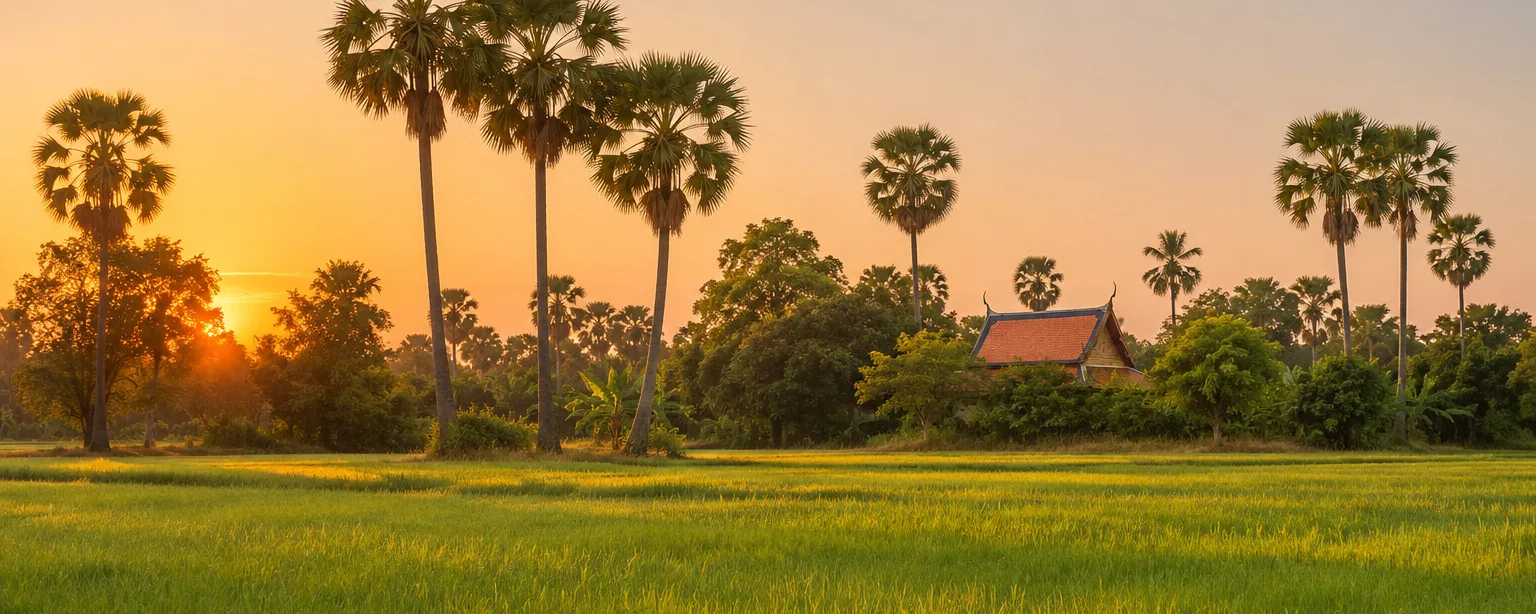
What is the Wat Tha Muang text: an Isan folk medicine text of 1,504 formulas on palm leaf
The Wat Tha Muang Isan palm-leaf medicine text
This article tells the story of the text in order: the community on the Chi River that kept the palm leaves, the old scripts they were inscribed in, Mahasarakham University's transliteration, and the day the text was declared national. It then sets out what a brand owner should know before telling this story or using a formula. For an overview of rights in every type of Thai traditional medicine formula, read Thai traditional medicine formula rights.
A large local Isan text among the national texts
Many national texts are royal texts printed for medical schools, or texts by teachers of traditional medicine used to prepare for the licensing exam. The Wat Tha Muang text is different: it is the knowledge of a rural Isan community, recorded in a local script on palm leaf. In the notice data we have compiled, the other national texts identified as coming from Isan are two items in Notice No. 26 of 2020, with 483 formulas between them. With 1,504 formulas, the Wat Tha Muang text is the largest local Isan text we have found. That matters for regional and community brands, and we come back to it in the section on telling the story in a brand.
Source: MOPH Notice (No. 21) B.E. 2562 · Narongsak Rawarin (2021) · The Isaan Record (2024) · Community Wiki, Sirindhorn Anthropology Centre
Ban Tha Muang on the Chi River: the Thai Noi community that kept an Isan folk medicine text on palm leaf
Ban Tha Muang is in Tha Muang Subdistrict, Selaphum District, Roi Et Province, on the bank of the Chi River, and covers village groups 2, 3, 4 and 9, according to the Community Wiki of the Princess Maha Chakri Sirindhorn Anthropology Centre. The Community Wiki says the village takes its name from the many mango trees (muang) at its bathing landing on the river.
Ancestors from Vientiane
According to community oral history, recorded in the same way by The Isaan Record (2024) and the Community Wiki, the ancestors of Ban Tha Muang, led by Pho Yai Sut and Mae Yai Bapha, migrated from Ban Na Phang Suan Mon in Vientiane. The Community Wiki says most villagers are of Lao Vieng descent but call themselves "Thai Noi". Online sources give conflicting years for the migration, so this article gives no year, and we suggest brands do the same until there is verifiable evidence.
Wat Tha Muang and the community's palm-leaf collection
The Community Wiki says the Centre for Local Culture and Wisdom at Wat Tha Muang holds about 360 bundles of palm-leaf manuscripts, mostly inscribed in Dhamma script, and that Mahasarakham University researchers collected and registered them from 2011, finishing in 2012. This figure comes from a single source, so it should always be told with its source. The Isaan Record says the community's palm leaves record Isan folk medicine, moral tales and local literature, so the medicine texts are part of a body of knowledge wider than medicine.
A script that is still taught
What sets this story apart from many other old texts is that its script still has people carrying it on. The Isaan Record reports that a community scholar, working with Mahasarakham University, taught Thai Noi script in the village school in 2011–2012 and kept teaching after retiring in 2013. The Community Wiki records that the community uses Thai Noi script on the school sign, the Wat Tha Muang sign and the logo of the silk weaving group, and that village group 3 was selected as an OTOP Nawatwithi (community tourism) village in 2018. The Wat Tha Muang text is not just an old document in a cabinet; it belongs to a living community.
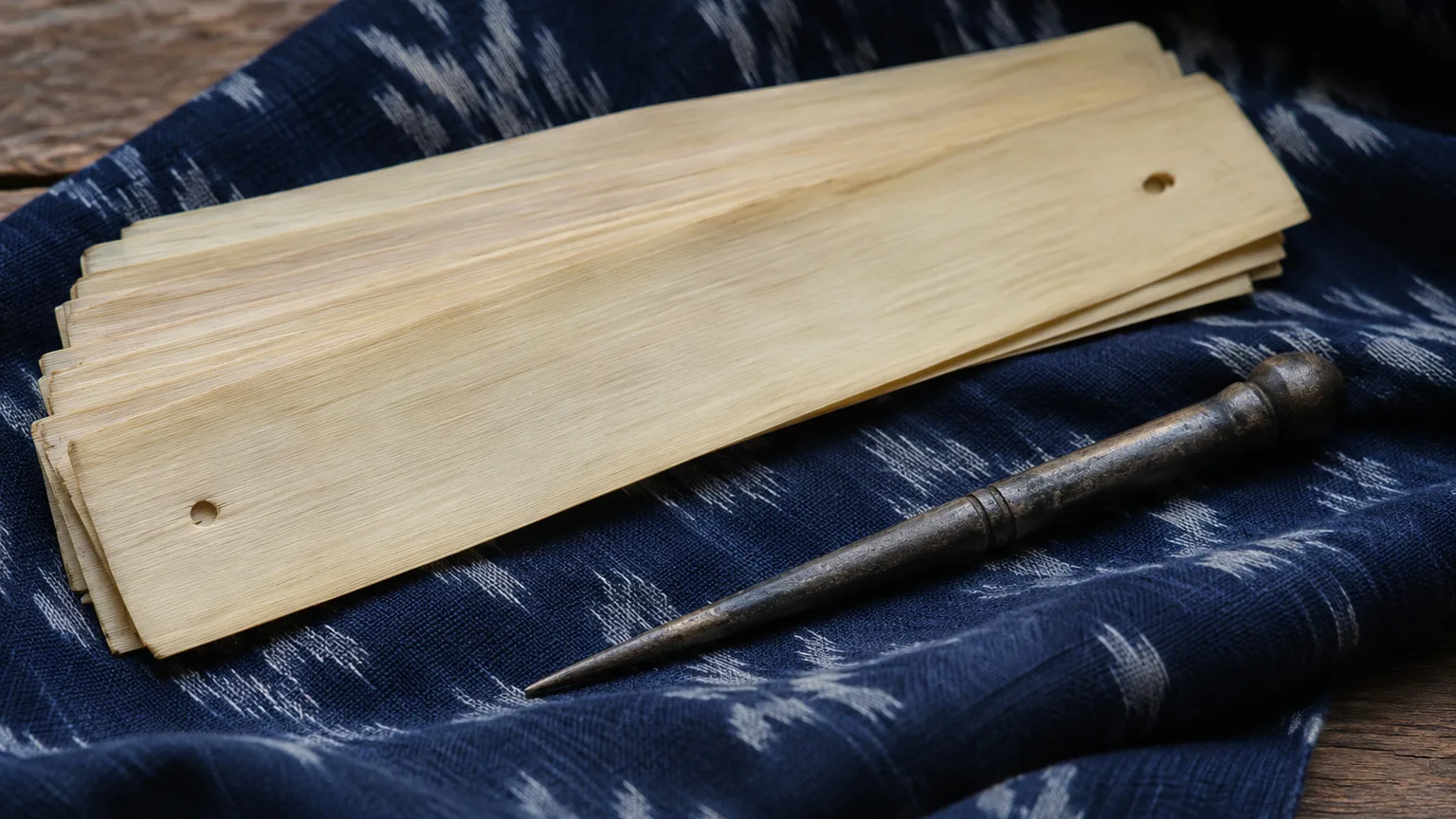
Palm-leaf manuscript, Isan Dhamma script and Thai Noi script: how the formulas were recorded
"Palm leaf" and "Dhamma script" may sound remote, but they explain why this text had to pass through scholars' hands before ordinary readers could use it.
What a palm-leaf manuscript is and how it is made
The National Library's database of old manuscripts explains that a palm-leaf manuscript is a book whose letters are inscribed with a sharp metal stylus onto the leaves of the lan palm. Most are Buddhist teachings, but some cover other subjects. TrueplookPanya, citing the Thai Junior Encyclopaedia, describes how the leaves are prepared: young, newly opened leaves are chosen, left out in sun and dew, soaked or boiled, dried, pressed between boards and trimmed, smoked over a rice-husk fire against mould, polished with hot sand, then pierced and strung into "bundles" (phuk) of about 24 leaves each. The "360 bundles" at Wat Tha Muang therefore means several thousand leaves strung in sets.
Isan Dhamma script
The list attached to Notice No. 21 classes the Wat Tha Muang text as "an old document in Isan Dhamma script", and the Community Wiki says most palm leaves at Wat Tha Muang are inscribed in Dhamma script. Another Isan text in Notice No. 26 is also described as translated from Dhamma script. This shows that the script was a main medium for the Isan medicine texts the state has declared protected. Most young people cannot read it, so the texts had to be transliterated first.
Thai Noi script
The Isaan Record (2024) explains that Thai Noi script has been used in Laos and Isan since around the 16th century CE (the 21st Buddhist century), and that the oldest inscription it cites is at Wat Daen Mueang (Wat Patchantaburi), Phon Phisai District, Nong Khai, dated 1530 (B.E. 2073). The same article says Mahasarakham University collected the community's medicine palm leaves "in Thai Noi script", while the notice uses the term Isan Dhamma script. The temple's collection contains both scripts. We have not seen the original ourselves, so we do not say which bundle of the medicine text uses which script. If a brand wants to talk about the script, the safe wording is "palm leaves in Isan Dhamma and Thai Noi scripts", as the sources say.
From palm leaf to two printed volumes: Mahasarakham University's transliteration of an Isan folk medicine text
The knowledge in palm leaves becomes widely usable once someone renders it into modern Thai script. This work is called transliteration (parivatta). The Wat Tha Muang text became widely known because of the transliteration done by a university in the region.
Chawanakon Channawet and Academic Documents Nos. 13–14
The bibliography of a 2021 Mahasarakham University research report by Narongsak Rawarin lists two books: "Academic Document No. 13,
The Isaan Record (2024) tells the same story from the community's side: the university collected the medicine palm leaves and translated them into Central Thai, and they became the Tha Muang medicine books, Volumes 1 and 2. The article says the books "were once presented to Her Royal Highness Princess Maha Chakri Sirindhorn"
What is inside
The list attached to the notice divides the text into two volumes and 12 sub-texts, and gives the number of formulas in each:
| Volume | Sub-text | Formulas |
|---|---|---|
| Volume 1 | No. 1 | 139 |
| Volume 1 | No. 1, Part 2 | 71 |
| Volume 1 | No. 3 | 343 |
| Volume 1 | No. 4 | 114 |
| Volume 1 | No. 6 | 123 |
| Volume 2 | No. 7 | 96 |
| Volume 2 | No. 8 | 69 |
| Volume 2 | No. 9 | 122 |
| Volume 2 | No. 10 | 31 |
| Volume 2 | No. 11 | 114 |
| Volume 2 | No. 12 | 136 |
| Volume 2 | No. 13 | 146 |
| Total | 12 sub-texts (Volume 1: 790 · Volume 2: 714) | 1,504 |
The numbering skips No. 2 and No. 5 but includes "No. 1, Part 2", which makes 12 items and 1,504 formulas in all. We have not found a source that explains the gaps, and the list does not name the formulas one by one. We have not seen the two books ourselves, so we draw no conclusions about which groups of formulas the text says are used for which conditions. Anyone who needs the actual composition of a formula should use the registrar's preliminary information request, explained in the section on using a formula in a product.
Do not confuse it with palm leaves from another temple in the same village
Ban Tha Muang has more than one temple, and researchers have also studied a medicine palm-leaf manuscript from another temple in the same village. That manuscript is a separate item from the Wat Tha Muang text in Notice No. 21. If a brand cites research, it should check which text the research studied.
- Mahasarakham University conserves folk medicine textsThe Research Institute of Northeastern Arts and Culture produces several Academic Document medicine series
- Volume 1 printedAcademic Document No. 13, transliterated by Chawanakon Channawet
- Volume 2 printedAcademic Document No. 14
- Palm-leaf register and Thai Noi classesThe Community Wiki says researchers registered about 360 bundles, and Thai Noi script was taught in the village school
- OTOP Nawatwithi villageVillage group 3 of Ban Tha Muang was selected (Community Wiki)
- Declared a national textMOPH Notice No. 21, Royal Gazette 18 Apr 2019, 1,504 formulas
Source: Narongsak Rawarin (2021) · Community Wiki · The Isaan Record (2024) · MOPH Notice (No. 21) B.E. 2562
Where the palm-leaf original is, and how to read the Wat Tha Muang text
This question cannot be fully answered, and we want to say so plainly. The sources we could reach say that the learning centre at Wat Tha Muang holds the community's palm leaves, but none states directly whether the bundles used for the two books are at the temple, or in what form Mahasarakham University keeps copies. We have also not found the year the leaves were inscribed, or how many bundles went into the books.
Practical ways to read the Wat Tha Muang text
- Read the transliteration. Search university libraries, especially Mahasarakham University's, for
"ตำรายาวัดท่าม่วง" or"เอกสารวิชาการลำดับที่ 13" and"ลำดับที่ 14". This is the easiest version for anyone who cannot read the old scripts. - Request preliminary information from the registrar. If the aim is a product, this channel gives the composition of the formula as protected, which matters more than reading the original yourself.
- Contact the temple and community respectfully. If you want to see the palm leaves, ask permission in advance, state your purpose clearly, and do not photograph them or use photographs without permission.
- Search online manuscript databases. The Sirindhorn Anthropology Centre has a database of digitised manuscripts, and Mahasarakham University has a palm-leaf database. When we opened the Mahasarakham listing page previously cited, we did not find an entry for Wat Tha Muang.
At the time of writing we have not found a digital copy of the Wat Tha Muang text from a government agency or university that we can confirm is available for download. If you find a file of unknown origin, use it only as a reading aid and do not redistribute it.
Declared a national Thai traditional medicine text: Notice No. 21 of 25 March 2019
Ministry of Public Health Notice on the designation of national Thai traditional medicine texts and national Thai traditional medicine formulas (No. 21) B.E. 2562 is dated 25 March 2019 and was published in the Royal Gazette on 18 April 2019 (Vol. 136, Special Part 97 Ngor, page 20). It was issued under Section 4, paragraph one, and Section 17 of the Protection and Promotion of Thai Traditional Medicinal Intelligence Act B.E. 2542 (1999). It declares the texts in the attached list to be national Thai traditional medicine texts, and the Thai traditional medicine formulas in those texts to be national formulas, with effect from the day after publication in the Royal Gazette.
The attached list has two texts. The first is the Wat Tha Muang text, Volumes 1–2, with 1,504 formulas. The second is
What "national" means
Section 17 lets the Minister declare as national any formula or text of special benefit or value to medicine or public health. Once declared, every formula in the text is protected, even if the notice does not list the formulas one by one. The key consequence for business is Section 19: anyone who wants to use a national formula to register a medicine and obtain a production licence, or to research and adapt it into a new formula for trade, must apply for permission to use it and pay compensation for that use under the ministerial regulation.
In practice, if your formula comes from the Wat Tha Muang text, whether from the transliterated books or from local oral accounts, assume it is a national formula even if you cannot find its name in the notice. Details of the three types of rights and the steps under the ministerial regulation are in Thai traditional medicine formula rights, and you can search the declared lists with the formula rights check tool.
Using a formula from the Wat Tha Muang text in a product: preliminary information, then Section 19 permission
Before investing in a product built on a formula from the Wat Tha Muang text, there are two steps to know. The first tells you what the declared formula actually contains. The second is permission to use it.
Step 1: request preliminary information from the registrar
The Notice of the Committee for the Protection and Promotion of Thai Traditional Medicinal Intelligence on the disclosure of preliminary information about national Thai traditional medicine formulas or texts, B.E. 2560 (2017), lets an applicant who wants preliminary information file the request form attached to the notice. The form must state the purpose, such as registering a medicine and obtaining a production licence, or researching and developing a new formula for trade, and must name the formula or text with the number of the notice. For this text, that is Notice No. 21 of 2019. The registrar discloses the herbal ingredients in proportion and the properties of the formula, or a short summary of the text. Attachments are an identity card, company documents, the establishment licence and, if someone else files for you, a power of attorney.
This step is especially useful for this text, because it has 1,504 formulas spread over 12 sub-texts, and a formula passed down locally may not match the declared one. Comparing your formula with the registrar's information first tells you whether you are using a national formula in full, in part, or in adapted form. In the request, state clearly that it is the Wat Tha Muang text, and which volume and sub-text, if you know.
Step 2: apply for permission under Section 19
To register and produce a formula, or to research and develop it into a new formula for trade, you must apply for permission under Section 19 of the Protection and Promotion of Thai Traditional Medicinal Intelligence Act B.E. 2542. This permission is separate from the Thai FDA steps under the herbal products law, which still apply as usual, and separate from any agreement to work with the temple or community. The detailed order of work is in Thai traditional medicine formula rights.
How far a brand can tell the story: an Isan folk medicine text for regional and community brands
The Wat Tha Muang text has a rare story: the Chi River, a Thai Noi community with roots in Vientiane, hundreds of palm-leaf bundles, a script that is still taught, and a regional university that made the knowledge readable. For regional brands, community brands, or any brand that wants to tell an Isan identity story, this is the largest local Isan text in the notices that we have found, which makes it a good starting point if the story is told correctly.
Angles that are safe to tell
- Verifiable facts such as the name of the text, the district and province, the classification as an old document in Isan Dhamma script, the 1,504 formulas, and Notice No. 21 of 2019
- The conservation story, such as "from a script young people cannot read to a book everyone can read", with the transliterator and publisher credited correctly
- Regional identity, such as Thai Noi culture on the Chi River and community tourism, without linking it to product properties
- Once you have Section 19 permission, which formula the product uses, within the scope of that permission
- If the text is only an inspiration, saying plainly that it is an inspiration, not the original formula
What to avoid
Section 70 of the Herbal Products Act B.E. 2562 (2019) prohibits advertising a herbal product or its benefits without a licence, and Section 74 prohibits several kinds of advertising, including claims that a product heals, relieves or prevents disease in a sacred or belief-based way or for good, false or exaggerated claims of properties, implying ingredients that are absent or present in smaller amounts than claimed, and using a person, group of persons or institution to endorse or praise its properties. Applied to this text's story, the points to watch are:
- Using the age of the palm leaves or folk wisdom as proof that the product works
- Words that suggest sacredness, amulet-like power or a secret formula from the temple
- Claiming a full formula when only some herbs are used or the proportions have changed
- Adding a migration year or temple founding year on which sources disagree, to make the story seem older
The temple and community are not endorsers of a product
This matters especially for a local text, because the text's name contains the temple's name. Writing that a product is "from Wat Tha Muang", or using images of the temple, monks, community scholars or the village's Thai Noi signs, may lead consumers to believe the temple or community endorses or co-produces the product. That can fall within using a person, group or institution to endorse a product under Section 74, even without intent. If a brand really works with the community, it should have a written agreement, get consent before using names or images, and describe the roles as they really are, such as who grows the raw materials and who manufactures. The same goes for Mahasarakham University: citing the transliterated books does not mean the university endorses the product.
The fact that the books were presented to Princess Maha Chakri Sirindhorn should not be used in sales material, because it may mislead people about endorsement. We have not researched the laws that restrict commercial use of royal names or symbols, and we have not checked whether using a temple's name as a product name is restricted in other ways. Brands that plan to do either should check separately.
✘Avoid
- Using the age of the palm leaves as proof the product works
- Words suggesting sacredness, amulet-like power or a secret temple formula
- Implying the temple, community or university endorses the product
- Claiming a full formula when only part is used
- Images of the temple, palm leaves or community members without permission
✔Safe to tell
- The text's name, province and Notice No. 21 of 2019
- Mahasarakham University's transliteration, with the transliterator credited correctly
- Thai Noi culture on the Chi River, without linking it to product properties
- The formula used, once you have Section 19 permission
- The community's real role, with an agreement and consent
Advertising a herbal product needs a licence first (Section 70)
Source: Herbal Products Act B.E. 2562, Sections 70, 74 · Thai Traditional Medicinal Intelligence Act B.E. 2542, Section 19
Images of the palm-leaf original and copyright in the transliterated books
Images are often overlooked, but they involve the rights of several parties. The points below are cautions, not a legal ruling.
Images of the palm-leaf original
As far as we know, the Wat Tha Muang palm leaves are in the care of the community, not the National Library. Photographing or using images of the temple's palm leaves should therefore be done with the temple's permission, and if the image is a scan or photograph made by the university, with the permission of whoever owns that image. The images of Wat Tha Muang and its palm leaves that we found in news articles and on the community web page carry no licence for reuse, so they should not be used on labels or in sales material.
For originals held by the National Library, its manuscript services page says that photographing or copying for trade or profit requires permission from the Director-General of the Fine Arts Department. If a copy of this text is ever found at the National Library, those rules apply.
The 2009–2010 transliterated books
The Copyright Act B.E. 2537 (1994) protects copyright for the life of the author plus 50 years after the author's death. The two Wat Tha Muang books were printed in 2009 and 2010, so the transliterated wording, notes, layout and images in them may still be protected. More generally, texts printed after B.E. 2490 (1947) should not be assumed to be in the public domain. Copying pages of the books or photographing them for sales material should therefore be done with permission. Rights in the books are a separate matter from rights in the formulas under the Thai traditional medicine law.
The safe route is to use images you photograph or create yourself, such as herbal raw materials, a river or rice field in general, or blank palm leaves, or images with a clear licence and credit given as required, and to cite your information sources as text.
Historical references
The list below gives the sources used for the historical story in this article. The laws cited are in the source list at the end of the article.
- Chawanakon Channawet
(ชวนากร จันนาเวช). (2009).เอกสารวิชาการลำดับที่ 13ตำรายาวัดท่าม่วง อำเภอเสลภูมิ จังหวัดร้อยเอ็ด เล่ม 1 (Academic Document No. 13, Wat Tha Muang medicine text, Volume 1). Northeastern Palm-Leaf Manuscript Conservation Project, Mahasarakham University. (Cited from the bibliography of Narongsak Rawarin 2021.) - Chawanakon Channawet
(ชวนากร จันนาเวช). (2010).เอกสารวิชาการลำดับที่ 14ตำรายาวัดท่าม่วง อำเภอเสลภูมิ จังหวัดร้อยเอ็ด เล่ม 2 (Academic Document No. 14, Volume 2). Northeastern Palm-Leaf Manuscript Conservation Project, Mahasarakham University. (Cited from the bibliography of Narongsak Rawarin 2021.) - Narongsak Rawarin
(ณรงค์ศักดิ์ ราวะรินทร์). (2021).การวิเคราะห์ และจัดทำอนุกรม ศัพท์สมุนไพร โรค ตำรับยา ที่ปรากฏ ในเอกสาร ใบลานอีสาน (Analysis and glossary of herbs, diseases and formulas in Isan palm-leaf manuscripts). Research report, revenue budget grant, fiscal year 2021. Mahasarakham University. - Theerasak Maneewong
(ธีรศักดิ์ มณีวงษ์). (25 March 2024).อักษรไทน้อยในชุมชนริมชี จากนาพังสวนหม่อน สปป.ลาว ถึงท่าม่วง เสลภูมิ ร้อยเอ็ด (Thai Noi script in a Chi River community, from Na Phang Suan Mon, Lao PDR, to Tha Muang, Selaphum, Roi Et). The Isaan Record. - Princess Maha Chakri Sirindhorn Anthropology Centre (Public Organization). Community Wiki: Ban Tha Muang. Accessed 18 November 2026.
- National Library of Thailand, Fine Arts Department. Database of old manuscripts, inscriptions, folding books, scripture cabinets and palm-leaf manuscripts: home page. Accessed 18 November 2026.
- National Library of Thailand, Fine Arts Department. "Manuscript services" page. Accessed 18 November 2026.
- TrueplookPanya.
"การเต รียมใบลานจาร หนังสือ" (Preparing palm leaves for inscribing), 10 May 2017, citing the Thai Junior Encyclopaedia, vol. 32.
Frequently asked questions
What is the Wat Tha Muang text?
A set of Isan folk medicine texts from Ban Tha Muang, Selaphum District, Roi Et Province. The original is on palm leaf and is classed in the notice as an old document in Isan Dhamma script. The Ministry of Public Health declared it a national Thai traditional medicine text in Notice No. 21 of 2019, with 1,504 formulas.
Why does the sub-text numbering skip No. 2 and No. 5?
The list attached to the notice orders the sub-texts as No. 1, No. 1 Part 2, 3, 4 and 6 in Volume 1, and Nos. 7–13 in Volume 2, 12 items in all. We have not found a source that explains the gaps, but the total of 1,504 formulas matches the notice.
Who transliterated the Wat Tha Muang text?
Chawanakon Channawet transliterated it, and the Northeastern Palm-Leaf Manuscript Conservation Project, Mahasarakham University, published it as Academic Document No. 13 (Volume 1, 2009) and No. 14 (Volume 2, 2010), according to the bibliography of a 2021 research report by Narongsak Rawarin.
How do Isan Dhamma script and Thai Noi script fit into this story?
The notice classes the text as an old document in Isan Dhamma script, while The Isaan Record describes the community's medicine palm leaves as written in Thai Noi script. The temple's collection contains both. We have not seen the original, so we suggest writing palm leaves in Isan Dhamma and Thai Noi scripts.
What do I need to do to produce and sell a formula from the Wat Tha Muang text?
The formulas in this text are national Thai traditional medicine formulas. To register and produce one, or to research and develop it into a new formula for trade, you need permission under Section 19 first, and you can request preliminary information from the registrar under the 2017 committee notice. The Thai FDA steps still apply as usual.
Can I use the Wat Tha Muang name or community images in advertising?
You can tell the historical facts, but you should not imply that the temple, community or university endorses the product, because Section 74 prohibits using a person, group or institution to endorse properties, and herbal advertising needs a licence under Section 70. Images of the temple and palm leaves need the owner's permission first.
Sources
- Protection and Promotion of Thai Traditional Medicinal Intelligence Act B.E. 2542 (1999) · Open source · Search our archive
- Ministry of Public Health Notice on the designation of national Thai traditional medicine texts and formulas (No. 21) B.E. 2562 (2019) · Open source · Search our archive
- Committee Notice on the disclosure of preliminary information about national Thai traditional medicine formulas or texts B.E. 2560 (2017) · Open source · Search our archive
- Herbal Products Act B.E. 2562 (2019) · Open source · Search our archive
- Copyright Act B.E. 2537 (1994), consolidated to amendment No. 3 B.E. 2558 (2015) · Open source · Search our archive
This article is for general information. It is not a Thai FDA ruling or legal advice, and rules change — check the latest notification or ask an expert before filing or producing. Spotted an error? Tell us and we will correct it
Related articles
 Brand ownersThai Traditional Medicine Formula Rights: National, General and Personal Formulas Before the Thai FDA StepsThai traditional medicine formulas come in 3 types. National ones need permission to use, personal ones the right holder's consent, then Thai FDA steps.
 Brand ownersAyurawet Sueksa Thai Medicine Text: A 1953 Textbook Declared National, With 2,773 FormulasKhun Nitthet Sukkit's Ayurawet Sueksa, first printed in 1953, became a national Thai medicine text in 2018. Two spellings, where to read it, lawful use.
 Brand ownersKhun Sophit Bannalak's Thai Traditional Medicine Text: a 1961 Teacher's Textbook Declared National Three TimesThe Khun Sophit Thai traditional medicine text: who wrote it, what is inside, why it was declared three times, formula permission and copyright caution.