 FDA Thailand
 Brand owners
Thai Folk Medicine Manuscripts (Ya Kret) at the National Library: Origins, Viewing and Using National Formulas
What are Thai folk medicine manuscripts called ya kret? The largest group of Thai medicine texts at the National Library
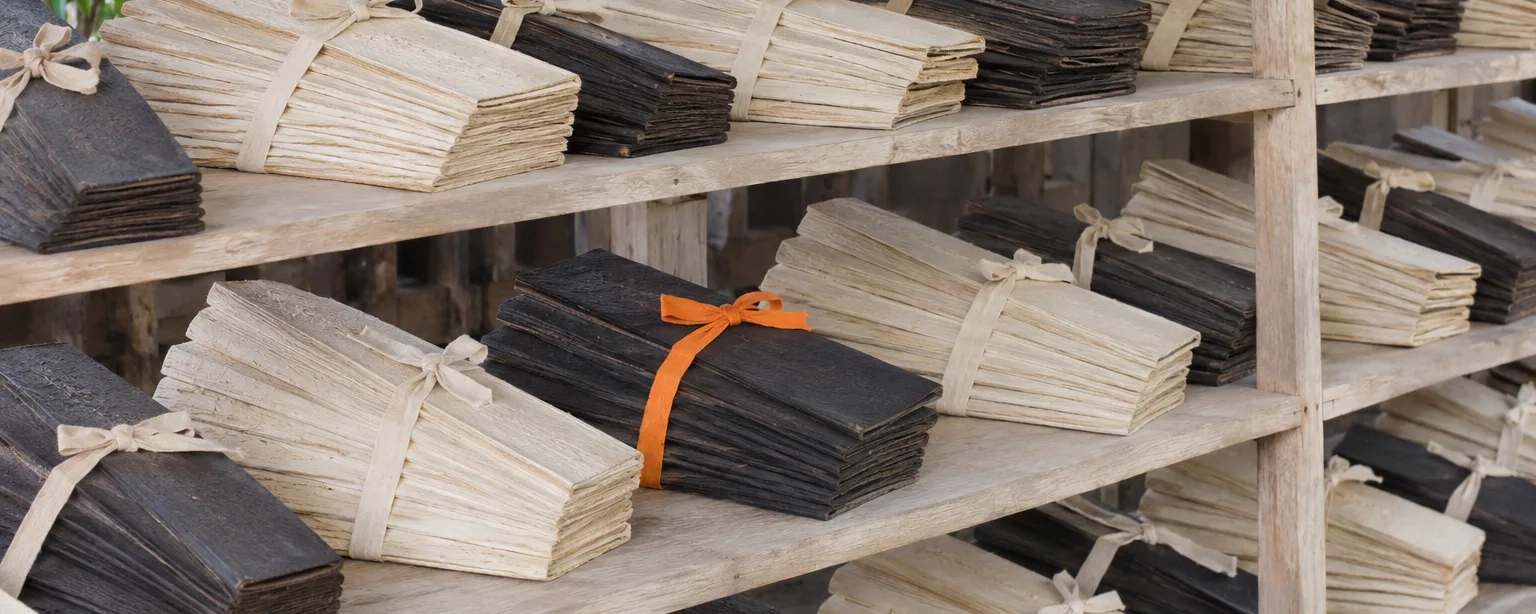
Thai folk medicine manuscripts known as tamra ya kret are Thai folding books that collect medicine formulas outside the royal texts. Among the medical texts declared national, the National Library holds more of this kind than of any other. The Ministry of Public Health declared them national Thai traditional medicine texts in stages, starting with notices no. 4 and nos. 8–10 (2016–2017). Counting from the lists annexed to the 17 notices now in force, there are about 215 entries whose title contains the word kret and whose original belongs to the National Library, with about 14,000 formulas in all. The originals are black and white Thai folding books, and each one holds anything from a few formulas to several hundred.
When people talk about national Thai medicine texts, most think of the Wat Pho inscriptions or the royal texts. By number, though, one of the largest bodies of old formulas sits in ya kret notebooks that hardly anyone names. The notices give only the title, the register number, the type of book and the number of formulas. They do not name the formulas. An old recipe a business has inherited from a family notebook or a village healer could therefore be the same kind of formula as one in this group, and a search by name would not find it.
This article explains what ya kret means, how it differs from the royal texts, how these notebooks reached the library, where to view the originals, and which steps apply before using a formula in a product. For the overall picture of formula rights, read Thai traditional medicine formula rights.
Ya kret versus the royal texts: old formulas outside the revised royal canon
The Royal Institute dictionary gives a short definition: ya kret is "medicine that is not from the royal texts". In one of its senses the word kret means a small part or a miscellaneous item. Put together, a ya kret text is a place where a healer noted down formulas one by one, rather than a text the court revised into a standard edition.
What a royal text is
The clearest example of a royal text is the royal edition of the medical texts from the reign of King Rama V. An article by Watthana Chayathawat (2021) explains that in 1870 King Rama V had Krommuen Phubodi Ratchaharuethai, head of the Royal Physicians' Department, lead the work of collecting and revising the medical formulas and texts in use at the time, which were then made into a royal edition in black Thai folding books. That set was declared national in notice no. 2 (2015). The full story is in the Royal Medical Texts of King Rama V.
Ya kret texts are the opposite pole. There was no lead officer and no single revised edition. Each book belonged to someone, who wrote down what had been passed on to them.
Ya kret does not always mean folk medicine
The library's list includes books titled "Tamra Phra Osot Kret" (no. 597), "Phra Tamra Ya Kret" (no. 623) and "Tamra Phra Osot Kret, the copy presented to King Rama IV" (no. 219). These titles use royal vocabulary, which shows that kret means formulas gathered outside the revised royal edition, not who wrote them down. Calling every ya kret text folk medicine is therefore not quite accurate, even though the English search term is common.
An example of a ya kret notebook outside the library
An article by Dokrak Phayakkhasri in the western-region manuscript database of the Princess Maha Chakri Sirindhorn Anthropology Centre (2015) shows what a ya kret notebook looks like. A white Thai folding book titled "Khamphi Ya Kret Phaen Boran", belonging to Mo He Saikosin, a second-class traditional physician at Wat Tha Phut in Nakhon Pathom, says it gathers the formulas of various teachers in one place for the owner's own use. It was finished on 14 July 1934 and holds 181 formulas. Of these, 64 name the owner of the formula, such as 25 formulas of Phra Thammapidok of Wat Phra Chetuphon and 12 formulas of Mo Khlai. This book is not a National Library original, but it shows the typical form of a ya kret notebook: one healer copying formulas from several schools into one book.
What is inside a ya kret manuscript: what the notice lists say, and what is still unknown
The lists annexed to the notices give four facts about each book: the title, the National Library register number, the type of manuscript, and the number of formulas. Later notices, such as no. 31 (2021) and no. 35 (2023), add the storage location, for example "bundle 38, cabinet 112", and a "history" field saying where the library got the book.
How large each book is
Counting from the notice lists, a ya kret book holds anything from 1 formula to several hundred. The largest is no. 254 (378 formulas), followed by no. 273 (341 formulas) and no. 269 (306 formulas). The register numbers of ya kret texts run in long sequences, such as 217–250 and 251–270, so they were probably filed as one group in the library's register. This is an inference from the numbers; no library document explaining it has been found.
Titles hint at the subject
Most books are simply called "Tamra Ya Kret", but a few titles say more, such as "Khamphi Kuman and Tamra Ya Kret" (no. 658), "Khamphi Phaetsat and Tamra Ya Kret" (no. 662), "Tamra Ya Kae Khai Thang Puang, Ya Kret Phu Yai" (no. 666, a text on fevers, per its title) and "Tamra Ya Kret on various medicines, incomplete" (no. 692). These titles only say what a book is about. They do not say the medicines work.
Black and white Thai folding books
The Thai Junior Encyclopedia, volume 32, explains that Thai folding books are made from long sheets of khoi-bark paper folded back and forth. Before binding, the sheets are coated with rice paste. For white books lime water is mixed into the paste; for black books soot or finely ground charcoal is added. Black books are written with a white chalk pencil or white ink, white books with black ink. All 29 ya kret books in notice no. 8 are black books, while nos. 666, 692 and 942 are white books.
What is still unknown
- The notices do not name the individual formulas in ya kret texts.
- No academic study of the National Library's ya kret texts has been found.
- The authors and dates of most books are unknown; the notices do not give the year of writing.
For that reason this article quotes no formula name or ingredient from any ya kret text: there is no source that can be checked.
How the manuscripts reached the library: provenance recorded in the notices
The early notices that declared ya kret texts, from no. 4 to no. 25, give only the title, register number, type of book and number of formulas. They have no "history" field. The provenance of ya kret nos. 217–589, the largest block, therefore does not appear in the notices. It has to be checked book by book in the library's register.
Later notices do record provenance, and they show that ya kret notebooks reached the library by several routes.
- No. 219, "Tamra Phra Osot Kret, the copy presented to King Rama IV": black book, 56 formulas. The history field reads "original property of the National Library" (notice no. 35). The title says it is a copy presented to King Rama IV, but the notice does not say who presented it or when.
- No. 614, "Tamra Ya Kret": black book, 23 formulas, received from the Secretariat of the Cabinet on 7 April 1939 (notice no. 31).
- Nos. 653, 658, 662 and 666: given to the National Library by the same private donor on 15 July 1951 (no. 662 gives 18 July 1951), 688 formulas in all (notice no. 31).
- No. 692, "Tamra Ya Kret on various medicines, incomplete": white book, 86 formulas, original property of the National Library (notice no. 31).
- No. 942, "Tamra Ya Kret": white book, 44 formulas, bought by the library from a private party on 19 May 1966 (notice no. 35).
In short, some books are the library's original property, some were transferred from a government office, some were donated by private individuals, and one was bought for the collection. The name "Tamra Ya Kret" is also found outside the library: notice no. 37 (2025), for example, lists Tamra Ya Kret no. 10 of Wat Sam Kaeo in Chumphon, a white book with 244 formulas.
- Presented to the kingThe title of no. 219 says it is a copy presented to King Rama IV; the notice does not say by whom or when
- Transferred from a government officeNo. 614 came from the Secretariat of the Cabinet
- Private donationA private donor gave nos. 653, 658, 662 and 666
- Bought for the collectionNo. 942 was bought from a private party
- First noticesNotices no. 4 and nos. 8–10 declare ya kret texts in register-number order
- Notices with provenanceNotices no. 31 and 35 record the storage location and source of each book
Source: Ministry of Public Health notices declaring national Thai traditional medicine texts, nos. 4, 8, 9, 10, 31 and 35
Where the originals are, and how to view one by its register number
All ya kret originals in this article are held by the Manuscripts and Inscriptions Group of the National Library, Fine Arts Department. The number in the notice is the library's register number for the manuscript and can be used as the reference when asking to view it. No free online scans of ya kret texts have been found; the library's e-book section for old manuscripts holds treaties and royal letters, not medicine texts.
Steps to view a book by its number
- Note the title and register number from the notice list, for example "Tamra Ya Kret no. 217", together with the notice number.
- Search the register in the library's manuscript database at manuscript.nlt.go.th. The search page has four tabs: inscriptions, palm-leaf manuscripts, Thai folding books and scripture cabinets. The Thai folding book tab searches by register number, or by registered title, cover title and subject. Results show register, subject, category, group, sub-group and library branch.
- Register and file the request form online. Fill in the form to study and use old manuscripts in the system. When the Director of the National Library approves it, the system notifies you by email. The library's rules advise noting the category, group, title and number in full before applying.
- Prepare the documents for your type of user. Members of the public use their ID card and a request letter; students and civil servants use a letter from their institution; foreign nationals use a letter from the National Research Council of Thailand.
- In the reading room you wear gloves, place the original on cloth and do not touch the script. You may not photograph old manuscripts yourself; copies are requested through staff, one form per register number. If a printed edition, transliteration, microfilm or digital copy already exists, the room shows you the copy instead of the original.
Website names in this article are given as text so you can look them up yourself. Procedures may change with the library's rules, so read the service rules and the guide to requesting old manuscripts in the same database before you go.
Declared national Thai traditional medicine texts: which notices, and what "national" means
The Ministry of Public Health notices declaring national Thai traditional medicine texts and national Thai traditional formulas are issued under sections 4 and 17 of the Protection and Promotion of Thai Traditional Medicinal Intelligence Act B.E. 2542 (1999). Ya kret texts are spread over many notices. The key ones are:
- No. 4 (signed 1 April 2016): Tamra Phra Osot Kret no. 597 (77 formulas) and Phra Tamra Ya Kret no. 623 (81 formulas).
- No. 8 (signed 25 August 2016, published in the Royal Gazette on 24 May 2017): the whole notice is ya kret texts, nos. 217–250, 29 books, all black books, 1,841 formulas.
- No. 9 (2016) and no. 10 (2017): continue with the number ranges 251–270 and 273–589.
- No. 19 (2018): 39 ya kret entries, the notice with the most formulas from this group.
- No. 31 (2021) and no. 35 (2023): the notices that record the storage location and history of each book.
The table below is counted from the notice lists, so the figures are approximate. Some numbers appear in more than one notice. Notice no. 12 (2017) also lists some ya kret numbers, but the file in our archive is a draft, so it is not counted.
What "national" means
Each notice has two key clauses. The first makes the Thai traditional medicine texts in the annexed list national texts. The next makes the Thai traditional formulas in those texts national formulas. In practice, every formula in a listed ya kret book is protected, even though the notice does not name a single one. "National" does not mean anyone may take the formulas for a product; it means the state looks after the rights and there is a procedure to ask permission to use them. For the three types of formula, read Thai traditional medicine formula rights.
Source: Annexed lists of the 17 Ministry of Public Health notices in force · counts only entries whose title contains kret and whose original is at the National Library · notice no. 12 (draft file) not counted
Using an old formula from a ya kret text in a product: preliminary information and permission under section 19
The key point for business is that ya kret texts are a large pool of old formulas that are already national formulas, about 14,000 counted from the notice lists, and the notices do not name them. Searching by recipe name helps very little.
When permission is needed
Section 19 of the Protection and Promotion of Thai Traditional Medicinal Intelligence Act B.E. 2542 provides that anyone who will use a national Thai traditional formula to register a drug formula and apply for a licence to produce the drug, or to study, research and improve it into a new formula for commercial purposes, must apply for permission to use it and pay remuneration for the use to the grantor, under the criteria in the ministerial regulation. If your formula was copied from a ya kret book in the list, or developed from a formula in that book for commercial purposes, assume it falls under this section until shown otherwise.
You can ask for preliminary information first
The Committee notice on disclosure of preliminary information about national Thai traditional formulas or national Thai traditional medicine texts B.E. 2560 (2017) allows an applicant for permission who wants preliminary information to file the form annexed to the notice. The registrar discloses the herbal ingredients with their proportions and the indications of the formula, or a short summary of the text. The form must name the formula or text and the number of the notice that declared it national.
For ya kret texts this route is especially useful, because nearly every book has the same title. What tells the books apart is the register number and the notice number, so record both correctly before filing.
Recommended order of work
- Write down where your formula came from: who gave it to you and which notebook.
- Open the notice lists in check a formula before making a product and look at texts with similar titles or subjects.
- If you suspect the formula is in a ya kret text, request preliminary information, stating the register number and notice number.
- If it is, apply for permission to use it under section 19 before registering or producing for sale.
- Plan the Thai FDA route separately, because a licence from one side does not replace the other.
This article does not state remuneration amounts or timelines, as these depend on the criteria and decisions of the Department of Thai Traditional and Alternative Medicine. Ask the department directly.
How far a brand can tell the story of Thai medicine texts: the ya kret case
The story of ya kret texts is attractive for brands: healers writing down what they learned from many teachers for their own use. But storytelling in the media of a herbal product falls under the advertising rules of the Herbal Products Act B.E. 2562 (2019).
What the law says
- Section 70: no one may advertise a herbal product or the benefits of a herbal product unless they have first received a licence from the licensing authority.
- Section 74 prohibits five kinds of herbal product advertising: (1) boasting that the product's properties or ingredients can heal, relieve or prevent disease or illness in a sacred way or according to personal belief, or claiming it can cure a disease completely; (2) stating false, exaggerated or misleading properties; (3) implying that an ingredient is present when it is not, or is present in a smaller amount than implied; (4) endorsing or praising the product's properties through any person, group or institution; and (5) breaching the criteria announced by the Minister.
Safer storytelling angles
- What ya kret means according to the dictionary, and how it differs from the royal texts.
- Ya kret texts as a large group in the national collection, stating that the figure is counted from the notice lists.
- The several routes by which these books reached the library: original property, transfer from a government office, private donation and purchase.
- Working with national formulas by the proper steps, for example saying you hold permission to use a formula once you actually do.
What to avoid
- Claiming that a formula from an old text works on a disease or symptom, or using words such as sacred, secret formula or court-only recipe.
- Using the title "copy presented to King Rama IV", or the names of the library, a temple or a state agency, in a way that implies these institutions endorse the product.
- Writing "made from a national ya kret formula" without knowing which book and number it came from and without permission.
- Implying the whole formula is used when the product uses only part of it or changes the proportions.
Story text used to advertise a product or its benefits should go through the advertising licence under section 70 before it is published.
✘Avoid
- Claiming a formula from an old text works on a disease or symptom
- Words such as sacred, secret formula or court-only recipe
- Implying the library, a temple, the court or a state agency endorses the product
- Citing a national ya kret formula without the register number or permission
- Implying the whole formula is used when only part is
✔Fine to tell
- What ya kret means in the dictionary, and how it differs from the royal texts
- The size of the group, stating it is counted from the notice lists
- How the books reached the library, as recorded in the notices
- Holding permission to use a national formula, once you actually do
Text used to advertise a product or its benefits needs an advertising licence under section 70 first
Source: Herbal Products Act B.E. 2562 sections 70 and 74 · Thai Traditional Medicinal Intelligence Act B.E. 2542 section 19
Images of the originals and copyright: using ya kret images with care
A page of a black Thai folding book written in white ink looks beautiful and tells a story well, but images of National Library originals have their own rules, separate from the rights in the formulas.
Images of National Library originals
- You may not photograph old manuscripts yourself in the reading room; copies are requested through staff.
- The library's old-manuscript service page states that photographing or copying for trade or profit requires permission from the Director-General of the Fine Arts Department.
- The service rules state that publishing images of old manuscripts in a book, research or article requires a letter to the Director-General of the Fine Arts Department.
- Work that uses the information must cite the National Library and send one copy of the work to the Manuscripts and Inscriptions Group.
Images from other databases also carry conditions. The manuscript database of the Princess Maha Chakri Sirindhorn Anthropology Centre, for example, states a licence that forbids commercial use and adaptation. If you use a general image of a Thai folding book under an open licence, caption it accurately as a sample Thai folding book, not as the ya kret book discussed in the article.
Copyright: take care with modern printed editions and transliterations
The Copyright Act B.E. 2537 (1994) protects literary works, which include books, writings and printed matter (sections 4 and 6), and copyright lasts for the life of the author plus 50 years after the author's death (section 19 of the Copyright Act). Regulations, notices and orders of government agencies are not copyright works (section 7), so the list of texts in a ministry notice can be cited.
No printed edition or transliteration of the National Library's ya kret texts has been found. If you come across a transcription, a study or a printed medicine book from a later period, especially one printed after 1947, do not assume it is in the public domain. Check its copyright status and ask the rights holder before copying text or images. This is a caution, not a legal ruling.
Historical references
Non-legal references in this article, given as text so you can look them up.
- Office of the Royal Society. Royal Institute Dictionary (online edition), entries
"ยาเกร็ด", "เกร็ด", "สมุดไทย". Accessed 18 November 2026. - Watthana Chayathawat. "The origin of drug properties in Thai traditional medicine texts: a case study of cinnamon." Journal of Thai Traditional Medicine Research 7, no. 2 (July–December 2021). In Thai.
- Dokrak Phayakkhasri. "Khamphi Ya Kret Phaen Boran of Mo He Saikosin, second-class traditional physician, Wat Tha Phut." Western Region Manuscript Database, Princess Maha Chakri Sirindhorn Anthropology Centre, 2015. In Thai.
- Dokrak Phayakkhasri. "Abscess diseases in Thai medicine texts." Manuscript Database of Thailand, Princess Maha Chakri Sirindhorn Anthropology Centre, 2022. In Thai. (Image-use terms of the database.)
- Thai Junior Encyclopedia, volume 32, on Thai folding books (making, coating and writing). In Thai.
- National Library of Thailand, Fine Arts Department. "Old manuscript services." National Library website. Accessed 18 November 2026.
- National Library of Thailand. Database of inscriptions, Thai folding books, scripture cabinets and palm-leaf manuscripts: search page, service rules and guide to requesting old manuscripts. Accessed 18 November 2026.
- Ministry of Public Health notices declaring national Thai traditional medicine texts and national Thai traditional formulas, nos. 4 (2016), 8 (2016), 9 (2016), 10 (2017), 19 (2018), 31 (2021), 35 (2023) and 37 (2025): annexed lists, used to count entries and formulas in this article.
Frequently asked questions
What is a ya kret text?
The Royal Institute dictionary defines ya kret as medicine that is not from the royal texts. A ya kret text is therefore a notebook that collects formulas outside the texts the court revised into a standard edition. The National Library holds many of them.
How does ya kret differ from the royal texts?
Royal texts, such as the royal edition of the medical texts from the reign of King Rama V, came from collection and revision led by an appointed officer. Ya kret texts are notebooks in which individuals wrote down formulas, never revised into a single edition. Read about the royal texts in the Royal Medical Texts of King Rama V.
How many ya kret books and formulas does the National Library have?
Counting from the lists annexed to the 17 notices in force, there are about 215 National Library entries whose title contains kret, with about 14,000 formulas. These are approximate, because some numbers appear in more than one notice.
The notices do not name the formulas. How can I tell if my recipe is in a ya kret text?
An applicant for permission to use a formula can request preliminary information under the Committee notice of 2017. The registrar discloses the herbal ingredients with their proportions and the indications of the formula. The form must give the text title, register number and notice number.
Where can I view an original ya kret text?
The originals are held by the Manuscripts and Inscriptions Group of the National Library. Search the register by number in the manuscript database at manuscript.nlt.go.th, on the Thai folding book tab, then file the online form to study and use old manuscripts.
Can I say a product is made from a ya kret formula?
Take care. If the formula comes from a ya kret text declared national, registering and producing it needs permission under section 19 first, and advertising a herbal product needs a licence under section 70. Under section 74, do not claim sacred powers, institutional endorsement, or a full formula when that is not the case.
Sources
- Protection and Promotion of Thai Traditional Medicinal Intelligence Act B.E. 2542 (1999) · Open source · Search our archive
- Committee notice on disclosure of preliminary information about national Thai traditional formulas or national Thai traditional medicine texts B.E. 2560 (2017) · Open source · Search our archive
- Ministry of Public Health notice declaring national Thai traditional medicine texts and formulas (No. 4) B.E. 2559 (2016) · Open source · Search our archive
- Ministry of Public Health notice declaring national Thai traditional medicine texts and formulas (No. 8) B.E. 2559 (2016) · Open source · Search our archive
- Ministry of Public Health notice declaring national Thai traditional medicine texts and formulas (No. 10) B.E. 2560 (2017) · Open source · Search our archive
- Ministry of Public Health notice declaring national Thai traditional medicine texts and formulas (No. 19) B.E. 2561 (2018) · Open source · Search our archive
- Ministry of Public Health notice declaring national Thai traditional medicine texts and formulas (No. 31) B.E. 2564 (2021) · Open source · Search our archive
- Ministry of Public Health notice declaring national Thai traditional medicine texts and formulas (No. 35) B.E. 2566 (2023) · Open source · Search our archive
- Herbal Products Act B.E. 2562 (2019) · Open source · Search our archive
- Copyright Act B.E. 2537 (1994), consolidated to (No. 3) B.E. 2558 (2015) · Open source · Search our archive
This article is for general information. It is not a Thai FDA ruling or legal advice, and rules change — check the latest notification or ask an expert before filing or producing. Spotted an error? Tell us and we will correct it
Related articles
 Brand ownersRama V Royal Medical Texts: 33 Thai Medical Scriptures Revised in 1870 and Declared a National TextThe Rama V royal medical texts: 33 black samut thai volumes and 1,999 formulas. Who revised them, what is inside, where to read them, and brand use.
 Brand ownersThai Traditional Medicine Formula Rights: National, General and Personal Formulas Before the Thai FDA StepsThai traditional medicine formulas come in 3 types. National ones need permission to use, personal ones the right holder's consent, then Thai FDA steps.
 Brand ownersAyurawet Sueksa Thai Medicine Text: A 1953 Textbook Declared National, With 2,773 FormulasKhun Nitthet Sukkit's Ayurawet Sueksa, first printed in 1953, became a national Thai medicine text in 2018. Two spellings, where to read it, lawful use.